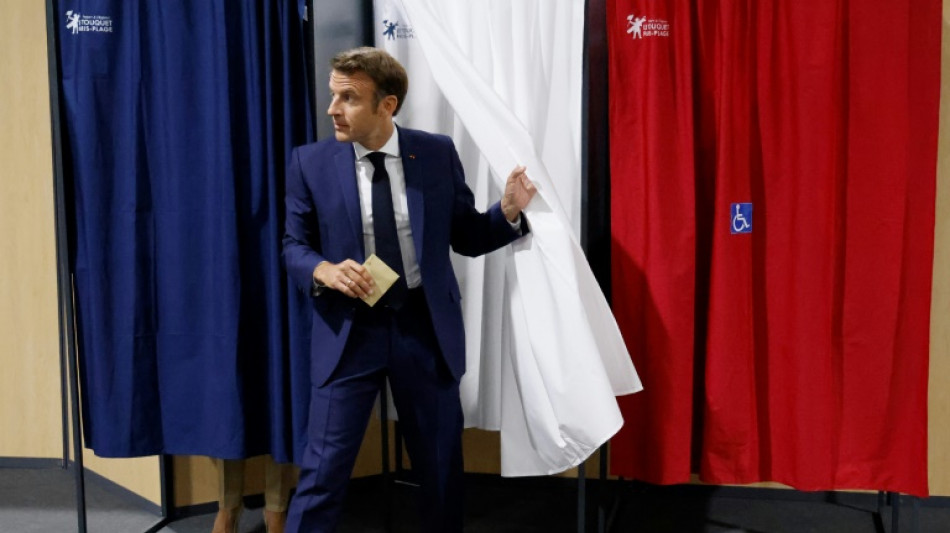
Record-low turnout expected as Macron seeks parliament majority / Photo: Ludovic MARIN - POOL/AFP
 Teatro Mayor Unveils 152-Performance 2027 Season Highlighting Beethoven and García Márquez

 Rutgers Defeats NJIT 101-64 Behind Francis and Mark Scores

 THIEAUDIO Introduces Clairvoyance MKII: The Evolution of a Signature Sound
 Guardian Metal Resources PLC Announces Proposed Spin-Out of Non-Tungsten Projects

 Fulcrum Metals PLC Announces New Critical Mineral Recoveries Expand Potential

 Thukukile Zuma Resigns from ANC Johannesburg Leadership Amid Disciplinary Dispute

 CM Mohan Yadav Meets Bohra Spiritual Leader to Discuss Simhastha 2028 and Development

 Eli Crane Defeats Jonathan Nez in Tight Arizona Congressional Race

French voters shunned parliamentary elections in record numbers on Sunday for a vote that is crucial for newly elected President Emmanuel Macron, who needs a majority to push through his domestic agenda.
Turnout was on course to be a record low of 47 to 47.5 percent, polling firm projections showed, a trend which analysts see as being favourable to the president's centrist coalition as it battles a new leftist alliance.
"Some people say that parliamentary elections aren't important but that's not true," Arnaud, a 40-year-old engineer, told AFP as he cast his vote in Paris. "If the president doesn't win a majority he can't get anything done."
Elections for the 577 seats in the lower-house National Assembly are a two-round process, with the shape of the new parliament becoming clear only after the second round on June 19.
The main contest is seen as being between centrist parties allied with Macron and a resurgent and newly unified leftwing alliance headed by Jean-Luc Melenchon that is seeking to thwart his ambitions.
The far-right National Rally of Marine Le Pen is also aiming to increase its number of seats in parliament from eight, with polls suggesting it might secure anywhere from 19 to 44.
The ballots follow presidential elections in April in which Macron secured a second term, pledging new tax cuts, welfare reform and raising the retirement age to 65 for most people.
After a dismal performance in that vote, the French left has united behind Melenchon, a former Trotskyist who has a radically different programme including lowering the retirement age, wealth taxes and hiking the minimum wage by 15 percent.
Opinion polls show the president's centrist Ensemble (Together) alliance and Melenchon's NUPES coalition of Socialists, Communists and Greens neck-and-neck in the popular vote -- though the actual breakdown of parliamentary seats will depend on turnout in the second-round run-offs.
- 'Gardening instead' -
The record-low turnout of below 50 percent is set to confirm the trend of dwindling interest for parliamentary elections over the past 20 years.
"The very personal nature of the presidential election still continues to interest people, but it overshadows all the other types of ballot, even the essential one which is electing the members of the national assembly," said Mathieu Gallard of the Ipsos polling group.
If Macron's coalition falls short of a majority, it could lead to messy bill-by-bill deals with right-wing parties in parliament, or even an unwanted cabinet reshuffle.
A win by the left-wing alliance -- seen as unlikely by analysts -- would spell political disaster for the president by raising the spectre of a clunky "cohabitation" -- where the prime minister and president hail from different factions.
Such a set-up has paralysed French politics in the past, most recently from 1997 to 2002 when right-wing president Jacques Chirac ruled in tandem with Socialist Lionel Jospin as premier.
- 'Can't get anything done' -
Polls have indicated that Macron's alliance is expected to win the largest number of seats but is by no means assured of getting over the line of 289 for an absolute majority.
While Macron and his European Union allies breathed a heavy sigh of relief after his solid, if unspectacular, presidential victory against far-right leader Marine Le Pen, the last weeks have brought no sense of a honeymoon.
Energy and food prices are soaring in France as elsewhere in Europe, the treatment of English fans at the Champions League final in Paris damaged France's image abroad, and Macron has been accused by Ukraine of being too accommodating to Russia.
His new Disabilities Minister Damien Abad has faced two rape accusations -- which he has vehemently denied -- while new Prime Minister Elisabeth Borne has yet to make an impact.
Macron has made clear that ministers who are standing in the election -- including Borne, who is making her first attempt at winning a seat -- will have to step down if they lose.
Europe Minister Clement Beaune, a close ally of Macron and a crucial influence over France's Brexit and wider EU policies, is standing in his first election and is seen as in a close fight with a left-wing rival.
Under France's system, a candidate needs over half the vote on the day as well as the backing of at least 25 percent of registered voters in a constituency to be elected outright in the first round.
burs-jh-adp/js/gw
T.Ward--AMWN