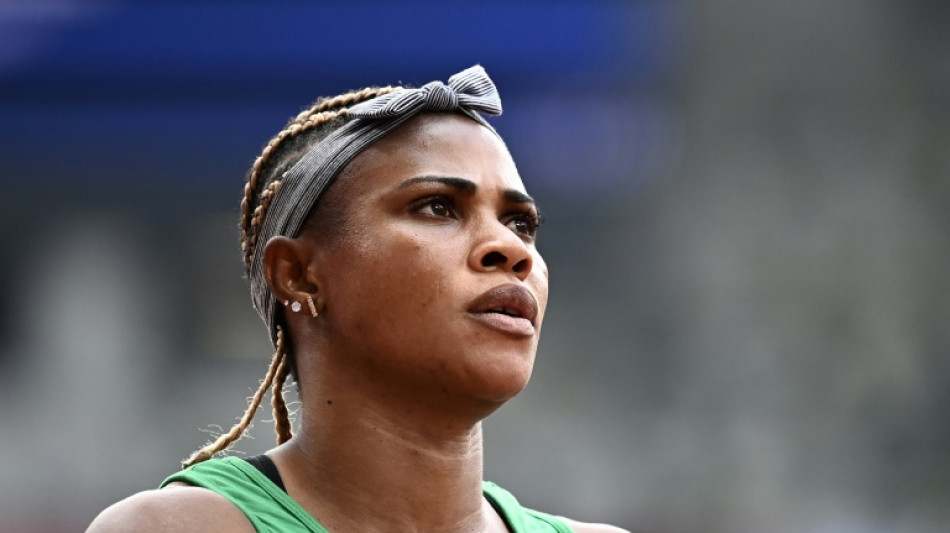
Nigerian sprinter Okagbare's ban extended to 11 years / Photo: Jewel SAMAD - AFP
 Teatro Mayor Unveils 152-Performance 2027 Season Highlighting Beethoven and García Márquez

 Rutgers Defeats NJIT 101-64 Behind Francis and Mark Scores
 Guardian Metal Resources PLC Announces Proposed Spin-Out of Non-Tungsten Projects

 Fulcrum Metals PLC Announces New Critical Mineral Recoveries Expand Potential

 Thukukile Zuma Resigns from ANC Johannesburg Leadership Amid Disciplinary Dispute

 CM Mohan Yadav Meets Bohra Spiritual Leader to Discuss Simhastha 2028 and Development

 Eli Crane Defeats Jonathan Nez in Tight Arizona Congressional Race

Sprinter Blessing Okagbare has been given an additional one-year ban for doping violations on top of her existing 10-year suspension, a decision that rules Nigeria out of the sprint relay at the world championships.
The Athletics Integrity Unit charged the 33-year-old with "evading sample collection, and tampering or attempted tampering with the doping control process".
In February, Okagbare was given her original ban for "multiple breaches of anti-doping rules".
She was suspended during last year's Tokyo Olympics after failing a drug test.
Six days after she had evaded sample collection on June 13, 2021, she competed in the relay event at Nigeria's Olympic trials, helping her team to qualify for the world championships.
Those results have now been disqualified due to Okagbare's involvement and Nigeria has therefore lost its potential qualification place in the women's 4x100m relay at the world championships in Oregon in July.
"Over the years, we have repeatedly seen how one person's actions adversely affect team-mates who have trained hard and worked honestly for their results," AIU head Brett Clothier said in a statement.
"In this instance, Nigeria has lost an important qualification spot. Those are the rules and we will not compromise on integrity."
Okagbare, the 2008 Olympic long jump silver medallist, won her 100m heat in Tokyo last year, but she was thrown out of the Games after the AIU said she had tested positive for a human growth hormone following an out-of-competition test.
As a result of the case, Texas therapist Eric Lira, who supplied performance-enhancing drugs to Okagbare, became the first person charged under a new US anti-doping law.
The case is the first time charges have been brought under the Rodchenkov Act -- a law introduced in the United States in 2020 in the wake of Russia's state-backed doping scandal.
L.Durand--AMWN