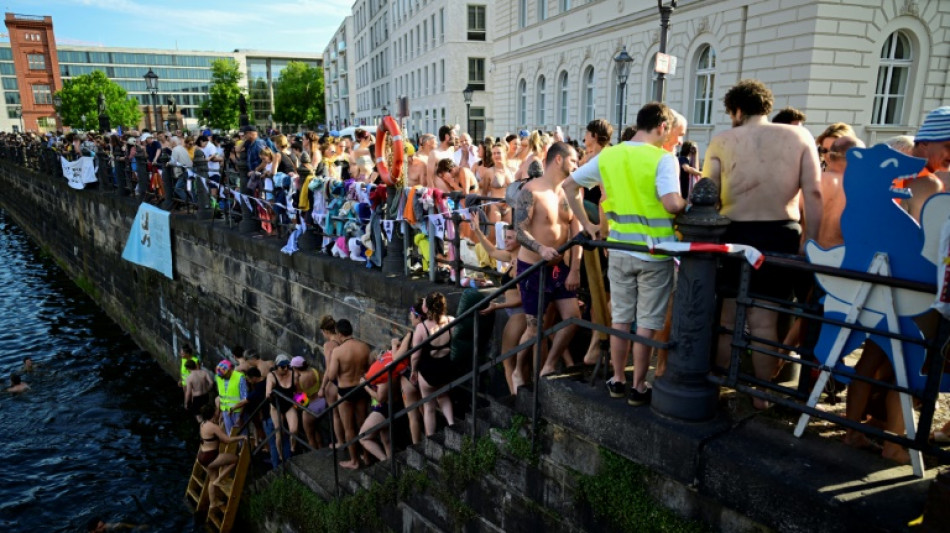
Berlin bathers demand lifting of swimming ban in Spree river / Photo: John MACDOUGALL - AFP
 Writer Realizes She Is Lesbian After Child Comes Out as Transgender

 Shruti Haasan Reveals Kamal Haasan’s Defense of Her Film Career

 Trump Reduces Public Appearances Amid CIA-Mossad Warnings of Iranian Drone Plot

 Italy Fines Meta $880 Million Over Facebook Photo Access Violations

 MotorTrend's Top Picks for the Best Hatchbacks of 2026

 Clare Luvanga Leads Washington Spirit to Third Straight NWSL Championship with 2-1 Win

 BingX: Major Announcement of Far-Reaching Significance
Hundreds of Berliners gathered to take a dip in the Spree river Tuesday to protest a 100-year-old ban on swimming in the city's main waterway.
Billed by organisers as a "swim demonstration", the gathering saw swimmers cool off from the summer heat with colourful bathing costumes and even the odd inflatable raft against the backdrop of Berlin's famous cathedral and TV tower.
While Berlin's outer districts boast plentiful opportunities for wild swimming, mostly in the city's lakes, doing so in the Spree has been banned since 1925.
The ban was lifted briefly on Tuesday for the demonstration, but activists want a stretch of the river called the Spree canal to be permanently open to the public.
The same spot was popular with bathers in the early twentieth century before city authorities decided pollution from the expanding metropolis had made the water too dirty.
While industrial pollution is no longer a problem, sewage is still periodically discharged into the river when rainfall overwhelms the city's drainage system.
Proponents of swimming in the Spree say that technology already exists that would permit water quality to be monitored to ensure it is safe for swimming.
Alisan Yasar, a 28-year-old lawyer, told AFP after emerging from the Spree that the swim was "wonderful" but admitted that "you do have to fight against certain preconceptions -- as a Berliner you have it in your head that you just don't go into the Spree".
Dilara, a 30-year-old marketing professional, was also pleasantly surprised at what was her first time in the river, despite living close by and jogging past it "hundreds of times".
"I went in slowly and kept my head above water but then went all the way in," she said, adding: "I didn't want to come out!"
The idea of reopening a section of the Spree has won the backing of some members of Berlin's city assembly but as with many infrastructure projects in the German capital, the idea has been beset by delays and disagreements over the necessary infrastructure.
Some have also objected to the cost that opening the river to bathers would entail, saying it's a luxury that cash-strapped Berlin can ill afford.
Katrin Androschin, one of the organisers of the demonstration, insisted it is "not a luxury to make a waterway that's already on hand open to the public".
She pointed out that a central location for river swimming would help avoid "people becoming sick because they have problems with the heat due to climate change".
Perhaps the most famous recent example of a city-centre river being re-opened for bathers is the Seine in Paris.
Its waters were cleaned for the Paris 2024 Olympics and last month three swimming zones across the city were opened to the public for the first time since 1923.
Stretches of the Isar river in Munich have also been made safe for bathing after UV disinfection measures were introduced in the city's wastewater treatment plants.
O.M.Souza--AMWN