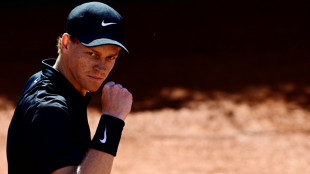
A quarter of World Cup games risk searing heat: scientists / Photo: CHARLY TRIBALLEAU - AFP/File
 Walter Koenig, who played original Chekov on 'Star Trek,' dies at 90
 Netanyahu, rivals trade attacks over Iran as clock counts down to Israel vote
 Townsend urges Scotland to use Nations Championship as World Cup springboard

 Microsoft offers voluntary exit packages to 60,000 staff
 S.Africa ambassador calls for talks with US over 'tense' ties

 'Smells of freedom': Serbians hopeful after landmark election

 South Africa select 'enforcer' Coetzee for Australia decider
 Botanists comb Gabon's rich rainforests with nature on the line
 New levy on non-EU parcels kicks in Sunday
 Stocks climb ahead of tech earnings, central bank calls

 Part of London's Oxford Street pedestrianised 'forever'

 Canadian youth seek climate action in landmark trial
 Trump blasts Norway over Nobel Peace Prize snub
 Japan PM vows swift response to wave of cyberattacks
 Stocks mostly rise before tech earnings, central bank calls

 France's Macron to visit Marseille after protest violence
 German union slams Audi boss's appearance at Trump rally
 UK set for 'limited' budget giveaways as borrowing costs surge
 Anthropic's AI model accessed US voter data: Axios

 Malaysia's Johor reopens schools as haze eases

 Carragher says Fernandes benching was intended as public punishment

 Canada-EU summit seeks deepened alliance as US ties fray

 Senegal to host Youth Games, Africa's first ever Olympics

 ITV drama Adultery examines temptation, class and family consequences

 New levy on non-EU parcels kicks in November 1

One in four 2026 World Cup games could take place in very hot conditions as climate change has increased the risk of extreme heat in North America since the US hosted the 1994 tournament, researchers warned Thursday.
Concerns about heat already prompted FIFA to mandate a cooling break during each half of the World Cup matches that will take place between June 11 and July 19 in 16 stadiums across the United States, Mexico and Canada.
"Players and fans face a much higher risk of gruelling heat and humidity at the 2026 World Cup compared to the 1994 tournament on the same continent," World Weather Attribution, a network of climate scientists, said in a statement.
WWA's scientific analysis estimates that 26 of the 104 matches could occur in conditions reaching at least 26C Wet Bulb Globe Temperature (WBGT) -- an index that measures how effectively the human body can cool itself under heat, humidity, sun exposure and wind.
At 26C WBGT, the international footballers' union FIFPRO recommends cooling breaks as heat strain becomes a real risk for players.
Of those 26 matches, 17 will be played in stadiums with cooling systems, reducing risks for players and fans.
During the 1994 World Cup hosted by the United States, 21 games would have been expected to reach a similar heat threshold, according to WWA.
Five games are expected to be played in conditions of 28C WBGT or higher, a level that FIFPRO says should lead to the delay or postponement of matches until conditions are safer for players and fans.
That risk has nearly doubled compared to the 1994 World Cup.
"It's dangerous for players, but of course there are also the fans who might gather outdoors and they are at even more risk because they will not be taken care of by a lot of medical doctors," said Friederike Otto, WWA co-founder and climate science professor at Imperial College London.
Three of the 16 stadiums -- in Dallas, Houston and Atlanta -- have air conditioning.
But more than a third of the games with a one in 10 chance of exceeding 26C will take place in venues without air conditioning.
The final, which will be played on July 19 at MetLife Stadium in New Jersey, has a one in eight chance of seeing 26C WBGT conditions and a 2.7 percent risk of 28C, according to WWA.
"That the World Cup Final itself -- one of the biggest sporting occasions on the planet -- faces a non-insignificant risk of being played in 'cancellation-level' heat should be a wake-up call for FIFA and fans," Otto said.
O.Karlsson--AMWN