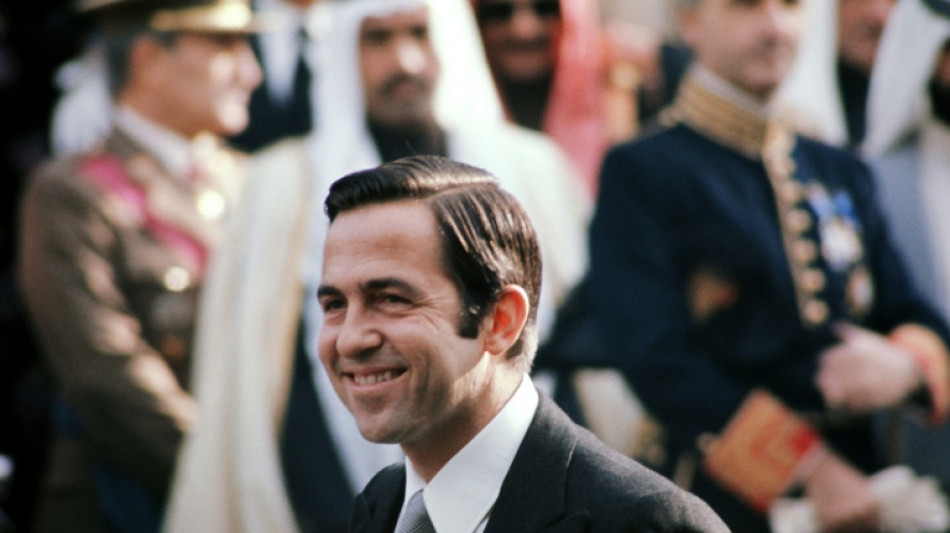
Greece's ex-king Constantine, end of a dynasty / Photo: - - AFP
 In-form Marc Marquez wins Aragon MotoGP Grand Prix

 At least six die in ferry capsize off Northern Cyprus

 Niamey back to normal after soldier mutiny
 King Haakon joins Norway memorials for Harald

 NASA launches Roman telescope on cosmic mapping mission

 Van Dijk wants Gakpo to stay at Liverpool amid Man City interest

 Five-wicket Abbas has Lord's landmark as Pakistan set 389 to win second Test

 Tadej Pogacar Out of Vuelta a Espana with Broken Collarbone and Concussion
 Iceland votes 'No' to resuming EU talks
 Berlin Literary Guide: Book Launches, Festivals, and Readings Through August

 Nepal rescuers drill through debris towards trapped tunnel workers

 Manhunt in Switzerland after fatal rave shooting

 'No' camp seen winning Iceland's EU referendum

 Nepal flood survivors return to ruins to salvage memories
 Killing of Palestinian children and teens by Israel surges in West Bank

 Educators keep 9/11 memory alive for next generation, 25 years on

 Venezuelans view US oil deal with doubt, hope

 Gobena and Jepchirchir power to Sydney Marathon victories

 Iceland in suspense after close EU vote

 Wallabies hold on for victory in Argentina

 Juve notch second straight win, Fiorentina's centenary party falls flat

 Rybakina eases injury fears ahead of US Open

 Djokovic kicks off latest Grand Slam quest under US Open lights

 'Sorry' De Zerbi won't panic after Spurs shambles
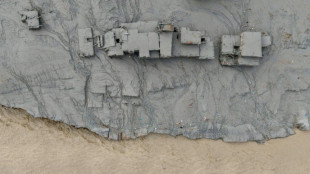 UN, Nepal warn of climate threat after deadly floods

Greece's former king Constantine II, who died on Tuesday aged 82, was the last member of a century-long dynasty in power when a brutal army dictatorship seized control of the country in 1967.
A descendant of Denmark's royal Gluecksburg family, Constantine ascended the throne in 1964 at the age of 23 during one of the most turbulent periods in modern Greek history.
The country was still bitterly divided 15 years after the Greek civil war, at the height of the Cold War and with anti-communist hysteria and fears of subversion rampant.
- Coup plots -
Most Greeks believe the young king, under the influence of his German-born mother Frederica, aggravated the country's political instability.
His critics argue he enabled the rise of the army dictatorship by clashing with the democratically elected prime minister Georgios Papandreou, encouraging his resignation in 1965.
Declassified US diplomatic cables say Constantine himself may have been mulling martial law in 1967.
They suggest he wanted to head off Papandreou's return to power, alongside his maverick son Andreas, the future firebrand socialist prime minister.
A 1967 State Department wire said Constantine's head of cabinet approached the local CIA station chief three months before the coup, to ask how Washington would react if "extreme measures" were taken ahead of elections in May.
The envoy told the then CIA station chief John Maury "for the present, the loyalty of the army could be relied upon to support a temporary dictatorship".
- 'Worst day of my life' -
In later years, the former king claimed he had done his utmost to avert the political crisis that led to the dictatorship.
He insisted that the putschists had "deceived" the Greek people by claiming to carry out the coup in his name.
Eight months after the colonels had seized power, Constantine organised a military counter-coup that failed.
"It was the worst day of my life," he said in a 2015 memoir released by To Vima weekly. "That day, I saw my first white hair."
Constantine fled to Rome with the royal family, and they moved to London in 1974.
He later said he had chosen not to pursue his counter-coup "because the risk of a general civil conflict was too great".
A senior putschist saw it differently. The ex-king had "plotted clumsily", he said.
But even after the dictatorship took hold, Constantine "seems to have been willing to return to Greece at practically any cost, including co-operation with the junta", historian Mogens Pelt wrote in a 2006 study of postwar Greece.
- Suing the state -
When democracy was restored in 1974, nearly 70 percent of Greeks voted for the abolition of the monarchy in a referendum, ending a dynasty begun by Constantine's Danish-born great-grandfather George I in 1863.
A long legal battle with the Greek state followed, with Constantine -- derisively nicknamed "Kokos" by anti-royalists -- determined to secure compensation for royal property and lands.
In 1991, he was permitted to remove 10 containers of items at the former royal estate of Tatoi near Athens, during the administration of prime minister Constantine Mitsotakis, father of the present premier.
Many of these items were later sold by auction house Christie's, the London-based ex-royals saying their ongoing storage and insurance costs were "impossible to cover".
The overall compensation case was finally settled in 2002 when the European Court of Human Rights ordered the Greek state to pay nearly 14 million euros to the former royal family.
- Rejected by the people -
Constantine was less than a year old when his family fled to Egypt to escape the invading Nazis, who occupied Greece until 1944. He was six when they returned to a devastated country.
As crown prince, he was part of a three-man sailing crew that won a gold medal in the 1960 Rome Olympics, Greece's first in nearly five decades.
A cousin of British monarch King Charles III, godfather to his heir Prince William and brother of Sofia, the mother of King Felipe VI of Spain, the ex-king was an honorary member of the International Olympic Committee from 1974.
Still styling himself "king", Constantine battled poor health in recent years.
He had returned to Greece in 2013, selling the 9,500-square-foot London mansion where his family had lived for four decades.
"I want nothing more than a quiet family life," he told reporters during a 1993 visit to Greece.
In a 2016 Skai TV interview, he said he had never voted in his life, and did not intend to.
"It's too late," he said.
In 2008, an opinion poll found fewer than 12 percent of Greeks favoured a return to a constitutional monarchy. More than 43 percent blamed him for the coming of the junta.
Constantine was married to Anne-Marie -- sister to the Queen of Denmark Margrethe II -- and they had five children.
D.Cunningha--AMWN