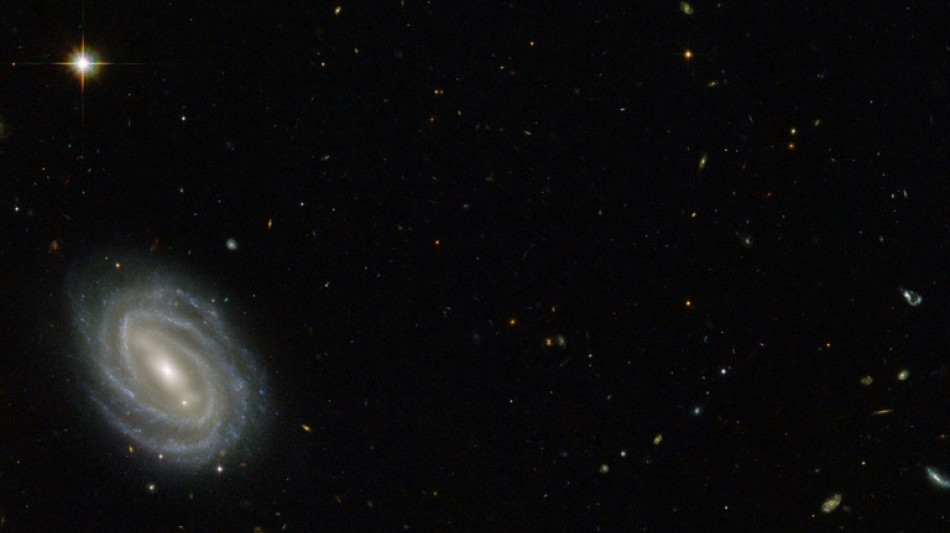
Nuclear reactor experiment rules out one dark matter hope / Photo: Handout - NASA/ESA/HUBBLE/AFP/File
 In-form Marc Marquez wins Aragon MotoGP Grand Prix

 At least six die in ferry capsize off Northern Cyprus

 Niamey back to normal after soldier mutiny

 King Haakon joins Norway memorials for Harald

 NASA launches Roman telescope on cosmic mapping mission

 Van Dijk wants Gakpo to stay at Liverpool amid Man City interest

 Five-wicket Abbas has Lord's landmark as Pakistan set 389 to win second Test

 Tadej Pogacar Out of Vuelta a Espana with Broken Collarbone and Concussion

 Iceland votes 'No' to resuming EU talks

 Berlin Literary Guide: Book Launches, Festivals, and Readings Through August

 Nepal rescuers drill through debris towards trapped tunnel workers

 Manhunt in Switzerland after fatal rave shooting

 'No' camp seen winning Iceland's EU referendum

 Nepal flood survivors return to ruins to salvage memories

 Killing of Palestinian children and teens by Israel surges in West Bank
 Educators keep 9/11 memory alive for next generation, 25 years on

 Venezuelans view US oil deal with doubt, hope

 Gobena and Jepchirchir power to Sydney Marathon victories

 Iceland in suspense after close EU vote

 Wallabies hold on for victory in Argentina

 Juve notch second straight win, Fiorentina's centenary party falls flat

 Rybakina eases injury fears ahead of US Open

 Djokovic kicks off latest Grand Slam quest under US Open lights

 'Sorry' De Zerbi won't panic after Spurs shambles

 UN, Nepal warn of climate threat after deadly floods

It was an anomaly detected in the storm of a nuclear reactor so puzzling that physicists hoped it would shine a light on dark matter, one of the universe's greatest mysteries.
However new research has definitively ruled out that this strange measurement signalled the existence of a "sterile neutrino", a hypothetical particle that has long eluded scientists.
Neutrinos are sometimes called "ghost particles" because they barely interact with other matter -- around 100 trillion are estimated to pass through our bodies every second.
Since neutrinos were first theorised in 1930, scientists have been trying to nail down the properties of these shape-shifters, which are one of the most common particles in the universe.
They appear "when the nature of the nucleus of an atom has been changed", physicist David Lhuillier of France's Atomic Energy Commission told AFP.
That could happen when they come together in the furious fusion in the heart of stars like our Sun, or are broken apart in nuclear reactors, he said.
There are three confirmed flavours of neutrino: electron, muon and tau.
However physicists suspect there could be a fourth neutrino, dubbed "sterile" because it does not interact with ordinary matter at all.
In theory, it would only answer to gravity and not the fundamental force of weak interactions, which still hold sway over the other neutrinos.
The sterile neutrino has a place ready for it in theoretical physics, "but there has not yet been a clear demonstration that is exists," he added.
- Dark matter candidate -
So Lhuillier and the rest of the STEREO collaboration, which brings together French and German scientists, set out to find it.
Previous nuclear reactor measurements had found fewer neutrinos than the amount expected by theoretical models, a phenomenon dubbed the "reactor antineutrino anomaly".
It was suggested that the missing neutrinos had changed into the sterile kind, offering a rare chance to prove their existence.
To find out, the STEREO collaboration installed a dedicated detector a few metres away from a nuclear reactor used for research at the Laue–Langevin institute in Grenoble, France.
After four years of observing more than 100,000 neutrinos and two years analysing the data, the verdict was published in the journal Nature on Wednesday.
The anomaly "cannot be explained by sterile neutrinos," Lhuillier said.
But that "does not mean there are none in the universe", he added.
The experiment found that previous predictions of the amount of neutrinos being produced were incorrect.
But it was not a total loss, offering a much clearer picture of neutrinos emitted by nuclear reactors.
This could help not just with future research, but also for monitoring nuclear reactors.
Meanwhile, the search for the sterile neutrino continues. Particle accelerators, which smash atoms, could offer up new leads.
Despite the setback, interest could remain high because sterile neutrinos have been considered a suspect for dark matter, which makes up more than quarter of the universe but remains shrouded in mystery.
Like dark matter, the sterile neutrino does not interact with ordinary matter, making it incredibly difficult to observe.
"It would be a candidate which would explain why we see the effects of dark matter -- and why we cannot see dark matter," Lhuillier said.
A.Mahlangu--AMWN