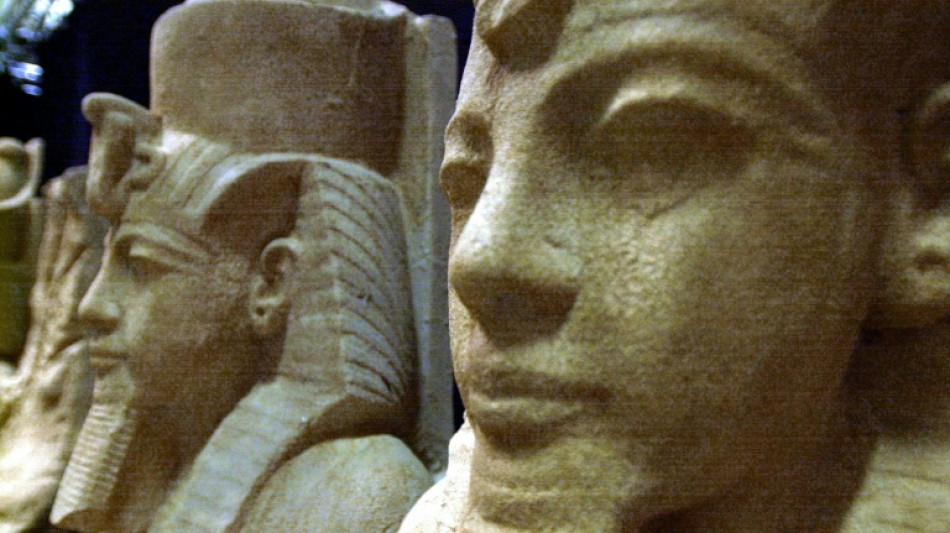
Pharaoh Ramses II's sarcophagus in Paris for rare loan / Photo: MYCHELE DANIAU - AFP/File
 Aston Villa Defy History With Rare Victory at Old Trafford

 Crowds Gather at San Francisco Park for Elizabeth Holmes Lookalike Tournament

 Making Your Home Safer for Aging Parents: Accessibility Renovations That Add Value

 iPS Cell Research Accelerates Drug Discovery for ALS and Spinal Cord Injury

 Rene Eyre Revisits Autobiographical Performance 'Say A Little Prayer' in London

 UAE's HCT Holds Record Graduation and Announces Major Training Expansion

 NASA Awards $10B Lunar Contract Framework to SpaceX, Blue Origin

The sarcophagus of ancient Egyptian pharaoh Ramses II is to return to Paris in April for the first time in almost 50 years, in a rare loan of the relic outside Egypt.
The ornate coffin will be on show in the French capital from April 7 to September 6, the star attraction alongside an exhibition previously shown in San Francisco and which will conclude in Sydney -- minus the sarcophagus.
"I almost wept for joy that I would be seeing him again here when they told me he was coming to Paris," said Dominique Farout, an Egyptologist at the prestigious Ecole du Louvre art history school who is scientific commissioner to the exhibit.
"I was 16 in 1976" when Ramses II was last in Paris, Farout added. "I had a big poster in my bedroom. I went eight times in a row."
Farout said Egyptian authorities had made an exception in loaning the yellow-painted cedar-wood sarcophagus to France. It did not travel to San Francisco and will not be included when the rest of the exhibition packs up and heads to Sydney.
The gesture marks gratitude towards Paris, where scientists preserved Ramses II's mummy by treating it against fungus when it was exhibited in 1976.
This time, the sculpted coffin will be shown empty, as Egyptian law now forbids transporting royal mummies abroad.
It depicts the recumbent king in bright colours with his arms crossed on his chest holding his sceptre and whip of office.
- 'Sacrificed to the gods' -
His eyes outlined in black, he wears a striped pharaonic headdress and a braided false beard.
One of the best-known pharaohs, reputed as a great warrior and builder of temples, Ramses II ruled from 1279-1213 BC.
Inscriptions on the sarcophagus' sides detail how his body was moved three times from 1070 BC, after his tomb in Luxor's Valley of the Kings was raided by grave-robbers.
Its final resting place was discovered in 1881, just as it too was being pillaged.
As well as the coffin, the Paris exhibition will include vast numbers of ancient Egyptian objects, solid gold and silver jewels, statues, amulets, masks and other sarcophagi.
Only animal mummies will be on show, including cats which were "raised and sacrificed to the gods", Farout said.
Other treasures come from the capital Tanis that Ramses II built east of the Nile Delta, including a solid silver coffin, finger and toe sheaths and solid-gold masks decorated with jewels.
Exhibition organisers hope large numbers of people will make the trip to the La Villette exhibition centre in northeast Paris. A previous exhibition about Tutankhamun drew 1.4 million visitors to the same place in 2019.
J.Williams--AMWN

