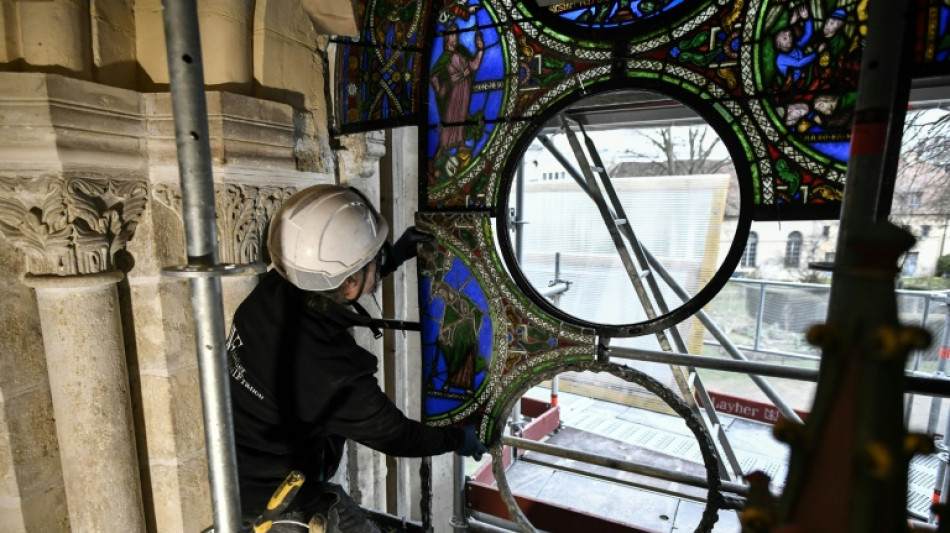
Light returns to the stained glass of the Saint-Denis Basilica / Photo: STEPHANE DE SAKUTIN - AFP
 Aston Villa Defy History With Rare Victory at Old Trafford

 Crowds Gather at San Francisco Park for Elizabeth Holmes Lookalike Tournament

 Making Your Home Safer for Aging Parents: Accessibility Renovations That Add Value

 iPS Cell Research Accelerates Drug Discovery for ALS and Spinal Cord Injury

 Rene Eyre Revisits Autobiographical Performance 'Say A Little Prayer' in London

 UAE's HCT Holds Record Graduation and Announces Major Training Expansion

 NASA Awards $10B Lunar Contract Framework to SpaceX, Blue Origin

The Basilica of Saint-Denis on the northern outskirts of Paris may be less famous than Notre-Dame, but when Emmanuel Putanier was asked to restore the historic monument's stained glass windows to their former glory, he jumped at the chance.
"This is something that you only do once in a lifetime," the master glassmaker told AFP.
For a year now, his team has been working in the Basilica to restore the windows, which date back to the 12th century, to their former, distant splendour.
Just down the road from that cathedral to sporting excellence, the national Stade de France, the Basilica is nestled in a Paris suburb with more of a reputation for crime, religious sectarianism and poverty than for medieval architecture.
However its architectural splendour, and the fact that it is the resting place of no fewer than 43 French monarchs, attracts 130,000 visitors each year.
The major renovation works have been underway for several years already.
Since last year, the building's stained glass windows have been the focus of the work at the Basilica, the culmination of 25 years of preparation work costing more than 2 million euros ($2.2 million).
"All things heritage take time," said Laurent Roturier, head of the Paris region branch of the office of cultural affairs (DRAC), which is in charge of the works.
The project began to take shape a quarter of a century ago when the Basilica's oldest glass windows went under the care of France's research laboratory for historical monuments (LRMH).
"We're just the final stage of the journey," said Guillaume Uvroas, a glassmaker working in the Basilica.
- Dating back to 12th century -
When the project kicked off in 1997, the windows dating back to the middle of the 12th century and considered a milestone in the history of stained-glassmaking, were worn down by time and dulled by the elements.
Duplicates made of polycarbonate were installed in their place.
That move started a new conversation: should the original stained glass art be restored and reinstalled, or should perfect copies be put in their place?
Experts decided to go with the latter option: more than 20 copies have been produced in total.
But getting it right has required deep research in the archives, going back to the French Revolution during which they were dismantled, said Thomas Clouet, an architect specialising in historic buildings.
Some windows had been vandalised, and there were various bits and pieces scattered about.
"We needed to find the pieces and retrace their history and journey before we could proceed to the duplication phase," said Roturier.
"What we do here requires insane precision, from the colour range to the composition," said Putanier.
Because his team was not allowed to remove the originals from the laboratory, "we set up an operation plan to take measurements on site," he said.
The most important task was to achieve consistency across the entire structure, a job made hard by the several restoration efforts the Basilica had undergone over the centuries.
"To make the copies, we took into account distortions that happened over time," he said, "They couldn't appear too new or modern-looking."
The final step will be to fit the copies into glass panes that date back to the 19th century.
"The most important thing for us was to recover this relationship to light, because that's the spirit behind the construction of this basilica," insisted Roturier. "It's what the founders would've wanted.
More restoration projects are planned over the next five years, including of the Basilica's tabernacles and its spire.
D.Cunningha--AMWN

