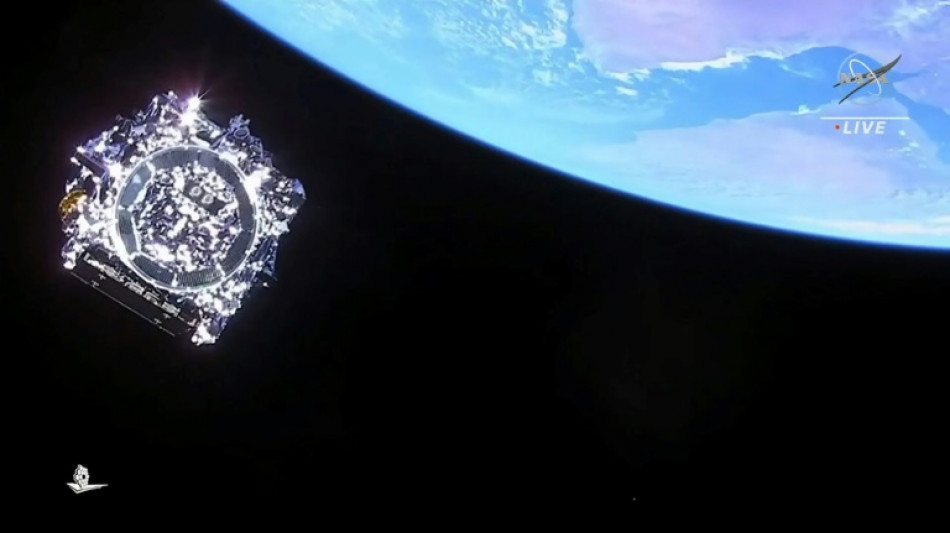
Small asteroid 'serendipitously' detected using James Webb telescope / Photo: - - NASA TV/AFP/File
 Fernandes hat-trick inspires Man Utd rout of Ipswich

 Suzuki sends 'perfect' Freiburg past Bremen, Schalke lose

 Instagram offers three routes to two-factor authentication

 September smartphone calendar spans Apple, Poco, Vivo and Xiaomi

 Eight dead and 23 missing after ferry sinks off Cyprus

 Russell Hobbs dual air fryer discounted to £99

 British woman dies after stabbing at German station

 Beeston pub closes after office fire injures man

 South West Water ranks worst in environmental comparison

 CERN creates quark-gluon plasma with smaller atomic nuclei

 WIRED tests label makers for home organisation

 Google Maps adopts Lake America label for US users

 Bellingham, Mbappe fire as Real Madrid ease to Malaga win

 Mas wins Vuelta 9th stage to extend lead

 Robinson strikes as England close in on series win over Pakistan

 Chelsea beat Brighton in seven-goal thriller to extend Alonso's perfect start

 Zambia's opposition leader charged with treason

 Marc Marquez wins Aragon MotoGP Grand Prix

 Robinson rocks Pakistan again as England eye series win at Lord's

 Nepal rescuers advance towards trapped tunnel workers

 Grisly search for missing as Nepal morgues overflow, burials begin
 Barcelona's Yamal getting back to 'top level': Flick

 Dutch federation calls for football summit without Infantino

 Ron’s Honky Tonk Residency Revives UK Country Music in Bermondsey

 Chelsea sign Argentina 'stopper Martinez from Villa

European astronomers using the James Webb Space Telescope have detected a previously unknown asteroid about the size of Rome's Colosseum in the main asteroid belt between Mars and Jupiter.
The asteroid measuring between 300 and 650 feet (100 to 200 meters) in length is the smallest object observed to date using the telescope, the US space agency NASA said Monday.
The European astronomers "serendipitously detected" the asteroid, NASA said in a statement, adding that more observations would be needed to better characterize its nature and properties.
"We -– completely unexpectedly -– detected a small asteroid," said Thomas Muller, an astronomer at the Max Planck Institute for Extraterrestrial Physics in Germany.
It was detected during calibration of the telescope's Mid-InfraRed Instrument (MIRI), which operates in mid-infrared wavelengths.
"Webb's incredible sensitivity made it possible to see this roughly 100-meter object at a distance of more than 100 million kilometers," Muller said.
Webb, which has been operational since July, is the most powerful space telescope ever built and has unleashed a raft of unprecedented data as well as stunning images.
One of the main goals for the $10 billion telescope is to study the life cycle of stars. Another main research focus is on exoplanets, planets outside Earth's solar system.
Webb was not designed to look for small objects such as the newly-discovered asteroid, but Muller said its discovery "suggests that many new objects will be detected with this instrument."
O.Norris--AMWN