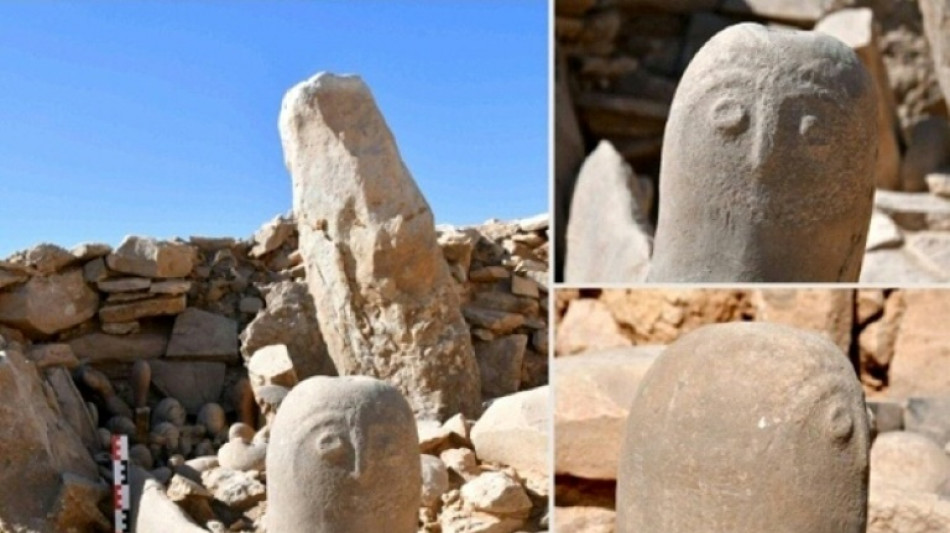
9,000-year-old ritual complex found in Jordan desert
 Nepal floods leave trail of destruction, aid challenge

 Experts outline sustainable ways to declutter Australian homes

 Bulk book purchases feed AI training through destructive scanning

 George and Amal Clooney attend Lake Como event after France evacuation

 Michelle Obama describes relief and adjustment after daughters leave home

 Very strong El Niño forecast to peak during southern African summer

 SAFA opens tender for dressing rooms, ablutions and grandstands

 TEEKS brings Māori-rooted soul and a new view of masculinity to South Africa

 Saudi customs seize 1.95 million amphetamine pills in lentil shipment

 Trump says Russia will not attack NATO as CIA chief visits Moscow

 British Museum schedules new Bayeux Tapestry ticket release
 From forced labour to living heritage: Sao Tome's colonial plantations

 Motorola September 2026 Deals: Up to $700 Off Razr Ultra and Moto G

 In war-split Myanmar 'spirit consorts' commune across divide

 Leaders of Russia, China, Iran to attend summit in Kyrgyzstan

 Alpha1 AI Expands Support for Federal Agencies

 Kane confirms talks on Bayern extension

 Trump govt. mulls deal to give away part of Yosemite park

 Indian release of Sonia Gandhi memoir uncertain after publisher clarification

 Cities show cleaner transport policies can reduce severe air pollution

 Four patients harmed in Nashville hospital medication mix-up

 Essex council hires private guards as Wethersfield asylum centre expands

 Haakon VIII becomes Norway's king after Harald V dies at 89

 Six injured after sign falls at Christian festival in West Sussex

 Dubai airport expands scanners that keep laptops and liquids in bags

Archaeologists deep in the Jordanian desert have discovered a 9,000-year-old ritualistic complex near what is thought to be the earliest known large human-built structure worldwide.
The Stone Age shrine site, excavated last year, was used by gazelle hunters and features carved stone figures, an altar and a miniature model of a large-scale hunting trap.
The giant game traps the model represents -- so-called "desert kites" -- were made of long walls that converge to corral running gazelles into enclosures or holes for slaughter.
Similar structures of two or more stone walls, some several kilometres (miles) long, have been found in deserts across Saudi Arabia, Syria, Turkey and Kazakhstan.
The Neolithic-era ritual site was discovered inside a larger campsite last October by a joint French-Jordanian team called the South Eastern Badia Archaeological Project.
The nearby desert kites in Jibal al-Khashabiyeh are "the earliest large-scale human built structures worldwide known to date," said a statement by the SEBA Project.
It hailed the "spectacular and unprecedented discovery" of the ritualistic site, believed to date to about 7000 BC.
It featured two steles with anthropomorphic features, the taller one 1.12 metres high, other artefacts including animal figurines, flints, and some 150 arranged marine fossils.
The wider, decade-old research project aims to study "the first pastoral nomadic societies, as well as the evolution of specialised subsistence strategies".
The desert kites suggest "extremely sophisticated mass hunting strategies, unexpected in such an early timeframe," said the project's statement.
The sacral symbolism was most likely meant "to invoke the supranatural forces for successful hunts and abundance of prey to capture," it said.
The teams of researchers have also found campsites with circular dwellings and large numbers of gazelle bones.
The project is a collaboration of Jordan's Al Hussein Bin Talal University and the French Institute of the Near East.
French ambassador Veronique Vouland-Aneini hailed the "outcome for both the scientific world and Jordan", saying "it provides us with a priceless testimony of the historical life in the Middle East, its traditions and rituals".
O.Karlsson--AMWN