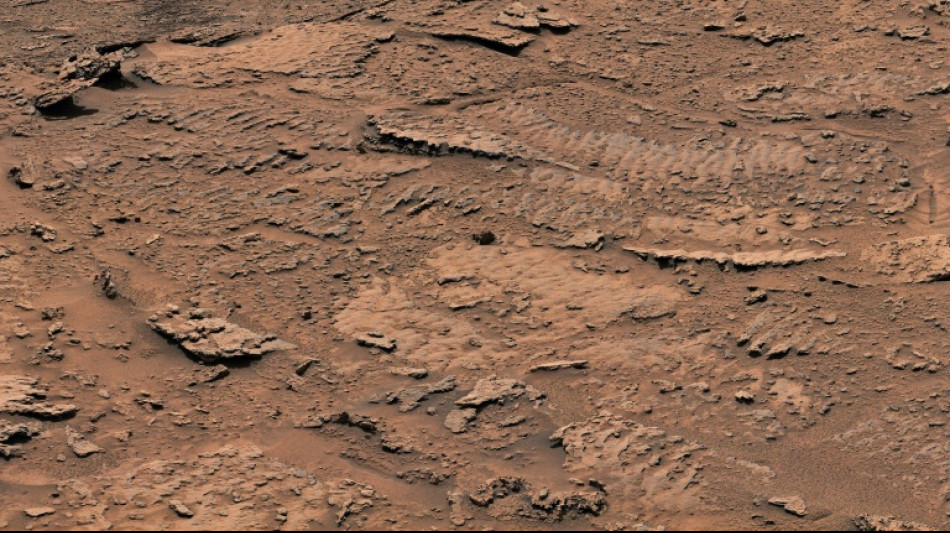
Mars rover finds rippled rocks caused by waves: NASA / Photo: Handout - NASA/JPL-Caltech/MSSS/AFP
 Fernandes hat-trick inspires Man Utd rout of Ipswich

 Suzuki sends 'perfect' Freiburg past Bremen, Schalke lose

 Instagram offers three routes to two-factor authentication

 September smartphone calendar spans Apple, Poco, Vivo and Xiaomi

 Eight dead and 23 missing after ferry sinks off Cyprus

 Russell Hobbs dual air fryer discounted to £99

 British woman dies after stabbing at German station

 Beeston pub closes after office fire injures man

 South West Water ranks worst in environmental comparison
 CERN creates quark-gluon plasma with smaller atomic nuclei

 WIRED tests label makers for home organisation

 Google Maps adopts Lake America label for US users

 Bellingham, Mbappe fire as Real Madrid ease to Malaga win

 Mas wins Vuelta 9th stage to extend lead

 Robinson strikes as England close in on series win over Pakistan

 Chelsea beat Brighton in seven-goal thriller to extend Alonso's perfect start

 Zambia's opposition leader charged with treason

 Marc Marquez wins Aragon MotoGP Grand Prix

 Robinson rocks Pakistan again as England eye series win at Lord's

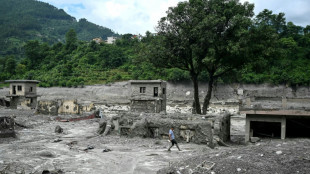 Nepal rescuers advance towards trapped tunnel workers

 Grisly search for missing as Nepal morgues overflow, burials begin

 Barcelona's Yamal getting back to 'top level': Flick

 Dutch federation calls for football summit without Infantino

 Ron’s Honky Tonk Residency Revives UK Country Music in Bermondsey

 Chelsea sign Argentina 'stopper Martinez from Villa

NASA's Curiosity rover has found wave-rippled rocks -- evidence of an ancient lake -- in an area of the planet expected to be drier, the US space agency said Wednesday.
"This is the best evidence of water and waves that we've seen in the entire mission," said Ashwin Vasavada, Curiosity's project scientist at NASA's Jet Propulsion Laboratory in California.
The rover, which has been exploring Mars since 2012, beamed back stunning pictures of rippled patterns on the surface of rocks caused by the waves of a shallow lake billions of years ago.
Curiosity had previously found evidence that lakes once covered parts of Mars in the salty minerals left behind when they dried up.
But NASA scientists were surprised to find such stark evidence of water in the Gale Crater that the rover is now exploring.
"We've climbed through many lake deposits during our mission but have never seen wave ripples this clearly," Vasavada said in a statement.
"This was especially surprising because the area we're in probably formed at a time when Mars was becoming more dry," he said.
Curiosity is exploring the foothills of a three-mile (five-kilometer) tall mountain known as Mount Sharp.
The rover has also spotted debris in a valley that was washed down by wet landslides on Mount Sharp, NASA said.
"This landslide debris is probably the most recent evidence of water that we'll ever see," Vasavada said. "It will allow us to study layers higher up on Mount Sharp that we can't reach."
NASA said Mount Sharp provides a sort of "Martian timeline" to scientists with the oldest layers at the bottom and youngest at the top.
This allows them to "study how Mars evolved from a planet that was more Earth-like in its ancient past, with a warmer climate and plentiful water, to the freezing desert it is today," it said.
Another Mars rover, Perseverance, landed on the Red Planet in February 2021 to look for signs of past microbial life.
The multi-tasking rover will collect 30 rock and soil samples in sealed tubes to be sent back to Earth sometime in the 2030s for lab analysis.
F.Dubois--AMWN