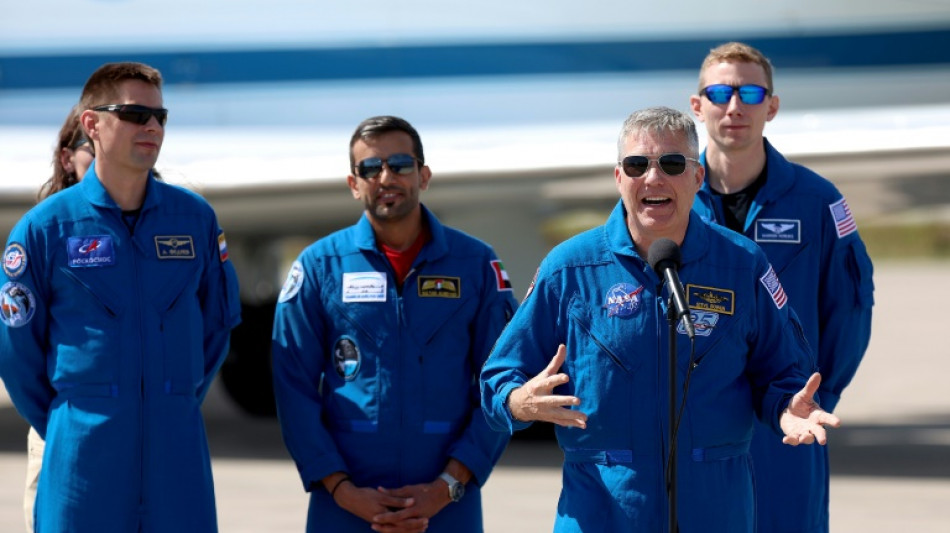
SpaceX Dragon crewed flight to ISS pushed back 24 hours / Photo: JOE RAEDLE - GETTY IMAGES/AFP
 Aston Villa Defy History With Rare Victory at Old Trafford

 Crowds Gather at San Francisco Park for Elizabeth Holmes Lookalike Tournament

 Making Your Home Safer for Aging Parents: Accessibility Renovations That Add Value

 iPS Cell Research Accelerates Drug Discovery for ALS and Spinal Cord Injury

 Rene Eyre Revisits Autobiographical Performance 'Say A Little Prayer' in London

 UAE's HCT Holds Record Graduation and Announces Major Training Expansion

 NASA Awards $10B Lunar Contract Framework to SpaceX, Blue Origin

US space agency NASA and SpaceX on Tuesday pushed back by 24 hours the launch of a Falcon 9 rocket that is to carry four astronauts to the International Space Station.
NASA's Stephen Bowen and Warren Hoburg, Russia's Andrey Fedyaev and Sultan al-Neyadi of the United Arab Emirates had been scheduled to blast off for the ISS at 2:07 am (0707 GMT) Sunday.
Liftoff of the SpaceX Dragon Crew-6 from the Kennedy Space Center in Florida has now been rescheduled for 1:45 am Monday, NASA officials said.
The four astronauts are scheduled to spend six months on the orbiting space station. They arrived in Florida on Tuesday to begin their final preparations for the mission.
"When we looked at the work remaining to go, primarily on the vehicle, getting Dragon and Falcon 9 ready to go, we were a little bit behind," said Steve Stich, manager of NASA's commercial crew program.
"And so we need a little bit more time," said Stich, speaking to reporters after the agency and SpaceX completed what is known as a flight readiness review of the Falcon 9 rocket and Dragon crew capsule.
Stich said several issues needed to be addressed including additional analysis concerning the thermal performance of some of the pods that cover the exterior of the Dragon spacecraft.
NASA officials said they expect the members of SpaceX Dragon Crew-6 to have a five-day handover with the four members of Dragon Crew-5, who have been on the ISS since October.
- Extended stay for Soyuz crew -
Also currently aboard the ISS are three astronauts whose return vehicle, a Soyuz MS-22 crew capsule, was damaged while docked with the ISS.
Russia's space agency Roscosmos said Tuesday that the trio -- Russian cosmonauts Dmitry Petelin and Sergei Prokopyev and NASA astronaut Frank Rubio -- were now expected to return to Earth in September.
They had been scheduled to return home on March 28 in the MS-22 but it began leaking coolant in mid-December after being hit by what US and Russian space officials believe was a tiny space rock.
Russia plans to send a rescue ship, Soyuz MS-23, to the ISS on Thursday.
Roscosmos said the extended space stay -- normally ISS missions last six months -- posed no health risks for the crew, and they had taken the extension news "positively."
The launch of the rescue Soyuz capsule was itself postponed earlier this month after another vessel -- a Russian supply ship docked at the ISS, Progress MS-21 -- also leaked coolant.
Roscosmos said that particular leak was caused by an "exterior impact," based on photos and videos that showed holes on the capsule's exterior, including on the radiator and solar panels.
Space has remained a rare venue of cooperation between Moscow and Washington since the start of the Russian offensive in Ukraine and ensuing Western sanctions on Russia.
The ISS was launched in 1998 at a time of increased US-Russia cooperation following the Cold War "Space Race."
Russia has been using the ageing but reliable Soyuz capsules to ferry astronauts into space since the 1960s.
But in recent years Russia's space program has been beset by a litany of problems which have led to the loss of satellites and vehicles.
B.Finley--AMWN

