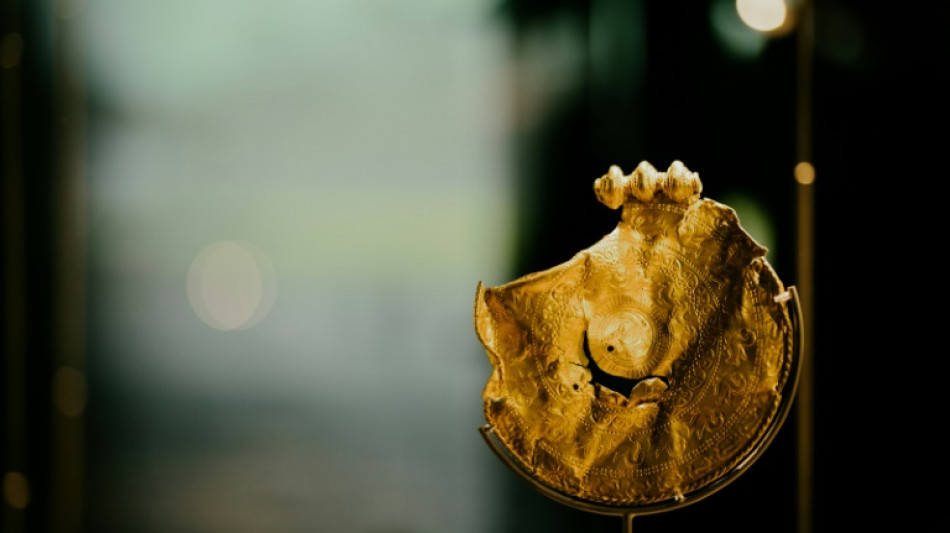
Treasure hunters' gems go on display in Denmark / Photo: Joakim ZUEGER - National Museum of Denmark/AFP
 Niger mutiny suppressed, but questions remain over junta's cohesion

 Como spoil Allegri's Napoli home debut

 Cruz Beckham Performs at Leeds Festival Following Family Support at Reading

 Fernandes hat-trick inspires Man Utd rout of Ipswich

 Suzuki sends 'perfect' Freiburg past Bremen, Schalke lose

 Instagram offers three routes to two-factor authentication

 September smartphone calendar spans Apple, Poco, Vivo and Xiaomi
 Eight dead and 23 missing after ferry sinks off Cyprus
 Russell Hobbs dual air fryer discounted to £99

 British woman dies after stabbing at German station
 Beeston pub closes after office fire injures man

 South West Water ranks worst in environmental comparison
 CERN creates quark-gluon plasma with smaller atomic nuclei

 WIRED tests label makers for home organisation
 Google Maps adopts Lake America label for US users

 Bellingham, Mbappe fire as Real Madrid ease to Malaga win

 Mas wins Vuelta 9th stage to extend lead

 Robinson strikes as England close in on series win over Pakistan

 Chelsea beat Brighton in seven-goal thriller to extend Alonso's perfect start

 Zambia's opposition leader charged with treason

 Marc Marquez wins Aragon MotoGP Grand Prix
 Robinson rocks Pakistan again as England eye series win at Lord's
 Nepal rescuers advance towards trapped tunnel workers
 Grisly search for missing as Nepal morgues overflow, burials begin
 Barcelona's Yamal getting back to 'top level': Flick

They may be derided elsewhere but in Denmark, hobby archaeologists who hunt treasures with metal detectors are such an asset the National Museum has dedicated an entire exhibit to their finds.
"What they save now means the world for what we can do in the future and how we can build our museums," exhibit curator Line Bjerg told AFP.
"What they do really matters."
In Denmark's muddy soil, if objects "are not saved, then they are lost to history", she added.
In three rooms on the museum's bottom floor, visitors can learn about "detectorists" and admire some of their discoveries, including rings, necklaces and gold coins, all marked with the name of their finder.
In the Scandinavian country once populated by Vikings, amateurs can use metal detectors almost everywhere as long as they get permission from the landowner. They are not, however, allowed to dig beneath the top layer of soil.
Any archaeological finds have to be turned over to a local museum for an initial evaluation before they are transferred to the National Museum for an in-depth assessment -- and a possible reward.
Detectorists' hauls can be abundant.
"Last year, we had almost 18,000 objects that were sent for treasure trove processing. The year before that it was 30,000 objects," Bjerg said.
Known as "Danefae", any archaeological artefacts found by treasure hunters automatically belong to the state, under an old medieval law.
According to Torben Trier Christiansen, an archaeologist with the Historical Museum of Northern Jutland, the collaboration with the hobbyists is invaluable.
They are "one of the most important collaborators of the museum", he insisted.
There are more than 250 detectorists in his region, with the most active among them handing over around a hundred objects per year.
Arne Hertz, a 64-year-old pensioner who heads a local association of detectorists, said "people are pleased to do the right thing by handing over the findings".
- Writing history together -
The unique collaboration is based on a mutual understanding. On the one hand, archaeological sites won't be looted. On the other, authorities are able to showcase the amateur discoveries.
"Sometimes it's these particular finds that change our history because they add knowledge that we simply did not have before," Bjerg noted.
One section of the biggest exhibition room is dedicated to the "Vindelev Treasure".
Comprised of 22 gold objects, it was buried in the sixth century in southwestern Denmark and found in late 2020 by an amateur who had just bought a metal detector.
The treasure trove includes a bracteate -- a thin coin stamped on one side.
"And on the inscription of the bracteate is mentioned the name of Odin, the Norse god. And it puts Odin 150 years before we actually knew that he existed as a god," Bjerg said.
"We're building our history together in Denmark."
For detectorists, whose finds have on occasion been displayed at local museums, the exhibit at the National Museum is a major recognition.
"It's very impressive to see how the things we've found are displayed -- and to see that we are actually helping a little to enrich Denmark's history," 38-year-old Simon Grevang, who works in online marketing and has been a detectorist for four years, told AFP.
The exhibit has drawn crowds since opening in February.
Annie Lund, a 72-year-old retiree who was enthralled by the jewellery on display, said it was a good way of making history accessible.
"Twenty or forty years ago, this was only for a small group of people, scientists... not for the general public. So I think this is really good," she said.
Ch.Havering--AMWN