Costa Rica's 'urban mine' for planet-friendlier lithium
/ Photo: Ezequiel BECERRA - AFP
 Niger mutiny suppressed, but questions remain over junta's cohesion

 Como spoil Allegri's Napoli home debut

 Cruz Beckham Performs at Leeds Festival Following Family Support at Reading

 Fernandes hat-trick inspires Man Utd rout of Ipswich

 Suzuki sends 'perfect' Freiburg past Bremen, Schalke lose
 Instagram offers three routes to two-factor authentication

 September smartphone calendar spans Apple, Poco, Vivo and Xiaomi
 Eight dead and 23 missing after ferry sinks off Cyprus
 Russell Hobbs dual air fryer discounted to £99

 British woman dies after stabbing at German station

 Beeston pub closes after office fire injures man
 South West Water ranks worst in environmental comparison

 CERN creates quark-gluon plasma with smaller atomic nuclei

 WIRED tests label makers for home organisation

 Google Maps adopts Lake America label for US users

 Bellingham, Mbappe fire as Real Madrid ease to Malaga win

 Mas wins Vuelta 9th stage to extend lead

 Robinson strikes as England close in on series win over Pakistan

 Chelsea beat Brighton in seven-goal thriller to extend Alonso's perfect start

 Zambia's opposition leader charged with treason

 Marc Marquez wins Aragon MotoGP Grand Prix

 Robinson rocks Pakistan again as England eye series win at Lord's
 Nepal rescuers advance towards trapped tunnel workers
 Grisly search for missing as Nepal morgues overflow, burials begin
 Barcelona's Yamal getting back to 'top level': Flick

Costa Rica, a country where open pit mining is banned, has become a leader in the extraction of heavy metals such as lithium -- not from the Earth, but old batteries.
The Fortech recycling factory which opened nearly three decades ago in Cartago about 27 kilometers (17 miles) from the capital San Jose, is referred to by its staff as an "urban mine."
For the last six years, it has focused on extracting lithium contained in rechargeable batteries used in everything from mobile phones and laptops to electric cars and solar panels.
Millions of batteries are discarded every year.
While the battery casings take about 100 years to decompose, the often toxic heavy metals inside never do.
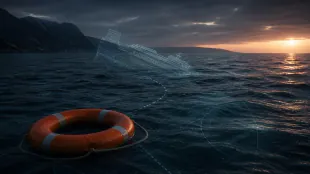
For Fortech, this presents a proverbial gold mine, and for our planet, perhaps a lifeboat.
"We now know that waste does not exist. We know it is a resource that can be used again," Fortech managing director Guillermo Pereira told AFP.
"It’s important to break paradigms," added the 54-year-old, who with his son Francisco, 25, created a new method for extracting metals from used batteries.
"The world needs a circular economy" that recycles precious primary materials rather than sourcing new ones, said Pereira.
- 'White gold' -
Unlike lithium mined elsewhere in conditions often harmful to the environment, workers and local populations, Fortech's metals are taken from 1,500 tons of used batteries discarded every year in Costa Rica alone, according to his son, the company's project manager.
They are collected in malls, electronics stores or electric vehicle sales points.
Lithium, dubbed "white gold" or the "oil of the 21st century," has seen its price explode on the global market from $5,700 per ton in November 2020 to 60,500 dollars in September 2022 due to electric cars replacing their polluting, gas-guzzling forerunners.
But lithium production plants consume millions of liters of water and can be harmful to the environment.
Obtaining lithium from recycling batteries expels only a quarter of the planet-warming CO2 that comes with mining it, according to Fortech chemist Henry Prado.
Recycling also saves the planet of the environment pollution caused by the "usual disposal method" of lithium batteries, which is often simply to dump them, he added.
According to the American Chemical Society, as little as five percent of the world’s lithium-ion batteries are thought to be recycled.
- 'Pioneer' -
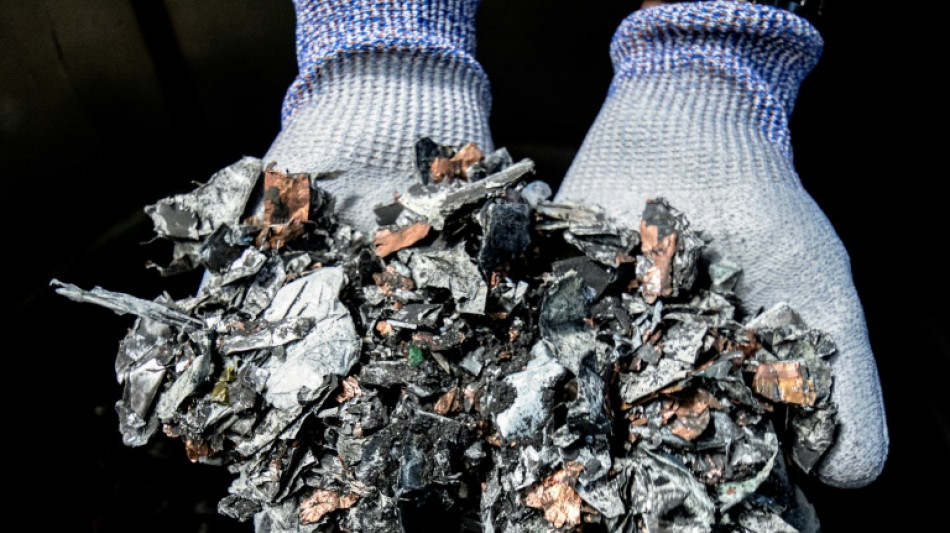
At Fortech, collected spent batteries are placed on a conveyor belt that feeds them into a crusher.
The waste extracted in this way is then transformed into a mix of cobalt, nickel, manganese and lithium known as "black mass."
These metals comprise about 57 percent of each battery -- the rest is copper, aluminum, plastic and iron, all of which can also be recycled.
Fortech does not have the technology to further separate the individual metals in the "black mass," which it sells instead to factories in Europe to complete the process and manufacture new batteries.
According to the German development agency GIZ, Fortech has turned Costa Rica into "a pioneer in Latin America in the valorization of used lithium batteries."
P.Silva--AMWN