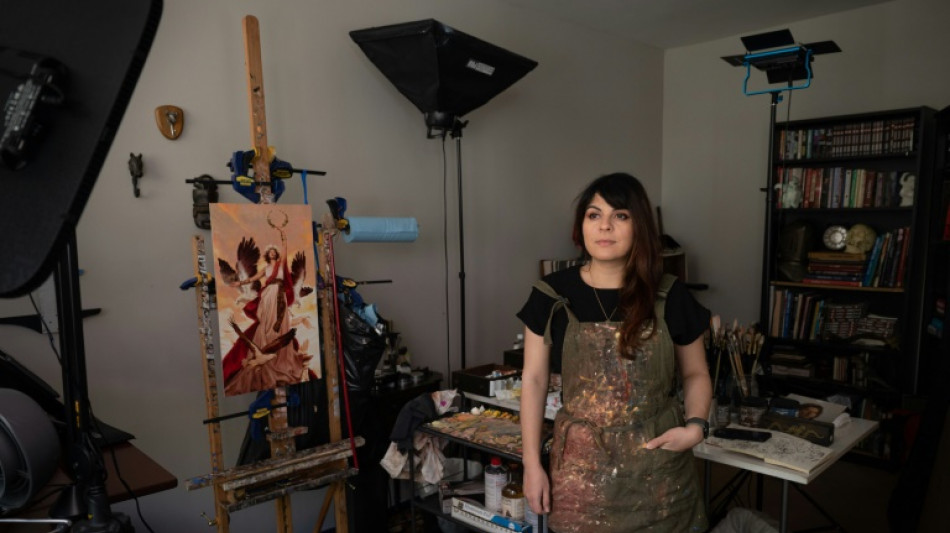
Artist Karla Ortiz sees AI 'identity theft', not promise / Photo: Amy Osborne - AFP
 Aston Villa Defy History With Rare Victory at Old Trafford

 Crowds Gather at San Francisco Park for Elizabeth Holmes Lookalike Tournament

 Making Your Home Safer for Aging Parents: Accessibility Renovations That Add Value

 iPS Cell Research Accelerates Drug Discovery for ALS and Spinal Cord Injury

 Rene Eyre Revisits Autobiographical Performance 'Say A Little Prayer' in London

 UAE's HCT Holds Record Graduation and Announces Major Training Expansion

 NASA Awards $10B Lunar Contract Framework to SpaceX, Blue Origin

For artist Karla Ortiz, the explosion in artificial intelligence that can stand in for flesh-and-blood artists is nothing more than identity theft.
A native of Puerto Rico, Ortiz is a California-based designer, a concept artist and painter who has worked for videogaming giant Ubisoft, Marvel Studios, the Wizards of the Coast fantasy game publisher and has exhibited her work in galleries.
But now her profession could be completely disrupted by generative AI, the technology behind apps such as Dall-E and ChatGPT, which in seconds can crank out original content -- illustrations, poems, computer code -- with only a simple prompt.
About a year ago, Ortiz discovered Disco Diffusion, an open source AI-based image generating tool, but it is not easy to use for those less tech savvy.
At first, she thought it was an interesting experiment, but quickly she realized that the program was using the work of many of her friends without them knowing it.
They asked to have their work removed, but to no avail, and they backed down. She told herself art theft is nothing new in their line of work.
"It's weird that this is happening, but whatever," she told herself at the time.
But months later, with the introduction of even more powerful programs such as Midjourney and Stable Diffusion, which can generate images "in the style of" a chosen artist, she was brought face to face with the magnitude of the phenomenon.
Ortiz said she was shocked when she looked at how the programs were trained.
"All the training data, all the training material, it's our work."
In her studio, standing between her easel and her computer, Ortiz puts the final touches of oil paint on her latest work, "Musa Victoriosa," a woman surrounded by eagles, brandishing a laurel wreath.
This muse, which will be used to illustrate a copyright protection app, embodies artists defiant against technology.
To those who argue that human artists also draw inspiration from others' work, Ortiz says they are missing the point.
"Just because I look at a painting that I love, it doesn't mean that I archive that influence and that it automatically becomes a part of how I paint," she said.
"Influences can only get you so far in art," she added.
"The rest is your training, your life, your experiences, your thoughts of the day; that extra bit of humanity that filters inspirations and experiences together and creates your own voice and work," she said.
She worries about young artists who need the time and experience to find their style but will be squeezed out by AI.
- 'Canary in the coalmine' -
"How does a person break in now? And if you break in and you do develop a style, that's wonderful, but what stops anybody from training a model on your work?"
Along with other artists, Ortiz filed a lawsuit in a California court against three generative AI companies, hoping one day to get the industry regulated.
This fight has strengthened bonds between creators, and not only designers, she said.
"I'm seeing more writers and also voice actors being very concerned because of the technology that can take your voice and mimic it perfectly," Ortiz said.
Silicon Valley investors "want to expand to pretty much every creative endeavor," she warned.
"Our profession was automated first so we kind of became the canary in the coal mine."
P.Costa--AMWN

