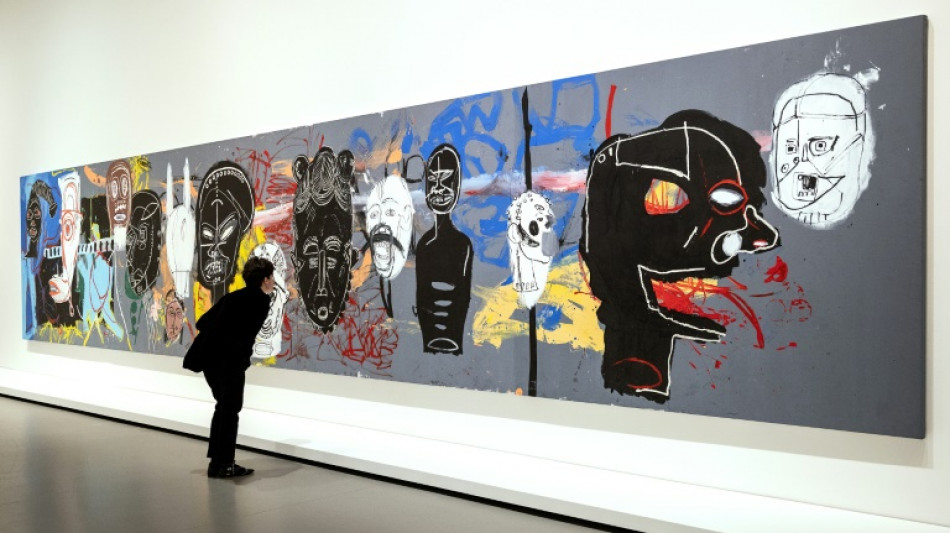
Basquiat-Warhol: a rare artistic duo, reunited in Paris / Photo: BERTRAND GUAY - AFP
 Aston Villa Defy History With Rare Victory at Old Trafford

 Crowds Gather at San Francisco Park for Elizabeth Holmes Lookalike Tournament

 Making Your Home Safer for Aging Parents: Accessibility Renovations That Add Value

 iPS Cell Research Accelerates Drug Discovery for ALS and Spinal Cord Injury

 Rene Eyre Revisits Autobiographical Performance 'Say A Little Prayer' in London

 UAE's HCT Holds Record Graduation and Announces Major Training Expansion

 NASA Awards $10B Lunar Contract Framework to SpaceX, Blue Origin

There are vanishingly few great collaborations in the annals of fine art. For a brief moment in the 1980s, Andy Warhol and Jean-Michel Basquiat showed the world how it was done.
It started with a bang. Warhol, 54, met Basquiat, 22, for lunch in October 1982 and took a polaroid of them together.
Basquiat took it to his studio and returned just two hours later with a portrait. Warhol was stunned by its brilliance.
Soon they were working together on portraits that combined their favoured tropes: Basquiat's masks, skulls, graffiti and obscure symbols; Warhol's pop-art imagery, logos and newspaper headlines.
The brief, intense collaboration lasted from 1983 to 1985 and produced some 160 works.
An unprecedented number of them -- 70 -- have been brought together for a show at the Louis Vuitton Foundation in Paris that opens Wednesday, mostly plucked from private collections.
"It's definitely the most successful collaboration in the history of art between two great artists. It's never been matched at this level or in this short space of time," said Dieter Buchhart, the show's lead curator and a Basquiat expert.
In room after room, two different aesthetics, generations and temperaments collide -- and find an unexpected synergy.
"It is neither Warhol, nor Basquiat, but a third artist that emerges," said Suzanne Page, the museum's artistic director.
"There was a great generosity between the two. They played with and provoked each other," she told AFP. "Warhol allowed himself to be completely subverted by Basquiat's interventions."
At their best, it is hard to tell where one artist begins and the other ends, as in the monumental, 10-metre-long (33 feet) "African Masks".
Others are unexpected: "Ten Punching Bags", never shown in their lifetimes, has the bags suspended in a line and decorated with the face of Jesus Christ inspired by Leonardo da Vinci's "The Last Supper", drawn by Warhol with the word "judge" and a crown of thorns added by Basquiat.
Cartoonist Keith Haring, a close friend of both -- and who makes a cameo in the exhibition -- praised their collaboration at the time as a "conversation in painting".
But there were doubters as well. Many felt portraits should be the singular vision of an individual artist.
Their supporters saw the two artists more like great jazz musicians, riffing off each other. Basquiat was inspired by the master, Warhol was reinvigorated by his young friend.
"It released an incredible energy," said Page, and on a more straightforward level, they shared an intuitive genius for composition and combining colours.
If Basquiat was the more serious, the more socially engaged -- "carried by anger" at the invisibility of black people -- Warhol was not as detached as he sometimes came across.
"He accepted the social engagement side of Basquiat, and shared it," Page said. "Warhol was engaged too, in his own way. He was a very complex creature."
What might have been seen as insolence in Basquiat's approach -- scrawling over works that Warhol had left around his Factory studio, for example -- was totally accepted by the elder artist.
Their collaboration ended happily. But within two years both were dead -- Warhol following routine surgery and Basquiat from a heroin overdose. Already global superstars, their fame would only continue to grow.
F.Pedersen--AMWN

