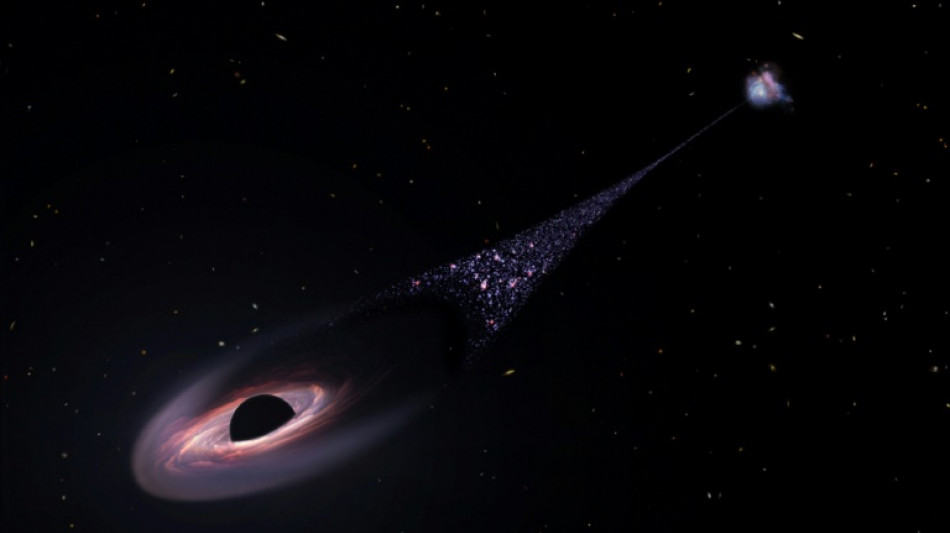
Runaway black hole creating trail of new stars: scientists / Photo: Handout - NASA/ESA/AFP
 US strikes Iran for first time in a month, Tehran retaliates

 Yin holds off Kim to win sixth LPGA title, end title drought

 Top-ranked Scheffler storms to PGA Tour Championship win

 Root urges England to be 'grown-ups' after Pakistan series win

 Google Maps renames Lake Ontario 'Lake America' in US -- but not Canada

 Aaron Donald ends retirement to rejoin Rams: team

 Niamey back to normal after soldiers' mutiny

 Niger mutiny suppressed, but questions remain over junta's cohesion

 Como spoil Allegri's Napoli home debut

 Cruz Beckham Performs at Leeds Festival Following Family Support at Reading

 Fernandes hat-trick inspires Man Utd rout of Ipswich

 Suzuki sends 'perfect' Freiburg past Bremen, Schalke lose

 Instagram offers three routes to two-factor authentication

 September smartphone calendar spans Apple, Poco, Vivo and Xiaomi

 Eight dead and 23 missing after ferry sinks off Cyprus

 Russell Hobbs dual air fryer discounted to £99

 British woman dies after stabbing at German station

 Beeston pub closes after office fire injures man

 South West Water ranks worst in environmental comparison

 CERN creates quark-gluon plasma with smaller atomic nuclei

 WIRED tests label makers for home organisation

 Google Maps adopts Lake America label for US users

 Bellingham, Mbappe fire as Real Madrid ease to Malaga win

 Mas wins Vuelta 9th stage to extend lead

 Robinson strikes as England close in on series win over Pakistan

A huge black hole is tearing through space, leaving behind a 200,000-light-year-long trail of newborn stars, space scientists say.
The supermassive monster -- likely born of a bizarre game of intergalactic billiards -- is rampaging through the blackness and plowing into gas clouds in its path.
The incredible forces at play mean this gas is being forged into a contrail of new stars, which have been captured on camera by NASA's powerful Hubble Space Telescope.
"We think we're seeing a wake behind the black hole where the gas cools and is able to form stars," said Pieter van Dokkum of Yale University.
"What we're seeing is the aftermath. Like the wake behind a ship, we're seeing the wake behind the black hole."
Researchers believe gas is probably being blasted and warmed by the motion of the black hole.
"Gas in front of it gets shocked because of this supersonic, very high-velocity impact of the black hole moving through the gas," said van Dokkum.
The black hole weighs about the same as 20 million of our Suns.
Scientists believe it began its rampage after being ejected from a celestial menage-a-trois.
The working theory is that two galaxies probably merged about 50 million years earlier, bringing together two supermassive black holes, which whirled around each other harmoniously.
But a third galaxy butted in with its own black hole, creating an unstable and chaotic scene that eventually saw one of them ejected at high speed -- fast enough to travel between the Earth and the Moon in just 14 minutes.
Stargazers say there is no cause for earthly concern because this is all very far away.
It's also a long time ago -- back when the universe was half of its current age. We are seeing it now because of the time it has taken for light to arrive here.
The runaway black hole, which has never been seen before, was discovered by accident, says van Dokkum.
"I was just scanning through the Hubble image and then I noticed that we have a little streak.
"It didn't look like anything we've seen before," he said, adding the star trail is "quite astonishing, very, very bright and very unusual."
While this is the first tearaway black hole ever spotted, it might not be the only one, says NASA.
Their Nancy Grace Roman Space Telescope, which is expected to launch some time this decade, should give astronomers a much wider view of the universe -- and could lead to the discovery of more of these star-forming runaways.
P.Costa--AMWN