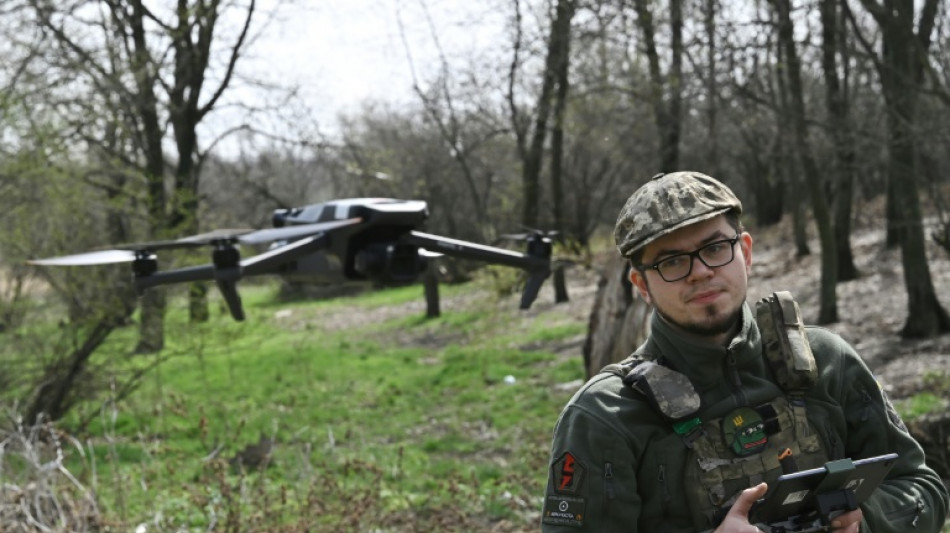
'Revenge of the geeks': Drones battle on Ukraine front / Photo: Genya SAVILOV - AFP
 US strikes Iran for first time in a month, Tehran retaliates

 Yin holds off Kim to win sixth LPGA title, end title drought

 Top-ranked Scheffler storms to PGA Tour Championship win

 Root urges England to be 'grown-ups' after Pakistan series win
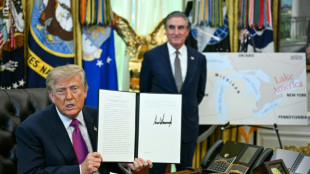 Google Maps renames Lake Ontario 'Lake America' in US -- but not Canada
 Aaron Donald ends retirement to rejoin Rams: team
 Niamey back to normal after soldiers' mutiny

 Niger mutiny suppressed, but questions remain over junta's cohesion

 Como spoil Allegri's Napoli home debut
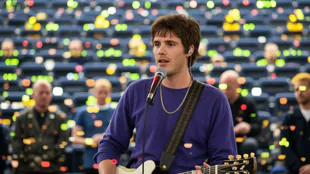 Cruz Beckham Performs at Leeds Festival Following Family Support at Reading
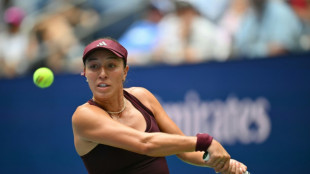
 Fernandes hat-trick inspires Man Utd rout of Ipswich

 Suzuki sends 'perfect' Freiburg past Bremen, Schalke lose

 Instagram offers three routes to two-factor authentication

 September smartphone calendar spans Apple, Poco, Vivo and Xiaomi
 Eight dead and 23 missing after ferry sinks off Cyprus
 Russell Hobbs dual air fryer discounted to £99

 British woman dies after stabbing at German station

 Beeston pub closes after office fire injures man
 South West Water ranks worst in environmental comparison
 CERN creates quark-gluon plasma with smaller atomic nuclei

 WIRED tests label makers for home organisation

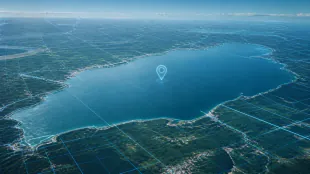 Google Maps adopts Lake America label for US users
 Bellingham, Mbappe fire as Real Madrid ease to Malaga win
 Mas wins Vuelta 9th stage to extend lead

 Robinson strikes as England close in on series win over Pakistan

At a Ukrainian training camp near Bakhmut, surrounded by soldiers lugging heavy equipment and firing ear-piercing weapons, a bespectacled man carrying a grey pouch struts jauntily across a field.
"My weapon is a lot more discreet. These are the eyes of the army," said Oleksandr, a soldier in his 30s with a camouflage helmet and a neatly trimmed beard, pulling out a discreet drone from the pouch.
Oleksandr is the head of an air support unit for the army's fifth brigade, mostly providing reconnaissance and surveillance but also using specially adapted drones to drop grenades.
His mission is to fly drones above the city of Bakhmut in eastern Ukraine -- scene of the longest battle of the war and current epicentre of the fighting between Russian and Ukrainian forces.
When he is not on a mission, Oleksandr is training or fixing his drones.
"We identify the enemy and we can accompany assault units," he said, clearing branches from a take-off spot for his drone.
In the modern battlefield, drones can update artillery units in real time, effectively replacing the role of spotters who adjust fire to hit targets.
The same is also true for the other side and drone operators also work to neutralise Russian drones.
- 'Gift from the Russians' -
Viktor, another member of Oleksandr's drone unit, keeps the interceptor in a large briefcase.
He shows off its screen with a predatory smile.
"Look, you can see them all! The Mavic and the others! All the drones!" he said.
He said the device was "a gift from the Russians".
"In Ukraine, we don't make machines like this. We stole it from the enemy," he said.
Many drones are lost, crash or get shot down. Oleksandr estimates he has lost around 100.
The operator said there was nothing straightforward about serving in drone units where you have to learn to be ingenious and adaptable to succeed.
"It's a big job. The operator has to know everything -- how to maximise the range of the drone, how to create a take-off point in complicated terrain, how to dig a trench and hide his presence," he said.
The drones used by the Ukrainian army are often commercial models.
Operators first have to hack the software to "make them invisible to Russian radio surveillance", said Oleksandr.
- 'Revenge of the geeks' -
They can also be adapted to drop grenades or become improvised explosive devices.
To do this, 3D-printed clips which can be activated by remote control can be attached to the drone so as to remove the pin grenade and drop it.
The most commonly used technique for doing this was elaborated through trial and error.
At first "we were experimenting, using the batteries of soldiers' e-cigarettes to power the clamp system for the grenades", Oleksandr said.
He remembers his first success -- destroying an MT-12 Rapira anti-tank gun by dropping a grenade.
He holds up one model with the word "Kamikaze" written on it in Japanese letters -- a reference to the Japanese pilots who carried out suicide missions during World War II.
Oleksandr said that it is thanks to drones that Bakhmut is still holding out.
"The attacks on Bakhmut by (Russian mercenary group) Wagner were held off thanks to drones dropping grenades," he said, gesturing towards the front line where outnumbered Ukrainian fighters have resisted waves of attacks for months.
"It's a bit like a revenge of the geeks," he said.
G.Stevens--AMWN