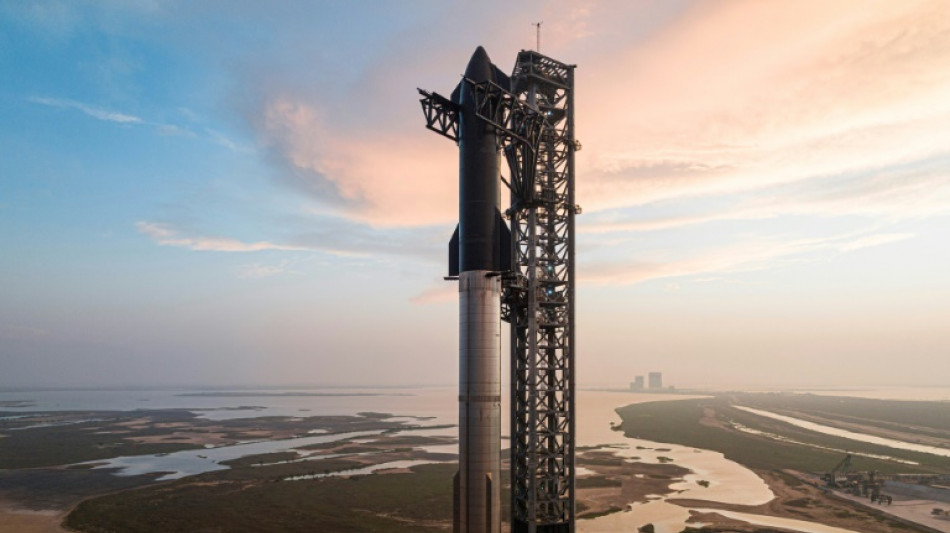
SpaceX Starship, world's biggest rocket, set for first test flight / Photo: - - SPACEX/AFP
 US strikes Iran for first time in a month, Tehran retaliates

 Yin holds off Kim to win sixth LPGA title, end title drought

 Top-ranked Scheffler storms to PGA Tour Championship win

 Root urges England to be 'grown-ups' after Pakistan series win

 Google Maps renames Lake Ontario 'Lake America' in US -- but not Canada

 Aaron Donald ends retirement to rejoin Rams: team

 Niamey back to normal after soldiers' mutiny

 Niger mutiny suppressed, but questions remain over junta's cohesion

 Como spoil Allegri's Napoli home debut

 Cruz Beckham Performs at Leeds Festival Following Family Support at Reading

 Fernandes hat-trick inspires Man Utd rout of Ipswich

 Suzuki sends 'perfect' Freiburg past Bremen, Schalke lose

 Instagram offers three routes to two-factor authentication

 September smartphone calendar spans Apple, Poco, Vivo and Xiaomi

 Eight dead and 23 missing after ferry sinks off Cyprus

 Russell Hobbs dual air fryer discounted to £99

 British woman dies after stabbing at German station

 Beeston pub closes after office fire injures man

 South West Water ranks worst in environmental comparison

 CERN creates quark-gluon plasma with smaller atomic nuclei

 WIRED tests label makers for home organisation

 Google Maps adopts Lake America label for US users

 Bellingham, Mbappe fire as Real Madrid ease to Malaga win

 Mas wins Vuelta 9th stage to extend lead

 Robinson strikes as England close in on series win over Pakistan

SpaceX is counting down to the first test flight on Monday of Starship, the most powerful rocket ever built, designed to send astronauts to the Moon and Mars and beyond.
The giant rocket is scheduled to blast off from Starbase, the SpaceX spaceport in Boca Chica, Texas, at 8:00 am Central Time (1300 GMT).
Fallback times are scheduled for later in the week if Monday's launch attempt is delayed -- something billionaire SpaceX founder Elon Musk said is a distinct possibility.
"It's a very risky flight," Musk said in a live event on Twitter Spaces on Sunday. "It's the first launch of a very complicated, gigantic rocket.
"There's a million ways this rocket could fail," he added. "We're going to be very careful and if we see anything that gives us concern, we'll postpone."
Musk said he wanted to "set expectations low" because "probably tomorrow will not be successful -- if by successful one means reaching orbit."
The US space agency NASA has picked the Starship spacecraft to ferry astronauts to the Moon in late 2025 -- a mission known as Artemis III -- for the first time since the Apollo program ended in 1972.
Starship consists of a 164-foot (50-meter) tall spacecraft designed to carry crew and cargo that sits atop a 230-foot tall first-stage Super Heavy booster rocket.
Collectively referred to as Starship, the spacecraft and the Super Heavy rocket have never flown in combination together, although there have been several sub-orbital test flights of the spacecraft alone.
If all goes according to plan, the Super Heavy booster will separate from Starship about three minutes after launch and splash down in the Gulf of Mexico.
Starship, which has six engines of its own, will continue to an altitude of nearly 150 miles, completing a near-circle of the Earth before splashing down in the Pacific Ocean about 90 minutes after launch.
"If it gets to orbit, that's a massive success," Musk said.
"If we get far enough away from the launchpad before something goes wrong then I think I would consider that to be a success," he said. "Just don't blow up the launchpad.
"The payload for this mission is information," he said. "Information that allows us to improve the design of future Starship builds."
- 'Multi-planet civilization' -
SpaceX conducted a successful test-firing of the 33 Raptor engines on the first-stage booster of Starship in February.
The Super Heavy booster was anchored to the ground during the test-firing, called a static fire, to prevent it from lifting off.
NASA will take astronauts to lunar orbit itself in November 2024 using its own heavy rocket called the Space Launch System (SLS), which has been in development for more than a decade.
Starship is both bigger and more powerful than SLS.
It generates 17 million pounds of thrust, more than twice that of the Saturn V rockets used to send Apollo astronauts to the Moon.
SpaceX foresees eventually putting a Starship into orbit, and then refueling it with another Starship so it can continue on a journey to Mars or beyond.
Musk said the goal is to make Starship reusable and bring down the price to a few million dollars per flight.
"In the long run -- long run meaning, I don't know, two or three years -- we should achieve full and rapid reusability," he said.
The eventual objective is to establish bases on the Moon and Mars and put humans on the "path to being a multi-planet civilization," Musk said.
"We are at this brief moment in civilization where it is possible to become a multi-planet species," he said. "That's our goal. I think we've got a chance."
L.Davis--AMWN