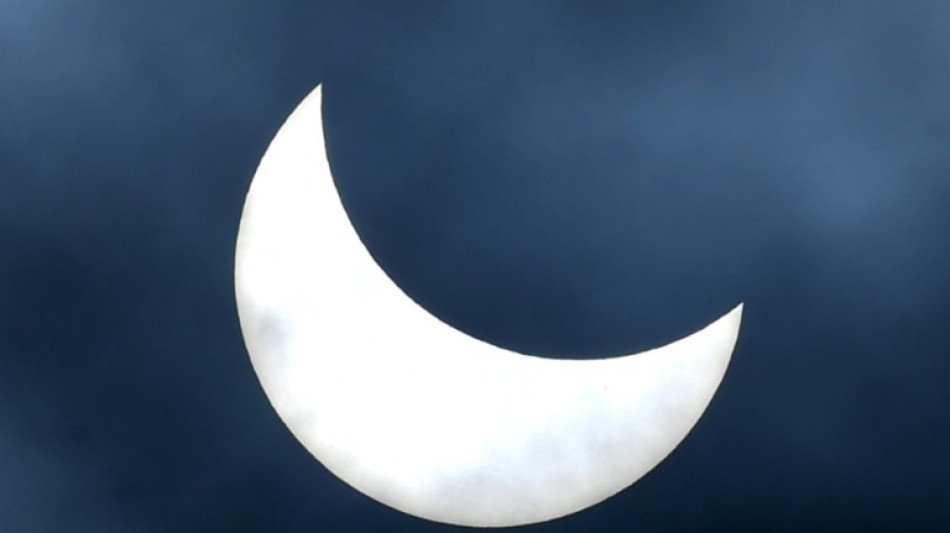
Pacific solar eclipse dazzles stargazers / Photo: SONNY TUMBELAKA - AFP
 Aston Villa Defy History With Rare Victory at Old Trafford

 Crowds Gather at San Francisco Park for Elizabeth Holmes Lookalike Tournament

 Making Your Home Safer for Aging Parents: Accessibility Renovations That Add Value

 iPS Cell Research Accelerates Drug Discovery for ALS and Spinal Cord Injury

 Rene Eyre Revisits Autobiographical Performance 'Say A Little Prayer' in London

 UAE's HCT Holds Record Graduation and Announces Major Training Expansion

 NASA Awards $10B Lunar Contract Framework to SpaceX, Blue Origin

Professional astronomers and amateur cosmologists across the southern Pacific donned protective glasses Thursday to witness a solar eclipse as the moon blocked out the sun for about a minute, in some cases totally.
Parts of Australia, Indonesia and East Timor were plunged into daytime darkness, delighting curious onlookers.
On Australia's northwest tip, the eclipse was total.
In the town of Exmouth, stargazers parked their caravans, pitched telescopes and donned protective glasses to watch the moon seemingly creep across the sun's surface before the totality hit at 11:29:48 local time.
"Many people become addicted to that minute or so of eerie otherworldliness," John Lattanzio of the Astronomical Society of Australia said.
"They become 'eclipse chasers' and they travel all over the world for repeat experiences."
When the darkness hit, it brought a spectral calm, according to witnesses.
Less than a minute later, the dusty outback was again bathed in light.
A little later, thousands waited in line at a planetarium in Jakarta, to see partial coverage of the sun through telescopes.
Over in Bekasi, on the outskirts of the Indonesian capital, Kristoforus Aryo Bagaskoro and his 10-year-old daughter Angela Tara watched the phenomenon on the reflective surface of a water-filled bucket.
"Tara could not stop talking about it since yesterday, so this morning, I used water to observe it in front of our house," he said.
"It was a rare event. Tara was enthusiastic about it and kept asking why it could happen".
Tara added that the partial eclipse -- with about 40 percent of the sun obscured -- was "awesome".
While fun and perhaps moving for spectators, the eclipse gave scientists a chance to observe the sun's corona, which is usually obscured by its bright rays.
At Com Beach on the eastern tip of East Timor, more than a thousand people, including tourists and astronomers from Southeast Asian countries, gathered to witness the one-minute total eclipse.
The stargazers observed the rare phenomenon by using anti-UV glasses distributed by astronomy groups, while others lined up to use telescopes provided by the National University of East Timor.
M.Fischer--AMWN

