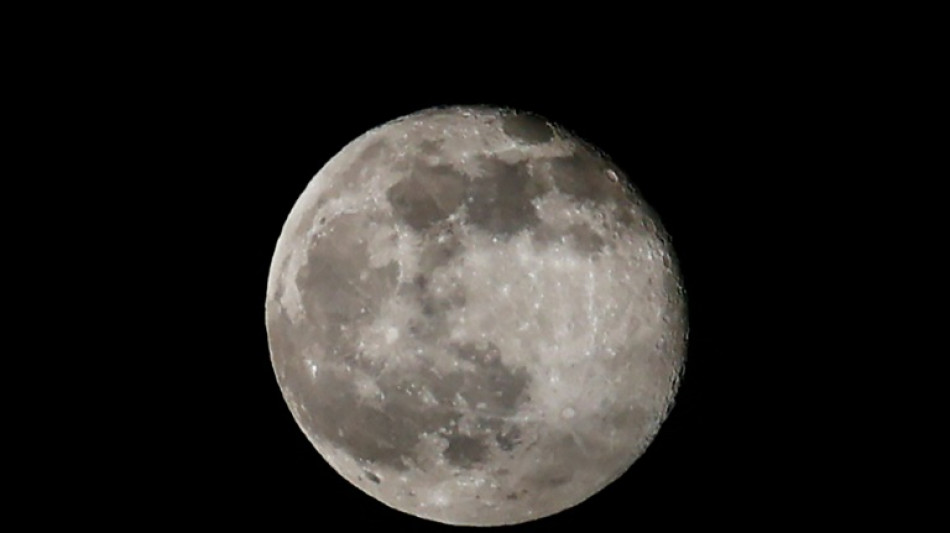
Moon shot: Japan firm to attempt historic lunar landing / Photo: David GANNON - AFP/File
 Aston Villa Defy History With Rare Victory at Old Trafford

 Crowds Gather at San Francisco Park for Elizabeth Holmes Lookalike Tournament

 Making Your Home Safer for Aging Parents: Accessibility Renovations That Add Value

 iPS Cell Research Accelerates Drug Discovery for ALS and Spinal Cord Injury

 Rene Eyre Revisits Autobiographical Performance 'Say A Little Prayer' in London

 UAE's HCT Holds Record Graduation and Announces Major Training Expansion

 NASA Awards $10B Lunar Contract Framework to SpaceX, Blue Origin

A Japanese space start-up will attempt Tuesday to become the first private company to put a lander on the Moon.
If all goes to plan, ispace's Hakuto-R Mission 1 lander will start its descent towards the lunar surface at around 1540 GMT.
It will slow its orbit some 100 kilometres above the Moon, then adjust its speed and altitude to make a "soft landing" around an hour later.
Success is far from guaranteed. In April 2019, Israeli organisation SpaceIL watched their lander crash into the Moon's surface.
ispace has announced three alternative landing sites and could shift the lunar descent date to April 26, May 1 or May 3, depending on conditions.
"What we have accomplished so far is already a great achievement, and we are already applying lessons learned from this flight to our future missions," ispace founder and CEO Takeshi Hakamada said earlier this month.
"The stage is set. I am looking forward to witnessing this historic day, marking the beginning of a new era of commercial lunar missions."
The lander, standing just over two metres tall and weighing 340 kilogrammes, has been in lunar orbit since last month.
It was launched from Earth in December on one of SpaceX's Falcon 9 rockets after several delays.
So far only the United States, Russia and China have managed to put a robot on the lunar surface, all through government-sponsored programmes.
However, Japan and the United States announced last year that they would cooperate on a plan to put a Japanese astronaut on the Moon by the end of the decade.
The lander is carrying several lunar rovers, including a miniature Japanese model of just eight centimetres that was jointly developed by Japan's space agency with toy manufacturer Takara Tomy.
The mission is also being closely watched by the United Arab Emirates, whose Rashid rover is aboard the lander as part of the nation's expanding space programme.
The Gulf country is a newcomer to the space race but sent a probe into Mars' orbit in 2021. If its rover successfully lands, it will be the Arab world's first Moon mission.
Hakuto means "white rabbit" in Japanese and references Japanese folklore that a white rabbit lives on the Moon.
The project was one of five finalists in Google's Lunar X Prize competition to land a rover on the Moon before a 2018 deadline, which passed without a winner.
With just 200 employees, ispace has said it "aims to extend the sphere of human life into space and create a sustainable world by providing high-frequency, low-cost transportation services to the Moon."
Hakamada has touted the mission as laying "the groundwork for unleashing the Moon's potential and transforming it into a robust and vibrant economic system."
The firm believes the Moon will support a population of 1,000 people by 2040, with 10,000 more visiting each year.
It plans a second mission, tentatively scheduled for next year, involving both a lunar landing and the deployment of its own rover.
C.Garcia--AMWN

