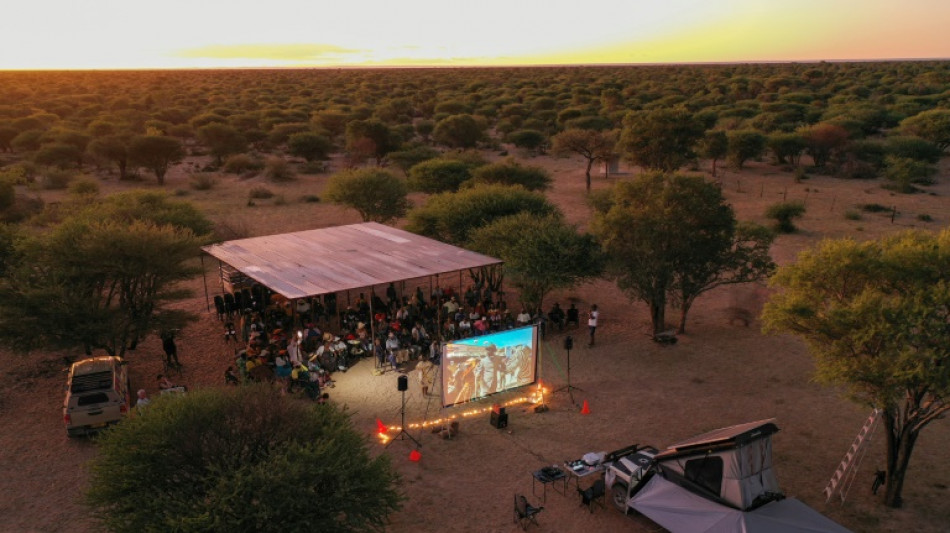
Germany's colonial crimes in Namibia tackled on screen / Photo: Sydelle Willow Smith - STUDIOCANAL/AFP
 US strikes Iran for first time in a month, Tehran retaliates

 Yin holds off Kim to win sixth LPGA title, end title drought

 Top-ranked Scheffler storms to PGA Tour Championship win

 Root urges England to be 'grown-ups' after Pakistan series win

 Google Maps renames Lake Ontario 'Lake America' in US -- but not Canada

 Aaron Donald ends retirement to rejoin Rams: team

 Niamey back to normal after soldiers' mutiny

 Niger mutiny suppressed, but questions remain over junta's cohesion

 Como spoil Allegri's Napoli home debut

 Cruz Beckham Performs at Leeds Festival Following Family Support at Reading

 Fernandes hat-trick inspires Man Utd rout of Ipswich

 Suzuki sends 'perfect' Freiburg past Bremen, Schalke lose

 Instagram offers three routes to two-factor authentication

 September smartphone calendar spans Apple, Poco, Vivo and Xiaomi

 Eight dead and 23 missing after ferry sinks off Cyprus

 Russell Hobbs dual air fryer discounted to £99

 British woman dies after stabbing at German station

 Beeston pub closes after office fire injures man

 South West Water ranks worst in environmental comparison
 CERN creates quark-gluon plasma with smaller atomic nuclei

 WIRED tests label makers for home organisation

 Google Maps adopts Lake America label for US users

 Bellingham, Mbappe fire as Real Madrid ease to Malaga win

 Mas wins Vuelta 9th stage to extend lead

 Robinson strikes as England close in on series win over Pakistan

Long overshadowed by World War II and the Holocaust, a colonial-era genocide committed by Germany in Namibia has been brought to the big screen, shining a light on the country's neglected crimes.
Lars Kraume's "Measures of Men" tells the story of a German ethnologist who travels to what was German South West Africa in the early 1900s to study the country's indigenous peoples and harvest their skulls.
The film was released in German cinemas on March 23 and has also been the subject of special screenings, including in schools and the Bundestag lower house of parliament.
"The colonial era was long repressed by Germany, which lost all its colonies in 1919," Kraume, 50, told AFP.
"This film is a contribution to making Germans aware of their responsibilities," he said.
Germany is well known for its efforts to remember and atone for the atrocities committed during World War II.
Children are taught about the Holocaust in schools, a memorial to the murdered Jews occupies a prominent place in Berlin, and countless films and documentaries have been made about the Nazis.
But only one other film, "Morenga" by German director Egon Guenther, based on the novel of the same name by Uwe Timm, has been made in Germany about the country's role in Namibia.
- Racist experiments -
Though smaller than those of France and Britain, Germany's colonial empire encompassed parts of several African countries, including present-day Burundi, Rwanda, Tanzania, Namibia and Cameroon.
In Namibia, Germany was responsible for mass killings of indigenous Herero and Nama people that many historians refer to as the first genocide of the 20th century.
Over the past 20 years, Germany has been gradually starting to talk more about the massacre, in which at least 60,000 Herero and 10,000 Nama were killed between 1904 and 1908.
Germany has returned skulls and other human remains to Namibia that it had sent to Berlin during the period for "scientific" experiments.
And in May 2021, the country officially acknowledged that it had committed genocide in Namibia and promised a billion euros in financial support to descendants of the victims.
"Since the centenary of the genocide in 2004, historians and activists have done a lot of work on the subject," said Joel Glasman, a professor of African history at the University of Bayreuth.
In "Measures of Men", an ethnologist from Berlin, Alexander Hoffmann (Leonard Scheicher), is sent to Namibia to conduct experiments on the population and collect their bones for research.
At the beginning of the film, Hoffmann believes no race is superior to any other.
But he is ambitious and, in order to further his career, ends up going along with the prevailing scientific wisdom -- which went on to pave the way for the racist ideology of the Nazis.
The story is told mainly from the German perspective, though Hoffmann's friend Kezia Kambazembi (Girley Charlene Jazama), a Herero translator, also plays a prominent role.
- 'Very emotional' -
Israel Kaunatjike, a Herero rights activist based in Berlin, said "Measures of Men" had "moved me deeply".
"It motivated me to continue to fight for our cause," said the 76-year-old, who was an anti-apartheid resistance fighter when Namibia was still under South African control.
When "Measures of Men" was shown in some Herero villages, "it was very emotional, people thought Lars Kraume was brave to show such a film to the descendants of the victims", Kaunatjike said.
A film showing the perspective of the Herero and Nama on the same events would be welcome, Kaunatjike said. "But unfortunately they don't have the money to make a film."
When the film was shown in schools, "the students understood the ambivalence of the hero and wanted to discuss it", Kraume said.
Both Kaunatjike and Kraume believe Germany still has some way to go to reckon with its colonial past.
"We need an official request for forgiveness from the German president in Namibia and the return of all the Herero and Nama skulls and bones still in German collections for burial," said Kraume.
For Kaunatjike, "development aid is no substitute for reparations".
P.Martin--AMWN