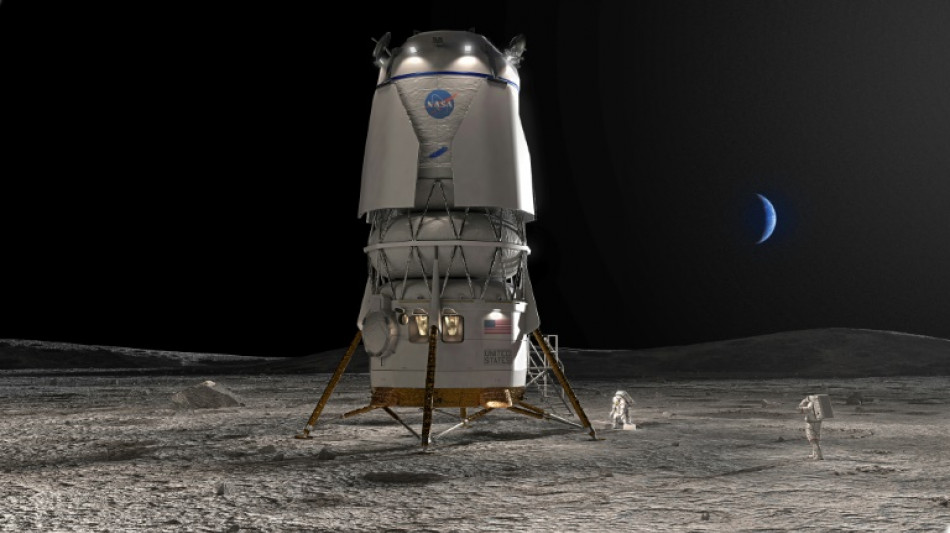
After SpaceX, NASA taps Bezos's Blue Origin to build Moon lander / Photo: Handout - NASA/AFP
 Aston Villa Defy History With Rare Victory at Old Trafford

 Crowds Gather at San Francisco Park for Elizabeth Holmes Lookalike Tournament

 Making Your Home Safer for Aging Parents: Accessibility Renovations That Add Value

 iPS Cell Research Accelerates Drug Discovery for ALS and Spinal Cord Injury

 Rene Eyre Revisits Autobiographical Performance 'Say A Little Prayer' in London

 UAE's HCT Holds Record Graduation and Announces Major Training Expansion

 NASA Awards $10B Lunar Contract Framework to SpaceX, Blue Origin

Two years after awarding Elon Musk's SpaceX a contract to ferry astronauts to the surface of the Moon, NASA on Friday announced it had chosen Blue Origin, a rival space company founded by billionaire Jeff Bezos, to build a second lunar lander.
Blue Origin's lander was selected for the Artemis 5 mission, currently scheduled to take place in 2029. The company will first have to demonstrate it can safely land on the Moon without a crew.
Bezos, the founder and former CEO of Amazon, said on Twitter he was "honored to be on this journey with @NASA to land astronauts on the Moon -- this time to stay."
The contract amounts to $3.4 billion, but John Couluris, vice-president in charge of lunar transport at Blue Origin, said during a press conference that the company would itself contribute "well north" of that amount to develop the craft.
The Artemis program marks NASA's return to the Moon after more than 50 years and is made up of several missions, each with increasing complexity.
In 2021, the US agency chose SpaceX to build a lander for Artemis 3, the first mission in the series to have actual astronauts set foot on the lunar surface.
The contract was worth $2.9 billion, although SpaceX is supplementing that amount with its own funding.
Blue Origin had also competed for the first contract, and filed an unsuccessful lawsuit against NASA when SpaceX was chosen as the sole lander provider.
The space agency had originally intended to offer two contracts, a practice commonly used to guard against the possibility one fails, but said it had been constrained by budget concerns.
NASA in 2022 also chose the SpaceX lander for its Artemis 4 mission, but at the same time requested submissions from other companies for the rest of the program.
"We want more competition. We want two landers," NASA boss Bill Nelson said on Friday. "It means that you have reliability. You have backups."
Blue Origin's lander, dubbed Blue Moon, is being developed with several partner companies, including Lockheed Martin, Draper, Boeing, Astrobotic, and Honeybee Robotics.
D.Sawyer--AMWN

