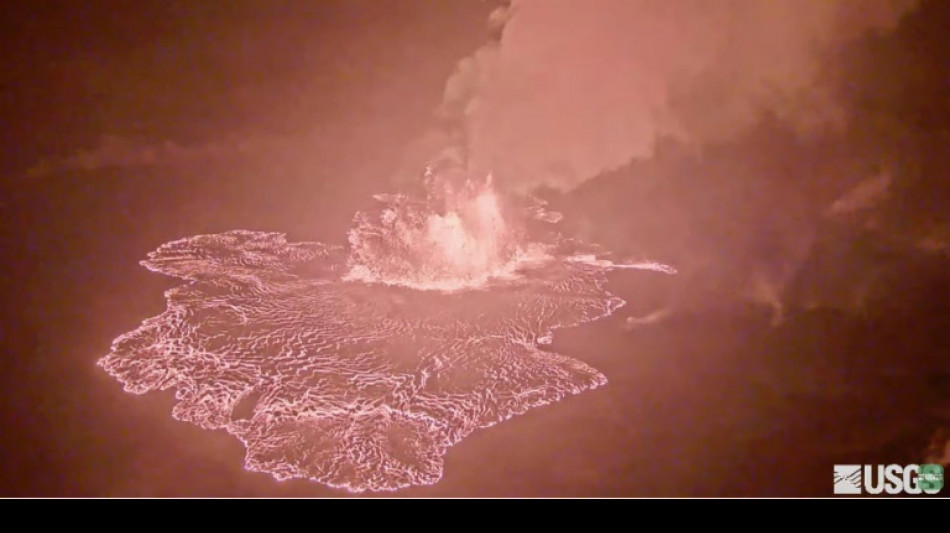
Hawaii volcano erupts again / Photo: - - US Geological Survey/AFP
 Brussels Education Unions Schedule Major November Protest Over Funding and Reforms

 Making Your Home Safer for Aging Parents: Accessibility Renovations That Add Value

 iPS Cell Research Accelerates Drug Discovery for ALS and Spinal Cord Injury

 Rene Eyre Revisits Autobiographical Performance 'Say A Little Prayer' in London

 UAE's HCT Holds Record Graduation and Announces Major Training Expansion

 NASA Awards $10B Lunar Contract Framework to SpaceX, Blue Origin

 Katy Perry Tells Fans Ex-Husband Russell Brand 'Should Be in Jail' During UK Concert

One of the world's most active volcanoes has erupted again, with lava spewing from Kilauea in Hawaii on Wednesday.
Footage showed fissures have opened up at the base of a crater on the volcano, which regularly springs to life, with vulcanologists calling the eruption "dynamic."
Scientists at the United States Geological Survey said they began detecting activity early on Wednesday morning, all well within the confines of the Hawai'i Volcanoes National Park, and away from population centers.
"High levels of volcanic gas are the primary hazard of concern, as this hazard can have far-reaching effects down-wind," the USGS said.
"As (sulphur dioxide) is released from the summit, it will react in the atmosphere to create the visible haze known as vog (volcanic smog) that has been observed downwind of Kilauea. "
This vog can create breathing difficulties for people and animals, and can also affect crops, the agency said.
The eruption could also produce a phenomenon called "Pele's hair" -- tiny slivers of volcanic glass that can be irritating to exposed skin, and can cause eye problems. Pele is the Hawaiian goddess of fire and volcanoes.
The eruption comes months after Kilauea's bigger neighbor Mauna Loa treated volcano watchers to a spectacular display.
Mauna Loa, the world's biggest volcano, put on a weeks-long show at the end of last year as it erupted for the first time in four decades, with lava fountains 60 meters high that sent rivers of molten rock down the flanks.
Kilauea is much smaller than Mauna Loa, but is far more active, and regularly wows helicopter-riding tourists who come to see its red-hot shows on Hawaii's Big Island.
Kilauea is one of six active volcanoes on the Hawaiian islands.
It erupted almost continuously between 1983 and 2019.
P.M.Smith--AMWN
