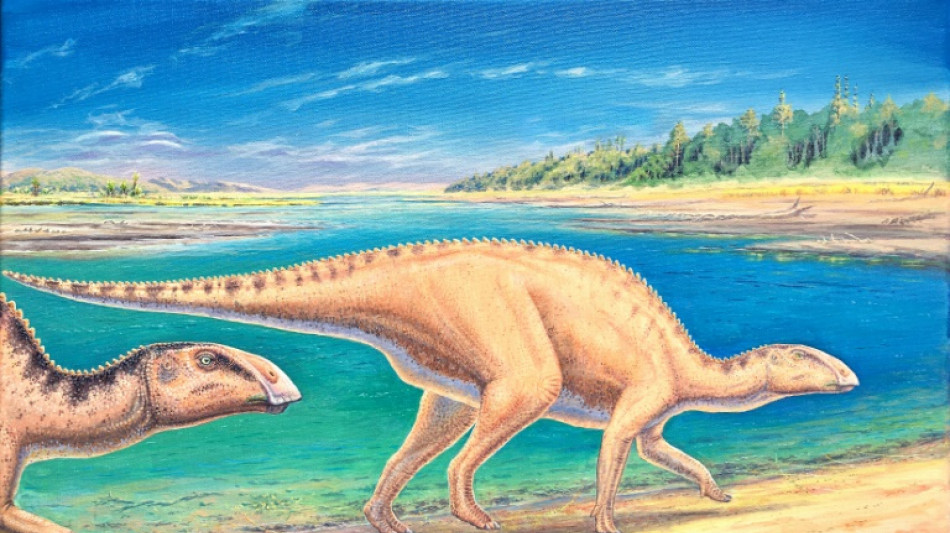
Remains of new species of duck-billed dinosaur found in Chile / Photo: Handout - Universidad de Chile/AFP
 Brussels Education Unions Schedule Major November Protest Over Funding and Reforms

 Making Your Home Safer for Aging Parents: Accessibility Renovations That Add Value

 iPS Cell Research Accelerates Drug Discovery for ALS and Spinal Cord Injury

 Rene Eyre Revisits Autobiographical Performance 'Say A Little Prayer' in London

 UAE's HCT Holds Record Graduation and Announces Major Training Expansion

 NASA Awards $10B Lunar Contract Framework to SpaceX, Blue Origin

 Katy Perry Tells Fans Ex-Husband Russell Brand 'Should Be in Jail' During UK Concert

Remains of a species of herbivorous dinosaur previously unknown in the southern hemisphere have been discovered in Chile, challenging long-held beliefs about the range of duck-billed dinosaurs, scientists said Friday.
Measuring up to four meters (13 feet) in length and weighing a ton, Gonkoken nanoi lived 72 million years ago in the extreme south of what is now Chilean Patagonia.
"These were slender-looking dinosaurs, which could easily adopt a bipedal and quadrupedal posture to reach the vegetation at height and at ground level," said Alexander Vargas, director of the paleontological network of the University of Chile and one of the authors of the study published by the journal Science Advances and presented in Santiago.
The discovery demonstrated that Chilean Patagonia served as a refuge for very ancient species of hadrosaurs, a type of duck-billed dinosaur common in North America, Asia and Europe during the Cretaceous period, from 145 to 66 million years ago.
Their presence in the remote southern lands surprised scientists, who will have to "understand how their ancestors got there," Vargas said.
Gonkoken nanoi, the fifth species of dinosaur discovered in Chile, was actually found in 2013, kicking off a decade-long investigation.
The name Gonkoken comes from the Tehuelche language, the first inhabitants of the region, and means "similar to a wild duck or a swan."
L.Harper--AMWN
