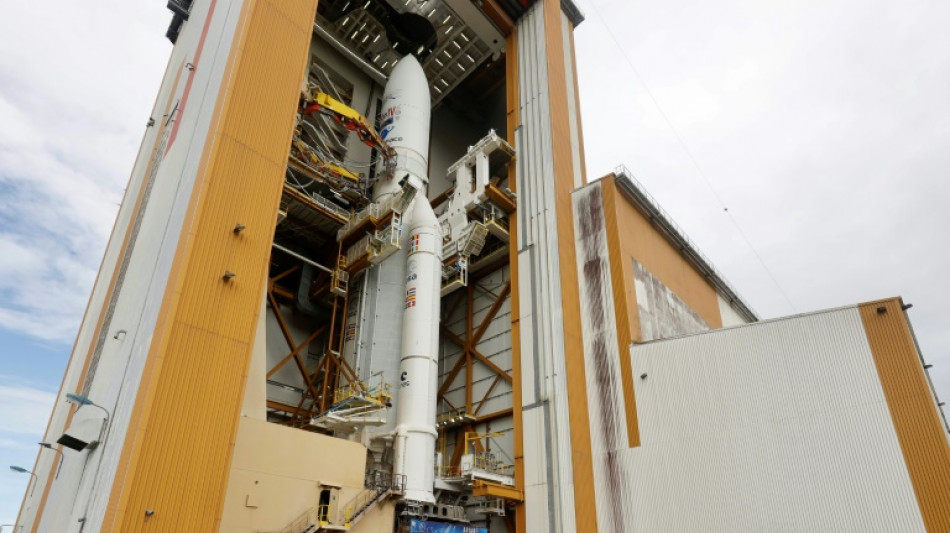
New date for Ariane 5 rocket's final launch after delay / Photo: Jody AMIET, Jody AMIET - AFP/File
 Brussels Education Unions Schedule Major November Protest Over Funding and Reforms

 Making Your Home Safer for Aging Parents: Accessibility Renovations That Add Value

 iPS Cell Research Accelerates Drug Discovery for ALS and Spinal Cord Injury

 Rene Eyre Revisits Autobiographical Performance 'Say A Little Prayer' in London

 UAE's HCT Holds Record Graduation and Announces Major Training Expansion

 NASA Awards $10B Lunar Contract Framework to SpaceX, Blue Origin

 Katy Perry Tells Fans Ex-Husband Russell Brand 'Should Be in Jail' During UK Concert

Europe's workhorse Ariane 5 rocket will blast off for the final time on July 4, its operator Arianespace said on Friday, after a previous launch was called off due to a technical problem.
After 27 years of launches, the 117th and last mission to take off on an Ariane 5 rocket was originally scheduled for June 16 from Europe's spaceport in Kourou, French Guiana, but was called off the day before.
It is now targeted for launch between 6:30 pm to 8:05 pm Kourou time (0930 to 1105 GMT) on July 4, Arianespace said in a statement.
The new date was set "following the replacement of the three pyrotechnical transmission lines identified as doubtful on the Ariane 5 launcher," the French firm said.
The pyrotechnical lines are involved in separating the boosters from the rocket.
Boosters help lift the rocket off the ground before being jettisoned.
The rocket and its payload of one French and one German communication satellite were stable and safe in Kourou, Arianespace added.
The postponement earlier this month marked the latest blow for European space efforts.
Europe has found itself with few ways to independently blast missions into space after Russia withdrew its Soyuz rockets due to sanctions over Moscow's war in Ukraine.
The first launch of Ariane 5's replacement, the next-generation Ariane 6, was originally scheduled for 2020.
But after a series of delays, it remains unclear if Ariane 6 will meet its deadline of getting off the ground for the first time by the end of this year.
European space efforts were dealt another blow in December last year, when the first commercial flight of the next-generation Vega C light launcher failed.
Lacking other options, the European Space Agency was forced to turn to its US rival SpaceX to launch its Euclid space telescope mission on July 1.
T.Ward--AMWN
