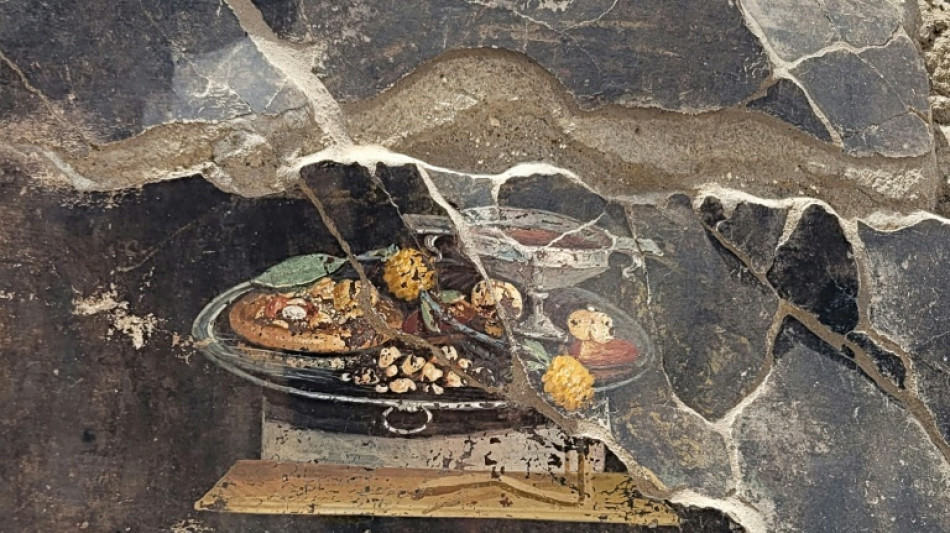
Pompeii fresco shows pizza precursor -- but hold the cheese / Photo: Handout - Parco Archeologico di Pompei press office/AFP
 Brussels Education Unions Schedule Major November Protest Over Funding and Reforms

 Making Your Home Safer for Aging Parents: Accessibility Renovations That Add Value

 iPS Cell Research Accelerates Drug Discovery for ALS and Spinal Cord Injury

 Rene Eyre Revisits Autobiographical Performance 'Say A Little Prayer' in London

 UAE's HCT Holds Record Graduation and Announces Major Training Expansion

 NASA Awards $10B Lunar Contract Framework to SpaceX, Blue Origin

 Katy Perry Tells Fans Ex-Husband Russell Brand 'Should Be in Jail' During UK Concert

Even the ancient Romans liked their pizza.
Archaeologists in Pompeii said Tuesday they had found depicted on an ancient fresco the precursor to the modern-day pizza -- but without the cheese and tomatoes.
The 2,000-year-old painting -- discovered in the middle of a half-crumbled wall during recent digs at the sprawling archaeological site -- depicts a silver platter holding a round flatbread, alongside fresh and dried fruits such as pomegranates and dates and a goblet filled with red wine.
"What was depicted on the wall of an ancient Pompeian house could be a distant ancestor of the modern dish," said experts at the archaeological park in a statement.
The devastating volcanic eruption of Mount Vesuvius in AD 79 buried the Roman city in thick ash, hiding from view its many treasures that archaeologists continue to slowly bring to light.
The fresco is believed to refer to the "hospitable gifts" offered to guests, following a Greek tradition dating to the 3rd to 1st centuries BC and described by imperial Roman-era writers including Virgil and Philostratus.
Pompeii's director, Gabriel Zuchtriegel, said the newly uncovered fresco shows the contrast between "a frugal and simple meal, which refers to a sphere between the bucolic and the sacred... and the luxury of silver trays and the refinement of artistic and literary representations.".
"How can we fail to think, in this regard, of pizza, also born as a 'poor' dish in southern Italy, which has now conquered the world and is also served in starred restaurants," Zuchtriegel added.
The new excavations revealed an atrium of a house that included an annex with a bakery, partially explored in the late 19th century.
"In the working areas near the oven, the skeletons of three victims have been found in the past weeks," said experts at the park.
Archaeologists estimate that 15 to 20 percent of Pompeii's population died in the eruption, mostly from thermal shock as a giant cloud of gases and ash covered the city.
H.E.Young--AMWN
