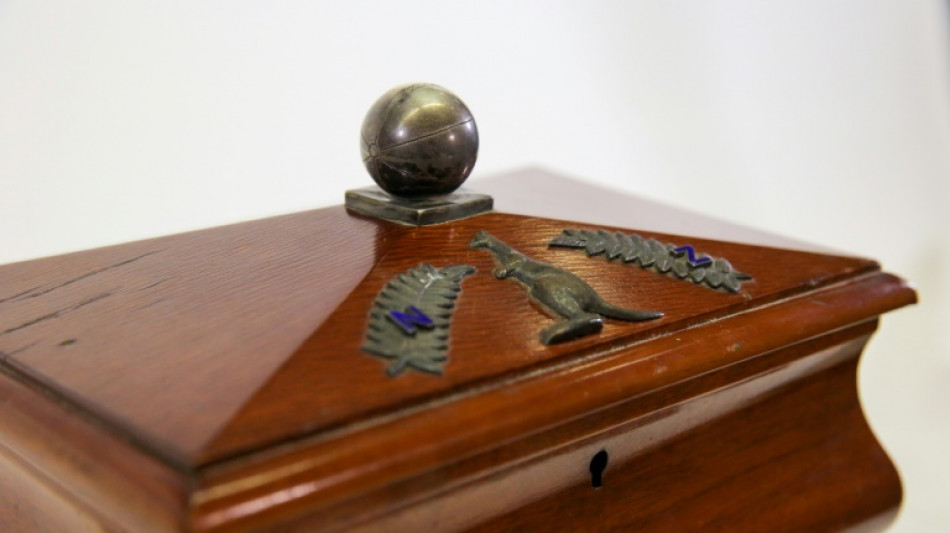
Australia, New Zealand revive 'football's Ashes' / Photo: Handout - FOOTBALL AUSTRALIA/AFP
 Brussels Education Unions Schedule Major November Protest Over Funding and Reforms

 Making Your Home Safer for Aging Parents: Accessibility Renovations That Add Value

 iPS Cell Research Accelerates Drug Discovery for ALS and Spinal Cord Injury

 Rene Eyre Revisits Autobiographical Performance 'Say A Little Prayer' in London

 UAE's HCT Holds Record Graduation and Announces Major Training Expansion

 NASA Awards $10B Lunar Contract Framework to SpaceX, Blue Origin

 Katy Perry Tells Fans Ex-Husband Russell Brand 'Should Be in Jail' During UK Concert

Australia and New Zealand will play this year for the "Soccer Ashes", sporting officials said Tuesday, a long-forgotten trophy recently rediscovered almost 70 years after it was lost.
The ornate wooden trophy houses a silver razor case carried during the treacherous Gallipoli landing of World War I, and has been dubbed the "greatest domestic treasure" in Australian football.
Missing since a fixture in 1954, the trophy was rediscovered during a clean-out of a suburban Sydney garage earlier this year.
Reminiscent of the celebrated Ashes cricket urn, it contains the ashes of cigars smoked by the Australian and New Zealand captains after the rivals met in 1923.
It will be put on the line for the first time in 69 years when the Australian Socceroos square off against the New Zealand All Whites at London's Wembley Stadium in October.
"This is a truly historic trophy and it will be brilliant to see it played for this year, and in future years, for the first time since the 1950s," New Zealand Football boss Andrew Pragnell said.
Football Australia chief executive James Johnson said the trophy was a "wonderful piece of sporting history" that highlighted the deep Anzac military connection between the countries.
"When discussing the significance of the trophy and the story behind it, returning it to its rightful place as the prize the Socceroos and All Whites play for was an easy decision."
The wooden trophy, or casket, was built from a mix of Australian maple wood and New Zealand honeysuckle, while the silver razor case was carried during the Gallipoli landing in 1915 by Private William Fisher -- a football administrator.
"This is quite possibly the greatest domestic treasure there is in the game," football historian Trevor Thompson said earlier this year.
"It's packed with so much imagery about the unity of the two countries, and the razor case that had been to Gallipoli referenced the recent experience of fighting shoulder to shoulder during the First World War."
A.Jones--AMWN
