NASA opens sample taken from the Moon 50 years on
 Morning Roundup: Cycling Classic Returns as Cruise Port Opens and Plant Library Grows

 Cowbells Mark Return of Philadelphia Cycling Classic for Carpenter Family

 Apprenticeship Awards Name Derbyshire and Nottinghamshire Finalists

 £1m Dental Foundation Launches Mobile Care for Vulnerable People

 Firebloom EP01 Delivers Fast Stone-Baked Pizza Indoors and Outdoors

 Family-Run Cafe Opens Second Nottingham City Centre Location

 Aldi Sets Reduced Hours for August Bank Holiday

 UK Moves 2026 Boxing Day Bank Holiday to Monday

 HMS Belfast Exhibition Revisits the Final Days Before D-Day
 Barnum Musical Returns With Circus Spectacle

 London Marathon Two-Day Plan Raises Questions Over 2027 Disruption

 Wormwood Scrubs Failings Found After Wife's Urgent Warning Went Unheeded

 London Kids' Open-Top Bus Tour Offers Family Alternative to the Tube
 London Couple Cuts Annual Spending by £1,600 Without Giving Up Travel

 Dubai Investor Explains Dh50,000 Monthly Draw and Long-Term Strategy

 Oil Traders Weigh Iran War Risk Against Diplomatic Signals

 US Cancels Taif Sami Mohammed's Visa and Adds Her to Watchlist

 Tamil Nadu Assembly Clash Continues Over 10.5% Vanniyar Reservation
 Chennai Police Arrest Mother and Daughter Over ₹40 Lakh Chit Fund Case

 PSBB K.K. Nagar Pair Wins Madras Quiz

 Chennai Hospital Opens Upgraded Holistic Wellness Facility
 Okinawan Festival Returns With Revised Convention Center Format

 Hawaiʻi Supreme Court Ruling Removes Waters From Council Contest

 Consolidated Theatres Launches Hawaiʻi-Made Film Series in September
 Iceland votes on whether to resume EU membership talks
The Apollo missions to the Moon brought a total of 2,196 rock samples to Earth. But NASA has only just started opening one of the last ones, collected 50 years ago.
For all that time, some tubes were kept sealed so that they could be studied years later, with the help of the latest technical breakthroughs.
NASA knew "science and technology would evolve and allow scientists to study the material in new ways to address new questions in the future," Lori Glaze, director of the Planetary Science Division at NASA Headquarters, said in a statement.
Dubbed 73001, the sample in question was collected by astronauts Eugene Cernan and Harrison Schmitt in December 1972, during the Apollo 17 mission -- the last of the program.
The tube, 35 cm long and 4 cm (13.8 inches by 1.6 inches) wide, had been hammered into the ground of the Moon's Taurus-Littrow valley to collect the rocks.
Of the only two samples to have been vacuum sealed on the Moon, this is the first to be opened.
It could as such contain gases or volatile substances (water, carbon dioxide, etc.)
And the aim is to extract these gases, which are probably only present in very small quantities, to be able to analyze them using spectrometry techniques that have become extremely precise in recent years.
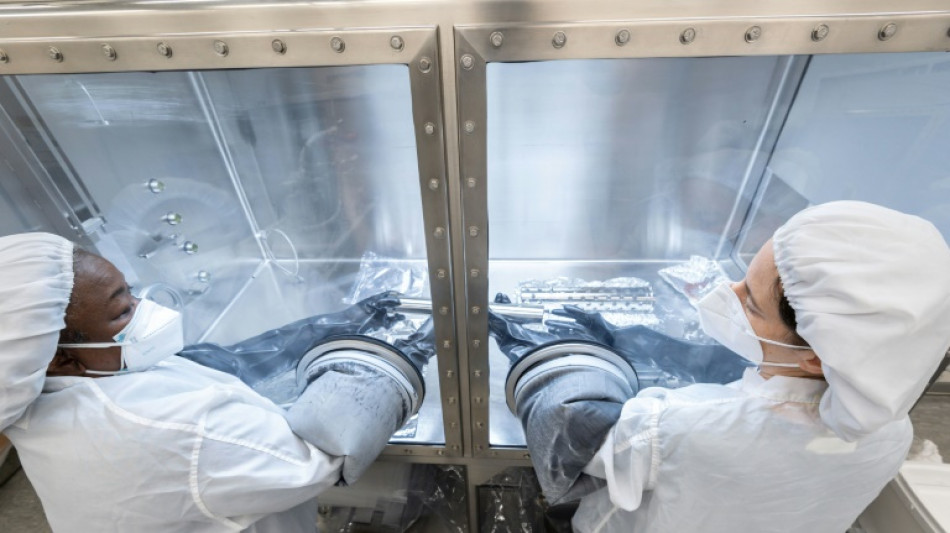
In early February, the outer protective tube was first removed.
It was not itself revealed to contain any lunar gas, indicating that the sample it contained remained sealed.
Then on February 23, scientists began a weeks-long process aimed at piercing the main tube and harvesting the gas contained inside.
In the spring, the rock will then be carefully extracted and broken up so that it can be studied by different scientific teams.
The extraction site of this sample is particularly interesting because it is the site of a landslide.
"Now we don't have rain on the Moon," said Juliane Gross, deputy Apollo curator. "And so we don't quite understand how landslides happen on the Moon."
Gross said researchers hope to study the sample to understand what causes landslides.
After 73001, there will be only three lunar samples still sealed. When will they in turn be opened?
"I doubt we'll wait another 50 years," said senior curator Ryan Zeigler.
"Particularly once they get Artemis samples back, it might be nice to do a direct comparison in real time between whatever's coming back from Artemis, and with one of these remaining unopened core, sealed cores," he said.
Artemis is NASA's next moon mission; the agency wants to send humans back to the Moon in 2025.
Large amounts of gas should then be collected, and the experiment currently being conducted helps to better prepare for it.
J.Oliveira--AMWN