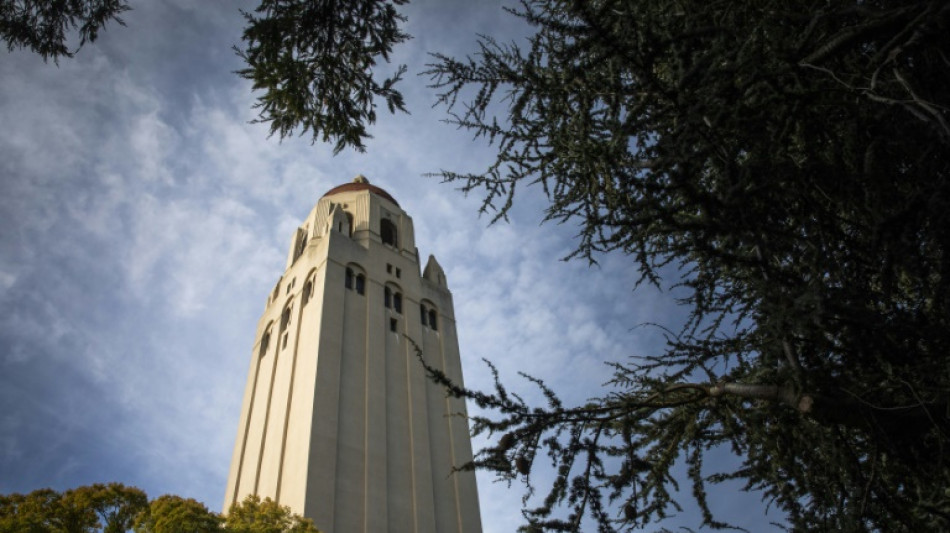
Stanford president to resign after research questioned / Photo: Philip Pacheco - GETTY IMAGES/AFP
 Brussels Education Unions Schedule Major November Protest Over Funding and Reforms

 Making Your Home Safer for Aging Parents: Accessibility Renovations That Add Value

 iPS Cell Research Accelerates Drug Discovery for ALS and Spinal Cord Injury

 Rene Eyre Revisits Autobiographical Performance 'Say A Little Prayer' in London

 UAE's HCT Holds Record Graduation and Announces Major Training Expansion

 NASA Awards $10B Lunar Contract Framework to SpaceX, Blue Origin

 Katy Perry Tells Fans Ex-Husband Russell Brand 'Should Be in Jail' During UK Concert

The president of Stanford University on Wednesday announced plans to resign after an investigation raised concerns about some of his scientific research.
Marc Tessier-Lavigne, a Canadian-born neuroscientist who has led the prestigious California-based school since 2016, said he would step down on August 31 but would remain on the faculty.
Tessier-Lavigne's decision came after the release of the findings of a panel of scientists who reviewed 12 publications that he had authored or co-authored.
The panel was convened after the school newspaper, The Stanford Daily, raised concerns about the research last year.
The experts found that Tessier-Lavigne "did not personally engage in research misconduct for any of the 12 papers about which allegations have been raised."
But several of the papers "exhibit manipulation of research data," they found.
In a letter announcing his resignation, the 63-year-old Tessier-Lavigne, whose research has focused on brain diseases such as Alzheimer's and Parkinson's, said the panel had "identified some areas where I should have done better."
"The Panel's review also identified instances of manipulation of research data by others in my lab," he said. "Although I was unaware of these issues, I want to be clear that I take responsibility for the work of my lab members.
"Although the report clearly refutes the allegations of fraud and misconduct that were made against me, for the good of the University, I have made the decision to step down as President effective August 31," he added.
Tessier-Lavigne said he would retract three papers published in scientific journals following the panel's review and provide corrections to two others.
Prior to becoming president of Stanford, Tessier-Lavigne was president of Rockefeller University in New York and chief scientific executive at biotechnology company
L.Davis--AMWN
