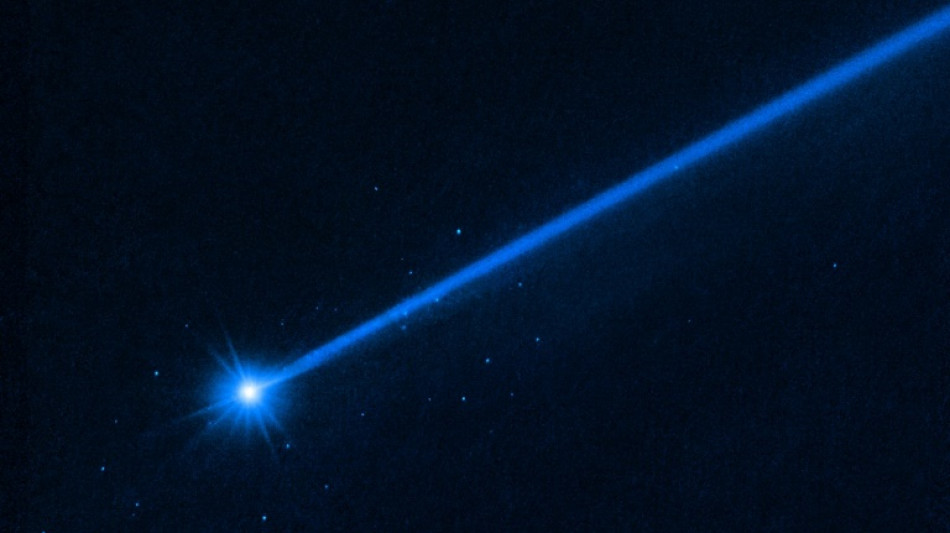
Asteroid-smashing NASA probe sent boulders into space / Photo: Handout - Space Telescope Science Institute/AFP
 Root says new balls behind batsmen's struggles in England

 Swollen rivers, washed-out roads hamper Nepal rescue effort

 In France's north, winegrowers bet on a warmer future

 Deadly virus stalks South Africa's sardines

 South Korea women's football body probes 'period' insult

 Transitional Fashion Essentials for Autumn: Key Pieces from M&S and Joe Browns

 China's Xi and Iran's Pezeshkian in Kyrgyzstan, Putin expected

 Rescuers hunt for missing after deadly N.Cyprus ferry accident

 Ethiopia's Abiy could consolidate power as 'executive president'
 Crude prices rise on US-Iran strikes, equities mixed after Warsh remarks

 South Korea court gives Unification Church leader 2 years prison

 US hosts G20 finance talks with growth, Iran pressure on agenda
 African players in Europe: Wissa flick seals Newcastle victory

 Venice film preview: Clooney, Oasis and Musk

 Poorly Djokovic crashes out of US Open first round

 Djokovic falls in US Open first round, earliest Grand Slam exit in 20 years

 Chinese guitar capital's stairway to export heaven

 Stocks drop as Warsh fans US rate hike bets, crude up on US-Iran strikes

 Injuries cloud tennis as US Open gets under way

 Iran retaliates after first US strikes in a month

 Itauma says 'I'll be back' after bruising heavyweight title loss

 Brilliant Palou clinches fourth straight IndyCar crown

 Nextech3D.ai Delivers 101% Revenue Growth in Fiscal Q1 2027 as AI-Powered Event Platform Accelerates

 ATHA Energy Provides Board of Directors Update
 Clough Global Opportunities Fund Section 19(a) Notice

When a NASA spacecraft successfully knocked an asteroid off course last year it sent dozens of boulders skittering into space, images from the Hubble telescope showed on Thursday.
NASA's fridge-sized DART probe smashed into the pyramid-sized, rugby ball-shaped asteroid Dimorphos roughly 11 million kilometres (6.8 million miles) from Earth in September last year.
The spacecraft knocked the asteroid significantly off course in the first-ever such test of Earth's planetary defences.
New images taken by the Hubble Space Telescope show that the collision also sent 37 boulders -- ranging from one metre (three feet) to seven metres (22 feet) across -- floating into the cosmos.
They represent around two percent of the boulders that were already scattered across the surface of the loosely-held-together asteroid, scientists estimated in a new study.
The finding suggests that possible future missions to divert life-threatening asteroids heading towards Earth could also spray off boulders in our direction.
But these particular rocks do not pose any threat to Earth -- indeed they have barely gone anywhere.
They are drifting away from Dimorphos at around a kilometre (half a mile) per hour -- roughly the speed a giant tortoise walks, Hubble said in a statement.
The boulders are moving so slowly that the European Space Agency's Hera mission -- which is due to arrive at the asteroid in late 2026 to inspect the damage -- will even be able to take a look at them.
"The boulder cloud will still be dispersing when Hera arrives," said David Jewitt, a planetary scientist at the University of California at Los Angeles and lead author of the new study.
"It's like a very slowly expanding swarm of bees," he said.
The "spectacular observation" by Hubble "tells us for the first time what happens when you hit an asteroid and see material coming out," he added.
"The boulders are some of the faintest things ever imaged inside our solar system."
The dispersal of the boulders indicates that DART left a crater roughly 50 metres (160 feet) wide on Dimorphos, according to Jewitt. The whole asteroid is 170 metres across.
The scientists plan to continue following the boulders to work out their trajectory and determine how exactly they launched off the surface.
The study was published in the Astrophysical Journal Letters.
S.F.Warren--AMWN