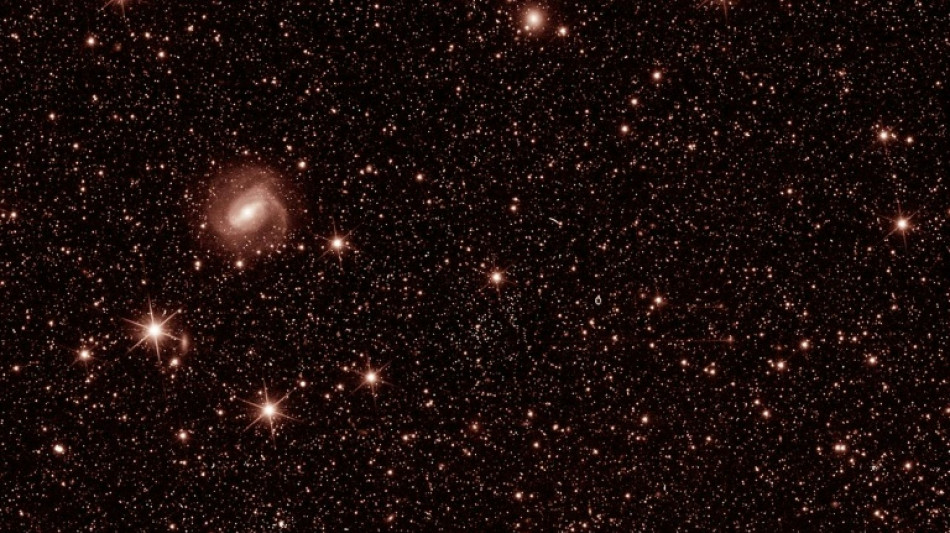
First test images from Euclid space telescope unveiled / Photo: - - ESA/Euclid/Euclid Consortium/NASA/AFP
 Root says new balls behind batsmen's struggles in England

 Swollen rivers, washed-out roads hamper Nepal rescue effort

 In France's north, winegrowers bet on a warmer future
 Deadly virus stalks South Africa's sardines

 South Korea women's football body probes 'period' insult

 Transitional Fashion Essentials for Autumn: Key Pieces from M&S and Joe Browns
 China's Xi and Iran's Pezeshkian in Kyrgyzstan, Putin expected

 Rescuers hunt for missing after deadly N.Cyprus ferry accident

 Ethiopia's Abiy could consolidate power as 'executive president'

 Crude prices rise on US-Iran strikes, equities mixed after Warsh remarks

 South Korea court gives Unification Church leader 2 years prison

 US hosts G20 finance talks with growth, Iran pressure on agenda

 African players in Europe: Wissa flick seals Newcastle victory

 Venice film preview: Clooney, Oasis and Musk

 Poorly Djokovic crashes out of US Open first round

 Djokovic falls in US Open first round, earliest Grand Slam exit in 20 years

 Chinese guitar capital's stairway to export heaven

 Stocks drop as Warsh fans US rate hike bets, crude up on US-Iran strikes

 Injuries cloud tennis as US Open gets under way
 Iran retaliates after first US strikes in a month

 Itauma says 'I'll be back' after bruising heavyweight title loss

 Brilliant Palou clinches fourth straight IndyCar crown

 Nextech3D.ai Delivers 101% Revenue Growth in Fiscal Q1 2027 as AI-Powered Event Platform Accelerates

 ATHA Energy Provides Board of Directors Update
 Clough Global Opportunities Fund Section 19(a) Notice

The Euclid space telescope, launched July 1 on a mission to shed more light on elusive dark matter and dark energy, has reached its destination orbit and on Monday its European operators revealed its first test images.
The star-filled snapshots were taken during the space telescope's commissioning -- a phase during which its powerful instruments are finely calibrated -- and therefore not representative of its full potential.
But the European Space Agency (ESA) says the tests already show it will be capable of fulfilling its massive mission.
"After more than 11 years of designing and developing Euclid, it's exhilarating and enormously emotional to see these first images," Euclid project manager Giuseppe Racca in a statement.
After blasting off from Florida, the satellite has traveled about one million miles (1.5 million kilometers) away from Earth to its observational orbit.
From there, Euclid will chart the largest-ever map of the universe, encompassing up to two billion galaxies across more than a third of the sky.
By capturing light that has taken 10 billion years to reach Earth's vicinity, the map will also offer a new view of the 13.8-billion-year-old universe's history.
Its visible light camera will let it measure the shape of galaxies, while its near-infrared spectrometer and photometer -- developed with the help of NASA -- will allow it to measure how far away they are.
But when the instruments were switched on, researchers were spooked by "an unexpected pattern of light contaminating the images," the ESA said.
An investigation led researchers to believe that "some sunlight was creeping into the spacecraft, probably through a tiny gap," but that it was only detected when Euclid was oriented in certain ways.
"By avoiding certain angles," ESA said, Euclid's imaging device "will be able to fulfil its mission."
Scientists hope to use information gathered to address what Racca previously called a "cosmic embarrassment": that 95 percent of the universe remains unknown to humanity.
Around 70 percent is thought to be made of dark energy, the name given to the unknown force that is causing the universe to expand at an accelerated rate.
And 25 percent is believed to be dark matter, thought to bind the universe together and make up around 80 percent of its mass.
The telescope's scientific operations are due to begin in October.
A.Malone--AMWN