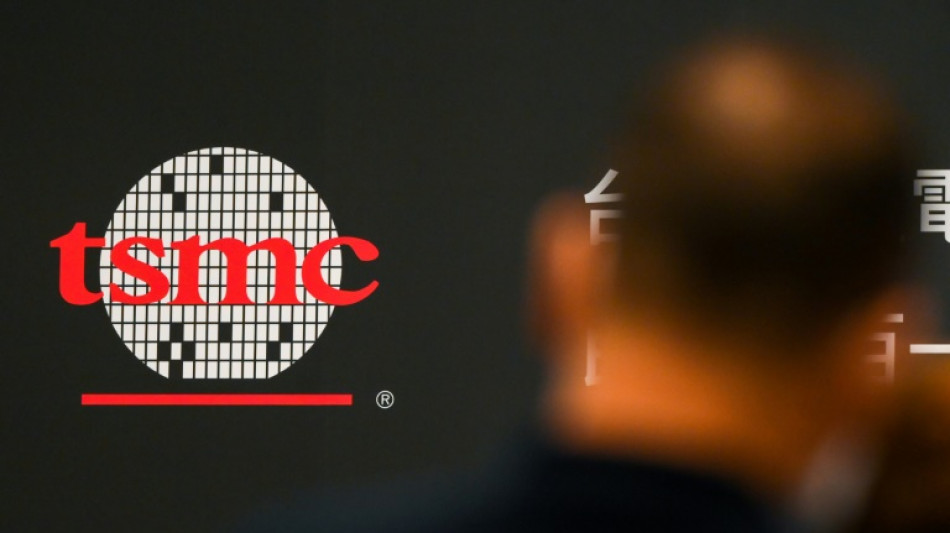
Germany gets Taiwan chip giant TSMC's first European plant / Photo: Sam Yeh - AFP/File
 Root says new balls behind batsmen's struggles in England

 Swollen rivers, washed-out roads hamper Nepal rescue effort

 In France's north, winegrowers bet on a warmer future

 Deadly virus stalks South Africa's sardines
 South Korea women's football body probes 'period' insult

 Transitional Fashion Essentials for Autumn: Key Pieces from M&S and Joe Browns

 China's Xi and Iran's Pezeshkian in Kyrgyzstan, Putin expected

 Rescuers hunt for missing after deadly N.Cyprus ferry accident

 Ethiopia's Abiy could consolidate power as 'executive president'
 Crude prices rise on US-Iran strikes, equities mixed after Warsh remarks

 South Korea court gives Unification Church leader 2 years prison
 US hosts G20 finance talks with growth, Iran pressure on agenda

 African players in Europe: Wissa flick seals Newcastle victory

 Venice film preview: Clooney, Oasis and Musk

 Poorly Djokovic crashes out of US Open first round

 Djokovic falls in US Open first round, earliest Grand Slam exit in 20 years

 Chinese guitar capital's stairway to export heaven

 Stocks drop as Warsh fans US rate hike bets, crude up on US-Iran strikes

 Injuries cloud tennis as US Open gets under way

 Iran retaliates after first US strikes in a month
 Itauma says 'I'll be back' after bruising heavyweight title loss
 Brilliant Palou clinches fourth straight IndyCar crown

 Nextech3D.ai Delivers 101% Revenue Growth in Fiscal Q1 2027 as AI-Powered Event Platform Accelerates

 ATHA Energy Provides Board of Directors Update
 Clough Global Opportunities Fund Section 19(a) Notice

Taiwanese chip giant TSMC agreed Tuesday to plough $3.8 billion (3.5 billion euros) into a new semiconductor factory in Germany, lending a major boost to Europe's efforts to bring production onto the continent.
Total investments in the factory, TSMC's first in Europe, are expected to exceed 10 billion euros, with "strong support from the European Union and German government", along with TSMC's partners in the project.
Taiwan Semiconductor Manufacturing Company will set up a joint venture with German groups Bosch and Infineon and Dutch firm NXP to build the plant, the companies said, with construction to begin in the second half of 2024.
TSMC is a key player in the sector, controlling more than half the world's output of microchips.
The facility in Germany is expected to begin production by the end of 2027, with monthly capacity to reach 40,000 300mm (12-inch) wafers. It will also create about 2,000 direct jobs, the companies said.
Hailing the news, Chancellor Olaf Scholz's economic adviser Joerg Kukies wrote on X that "this is another major step to implement our strategy to make Germany a globally leading location for the global semiconductor industry".
Stung by the energy crisis unleashed by Russia's war in Ukraine, Germany and its allies have been racing to slash dependencies on countries such as China and ramp up domestic production of sensitive components such as semiconductor chips.
The ambition set by the EU under its "Chips Act" is to increase Europe's slice of global semiconductor production to 20 percent by 2030.
Such chips are necessary to power everything from computers to smartphones to missiles in an increasingly tech-dependent world.
The EU's industry commissioner Thierry Breton hailed the planned new plant as the Chips Act "in motion -- bringing stronger security of supply for Europe, including for EU's automotive industry".
- Huge challenges -
Tension between China and Taiwan, a self-ruled democracy that Beijing claims as its territory, has prompted the West to cast a wary eye on its reliance on TSMC.
The new German factory will be based in the eastern city of Dresden in a region known as Silicon Saxony for its high-tech manufacturing base.
"Europe is a highly promising place for semiconductor innovation, particularly in the automotive and industrial fields, and we look forward to bringing those innovations to life on our advanced silicon technology with the talent in Europe," TSMC's chief executive CC Wei said in a statement.
Michael Kretschmer -- leader of Saxony state, where the plant will be based -- said the project would have an impact across the region.
"It will generate billions in investment and many jobs -- both directly and indirectly, including in skilled trades and for small- and medium-sized enterprises," he said.
But the German chip drive faces numerous challenges, ranging from high energy prices following Russia's invasion of Ukraine to shortages of skilled workers.
In June, Berlin and Intel signed a deal for the US chip behemoth to build manufacturing sites in the eastern city of Magdeburg after months of tense negotiations.
But the huge level of state support -- Berlin is providing 9.9 billion euros for the 33-billion-euro project -- has proved controversial, with some questioning whether the investment is worth it.
TSMC did not disclose the level of financial support from Germany but business weekly Handelsblatt reported on Monday that it would reach five billion euros.
Ch.Kahalev--AMWN