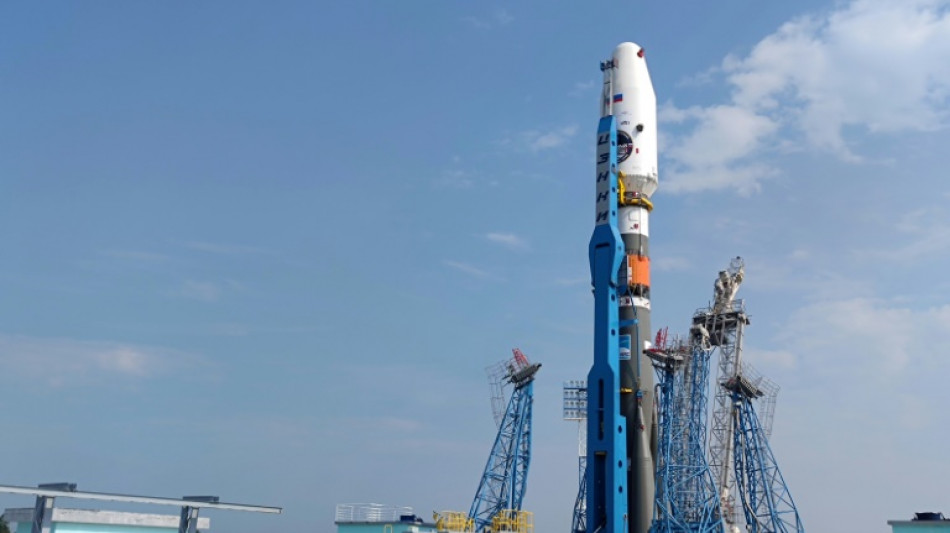
Russia's bruised space programme eyes comeback with lunar launch / Photo: Handout - Russian Space Agency Roscosmos/AFP
 This year's El Nino likely to become record-breaker: top expert

 Kenya, Tanzania shut down protest anniversaries

 Women pushed back to Afghanistan pin hopes on rare private sector jobs

 Bomb attacks wound 18 in Damascus as Macron visits

 Cuba slowly gets power back after third nationwide blackout in six months
 NATO summit showcases arms deals in push to win over Trump

 Seoul dives on tough day for Asia as Samsung fails to ease tech woes

 Democrats push key US Senate candidate to quit over sex assault claim

 As South Korean Buddhism woos Gen Z, how hip is too hip?

 'Disappointed' Pochettino says Balogun row no excuse for US World Cup exit
 Seoul dives on mixed day in Asia as Samsung fails to ease tech woes

 Belgium dump US out of World Cup after Balogun row

 How US is using cash and threats to dump migrants in Africa

 Democrat in key US Senate race denies sex assault claim

 Samsung expects 1,800% leap in quarterly operating profit on AI boom

 Sekur Private Data Appoints Special Operations Communications Chief Master Sergeant (Ret.) Rafael Beltran to Its OpsTech Special Advisory Board
 Most 'AI-Powered' Tools Ask Users to Trust the Black Box - NutraVeri Built One They Can Audit
 5E Advanced Materials Signs Third Offtake Heads of Agreement for Fort Cady

 Lavish Enterprises Unveils FleetPath's 50-State Compliance Engine: The Software That Keeps a Trucking Company Ready for a Government Audit Every Day, in All 50 States

 The Glimpse Group Sharpens Focus as a Pureplay Physical AI Company With Strategic Divestment

 NX3 Commercial Group Closes $27.5 Million Five-Property NNN Portfolio in Florida 1031 Exchange

 374Water Appoints Charles "Chuck" Weiser as Chief Financial Officer

 Absentia Labs' Digital Liver Model Becomes First AI Drug Development Tool Accepted Into FDA Qualification Program
 United States Antimony Corporation Announces Today "Wet Commissioning" of Its Radersburg Flotation Mill

 Polaris Announces Execution of Mixed Investment Agreement for the Three Mexico Projects

Russia is launching its first mission to the Moon's surface in nearly 50 years on Friday, hoping to reclaim prestige in space despite military and diplomatic setbacks at home over the Ukraine conflict.
The Luna-25 launch is Moscow's first lunar mission since 1976, when the Soviet Union boasted a pioneering space programme that has lost its shine because of funding problems and corruption.
The launch from the Vostochny Cosmodrome in the Far East is scheduled for 2:11 am Moscow time Friday (2311 GMT Thursday), Russia's space agency Roscosmos has said.
The four-legged lander weighs around 800 kilogrammes (1,750 pounds) and is set to reach the lunar orbit aroundfive days later.
It is estimated to touch near the Moon's south pole sometime around August 21, a source at Roscosmos told AFP.
Roscosmos said the module would operate for one year and "take and analyse soil samples and conduct long-term scientific research" on lunar surface material and the atmosphere.
Independent space analyst Vitaly Yegorov said the Luna-25 mission was an important test for Russia's space programme.
"So the biggest question will be: can it land?"
President Vladimir Putin wants to strengthen cooperation in space with China and scale back partnerships with the West, mirroring Russia's geopolitical priorities.
Moscow has announced it will end its work with the United States on the International Space Station (ISS) by 2028 and wants to participate in a rival project led by Beijing.
- 'Ambition of our ancestors' -
The European Space Agency (ESA) said it would not cooperate with Moscow on the Luna-25 launch -- as well as future 26 and 27 missions -- after Putin deployed troops in Ukraine last year.
Moscow vowed to go ahead with the mission and replace ESA equipment with Russian-made instruments.
Speaking at the Vostochny Cosmodrome last year, Putin said the Soviet Union had sent the first man to space in 1961 despite a "total" sanction regime.
He said Russia would develop its lunar programme despite Western economic penalties that reached unprecedented levels over the Ukraine conflict.
"We are guided by the ambition of our ancestors to move forward, despite any difficulties and despite external attempts to prevent us from moving," Putin said.
In June, the head of Roscosmos, Yuri Borisov, described the launch as high-risk.
"This mission involves landing at the south pole. No one in the world has ever done such things," he said during a meeting with Putin.
Most Moon landings have occurred near the lunar equator.
"These kinds of missions are always risky," he told the Russian leader, claiming estimates put the chance of success at around 70 percent.
The rocket boosters are predicted to fall in the vicinity of the village of Shakhtinsky in the far-eastern region of Khabarovsk, so the residents of the settlement will be evacuated on Friday morning, local authorities said.
The last Soviet Moon mission in 1976, the Luna 24, brought lunar soil samples back to Earth.
The Soviets launched the first satellite Sputnik, and sent into orbit the first animal, a dog named Laika; the first man, Yuri Gagarin; and the first woman, Valentina Tereshkova.
Russia's programme, which still relies on Soviet-designed technology, has struggled to innovate and the Kremlin has instead prioritised military spending.
It has also been plagued by corruption scandals and botched launches, and faced competition from the United States and growing Chinese ambitions.
T.Ward--AMWN