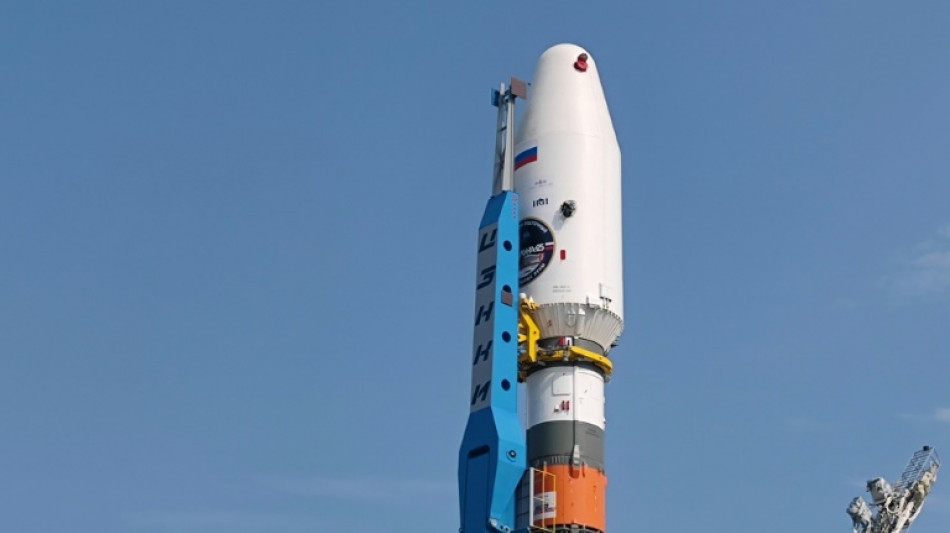
Russia launches first Moon mission in nearly 50 years / Photo: Handout - Russian Space Agency Roscosmos/AFP
 Brussels Education Unions Schedule Major November Protest Over Funding and Reforms

 Making Your Home Safer for Aging Parents: Accessibility Renovations That Add Value

 iPS Cell Research Accelerates Drug Discovery for ALS and Spinal Cord Injury

 Rene Eyre Revisits Autobiographical Performance 'Say A Little Prayer' in London

 UAE's HCT Holds Record Graduation and Announces Major Training Expansion

 NASA Awards $10B Lunar Contract Framework to SpaceX, Blue Origin

 Katy Perry Tells Fans Ex-Husband Russell Brand 'Should Be in Jail' During UK Concert

Russia launched its first probe to the Moon in almost 50 years on Friday, a mission designed to give fresh impetus to its space sector, which has been struggling for years and become isolated by the conflict in Ukraine.
The launch of the Luna-25 probe is Moscow's first lunar mission since 1976, when the USSR was a pioneer in the conquest of space.
The rocket with the Luna-25 probe lifted off at 02:10 am Moscow time (2310 GMT Thursday) from the Vostochny Cosmodrome, according to live images broadcast by the Russian space agency Roscosmos.
The spacecraft is due to reach lunar orbit in five days.
It will then spend between three and seven days choosing the right spot before landing in the lunar south pole area.
"For the first time in history, the lunar landing will take place on the lunar south pole. Until now, everyone has been landing in the equatorial zone," senior Roscosmos official Alexander Blokhin said in a recent interview.
Roscosmos expects the probe to land on the Moon around August 21, a source in the agency told AFP.
- 'The ambition of our ancestors' -
The spacecraft, which will remain on the Moon for a year, will be tasked with "taking (samples) and analysing the soil" as well as "conducting long-term scientific research", the Russian space agency said.
The launch is the first mission in Russia's new lunar programme, which gets underway at a time when Roscosmos is being deprived of its partnerships with the West amid the conflict with Ukraine.
According to Russian space expert Vitali Iegorov, the mission is the first time that post-Soviet Russia has attempted to place a device on a celestial body.
"The biggest question will be: can it land?" he told AFP, stressing that this mission is "of great importance" for Russia.
President Vladimir Putin has pledged to continue Russia's space programme despite sanctions, pointing to the USSR's sending of the first man into space in 1961, at a time of escalating East-West tensions.
"We are guided by the ambition of our ancestors to move forward, despite difficulties and external attempts to prevent us from doing so," Putin said at the Vostochny Cosmodrome last year.
The mission is important for the Russian space sector, which is suffering from funding problems, corruption scandals and increasing competition from the United States and China, as well as from private initiatives such as billionaire Elon Musk's SpaceX.
B.Finley--AMWN
