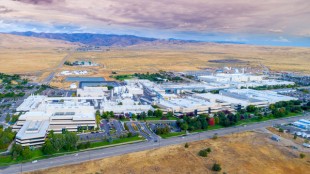
US to invest $1.2 bn on facilities to pull carbon from air / Photo: Patrick T. Fallon - AFP/File
 Root says new balls behind batsmen's struggles in England

 Swollen rivers, washed-out roads hamper Nepal rescue effort

 In France's north, winegrowers bet on a warmer future

 Deadly virus stalks South Africa's sardines
 South Korea women's football body probes 'period' insult

 Transitional Fashion Essentials for Autumn: Key Pieces from M&S and Joe Browns

 China's Xi and Iran's Pezeshkian in Kyrgyzstan, Putin expected

 Rescuers hunt for missing after deadly N.Cyprus ferry accident
 Ethiopia's Abiy could consolidate power as 'executive president'
 Crude prices rise on US-Iran strikes, equities mixed after Warsh remarks

 South Korea court gives Unification Church leader 2 years prison
 US hosts G20 finance talks with growth, Iran pressure on agenda
 African players in Europe: Wissa flick seals Newcastle victory

 Venice film preview: Clooney, Oasis and Musk

 Poorly Djokovic crashes out of US Open first round
 Djokovic falls in US Open first round, earliest Grand Slam exit in 20 years

 Chinese guitar capital's stairway to export heaven

 Stocks drop as Warsh fans US rate hike bets, crude up on US-Iran strikes
 Injuries cloud tennis as US Open gets under way

 Iran retaliates after first US strikes in a month

 Itauma says 'I'll be back' after bruising heavyweight title loss
 Brilliant Palou clinches fourth straight IndyCar crown

 Nextech3D.ai Delivers 101% Revenue Growth in Fiscal Q1 2027 as AI-Powered Event Platform Accelerates
 ATHA Energy Provides Board of Directors Update
 Clough Global Opportunities Fund Section 19(a) Notice

The US government said Friday it will spend up to $1.2 billion for two pioneering facilities to vacuum carbon out of the air, a historic gamble on a still developing technology to combat global warming that is criticized by some experts.
The two projects -- in Texas and Louisiana -- each aim to eliminate one million tons of carbon dioxide per year, equivalent in total to the annual emissions of 445,000 gas-powered cars.
It is "the world's largest investment in engineered carbon removal in history," the Energy Department said in a statement.
"Cutting back on our carbon emissions alone won't reverse the growing impacts of climate change," Energy Secretary Jennifer Granholm said in the statement. "We also need to remove the CO2 that we've already put in the atmosphere."
Direct Air Capture (DAC) techniques -- also known as Carbon Dioxide Removal (CDR) -- focus on that CO2 emitted into the air, which is helping to fuel climate change and extreme weather.
Each of the projects will remove 250 times more CO2 from the air than the largest carbon capture site currently in operation, the Energy Department said.
The UN's International Panel on Climate Change (IPCC) considers capturing carbon dioxide directly from the atmosphere one of the methods necessary to combat global warming.
But the sector is still marginal -- there are just 27 existing carbon capture sites commissioned worldwide, according to the International Energy Agency, though at least 130 projects are under development.
And some experts worry that use of the technology will be a pretext for continuing to emit greenhouse gases, rather than switching more quickly to clean energies.
Direct capture "requires a lot of electricity for extracting CO2 from the air and compressing it for pipes," Stanford University professor Mark Jacobson told AFP.
"Even in the best case, where the electricity is renewable, that renewable electricity is then prevented from replacing a fossil electricity source on the grid, such as coal or gas."
That means such technology is nothing more than a "gimmick," he said, adding: "It will only delay our solution to the climate problem."
- Storing CO2 underground -
US non-profit Battelle is the prime contractor on the Louisiana project, which will inject captured CO2 for storage deep underground.
It will partner with another American company, Heirloom, and the Swiss firm Climeworks, already a sector leader that operates a plant in Iceland with an annual capacity to capture 4,000 tons of CO2 from the air.
The Texas project will be led by the American company Occidental and other partners, including Carbon Engineering. It could be developed to eliminate up to 30 million tons of CO2 per year, according to a statement from Occidental.
"The rocks in the subsoil of Louisiana and Texas are sedimentary rocks, very different from Icelandic basalts, but they are perfectly viable for storing CO2," Helene Pilorge, an associate researcher at the University of Pennsylvania studying carbon capture, told AFP.
The two projects should create 4,800 jobs, according to the energy department. No start date is yet confirmed for either.
They will be funded by President Joe Biden's major infrastructure bill passed in 2021.
The Energy Department previously announced plans to invest in four projects to the tune of $3.5 billion.
Direct capture differs from carbon capture and storage (CCS) systems at source, such as factory chimneys, which prevent additional emissions from reaching the atmosphere.
In May, the Biden administration announced a plan to reduce CO2 emissions from gas-fired and coal-fired power plants, focusing in particular on this second technique.
O.Karlsson--AMWN