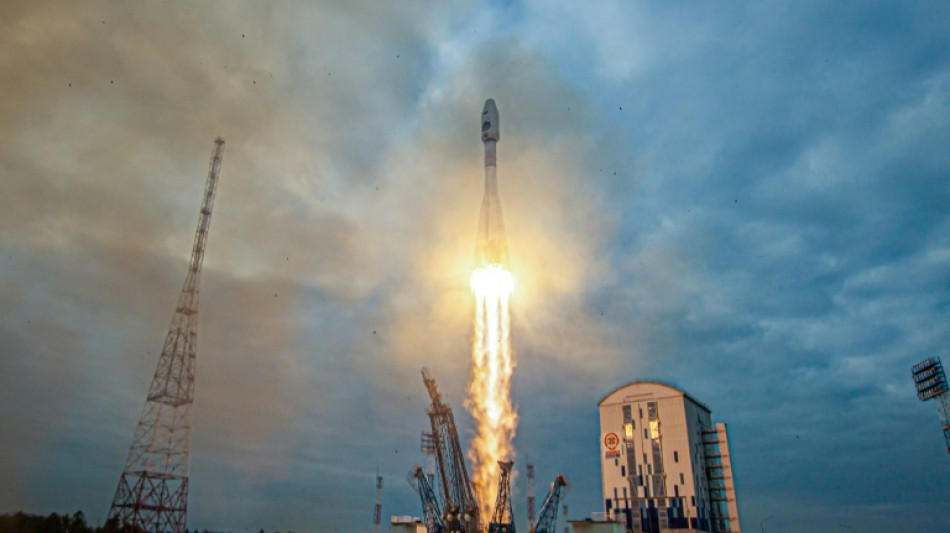
Russia's Luna-25 probe enters Moon orbit / Photo: Handout - Russian Space Agency Roscosmos/AFP/File
 Brussels Education Unions Schedule Major November Protest Over Funding and Reforms

 Making Your Home Safer for Aging Parents: Accessibility Renovations That Add Value

 iPS Cell Research Accelerates Drug Discovery for ALS and Spinal Cord Injury

 Rene Eyre Revisits Autobiographical Performance 'Say A Little Prayer' in London

 UAE's HCT Holds Record Graduation and Announces Major Training Expansion

 NASA Awards $10B Lunar Contract Framework to SpaceX, Blue Origin

 Katy Perry Tells Fans Ex-Husband Russell Brand 'Should Be in Jail' During UK Concert

Moscow's Luna-25 lander was successfully placed in the Moon's orbit Wednesday, the first such Russian mission in almost 50 years, space agency Roscosmos announced.
With the lunar launch, Moscow's first since 1976, Russia is seeking to restart and rebuild on the Soviet Union's pioneering space programme.
"For the first time in Russia's contemporary history, an automatic station was placed in lunar orbit at 12:03 pm Moscow time (0903 GMT)," a Roscosmos spokesperson told AFP.
The probe will orbit 100 kilometres (62 miles) above the Moon's surface, before a planned landing Monday north of the Boguslawsky crater on the lunar south pole.
"All the 'Luna-25' systems are operating normally, and communication with it is stable," the spokesperson said.
Cameras installed on the lander have already taken distant shots of the Earth and Moon from space.
The lander, weighing around 800 kilograms (1,764 pounds), was carried into space by a Soyuz rocket launched Friday from the Vostochny cosmodrome in Russia's Far East.
It is expected to stay on the Moon for a year, where it is tasked with collecting samples and analysing soil.
The mission comes as the future of Russia's long-running cooperation with the West in space looks in doubt, as Moscow presses ahead with its offensive in Ukraine.
Russia said it would go ahead with its own lunar plans, despite the European Space Agency announcing it would not cooperate with Moscow on future missions over its actions in Ukraine.
A.Malone--AMWN
