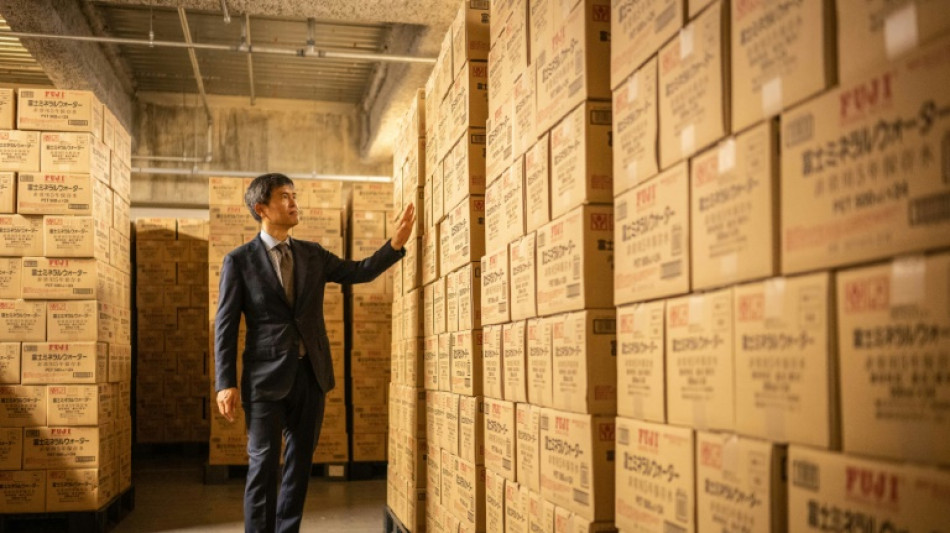
Japan's century of efforts to tame earthquakes / Photo: Yuichi YAMAZAKI - AFP
 Root says new balls behind batsmen's struggles in England

 Swollen rivers, washed-out roads hamper Nepal rescue effort

 In France's north, winegrowers bet on a warmer future

 Deadly virus stalks South Africa's sardines
 South Korea women's football body probes 'period' insult
 Transitional Fashion Essentials for Autumn: Key Pieces from M&S and Joe Browns

 China's Xi and Iran's Pezeshkian in Kyrgyzstan, Putin expected

 Rescuers hunt for missing after deadly N.Cyprus ferry accident
 Ethiopia's Abiy could consolidate power as 'executive president'

 Crude prices rise on US-Iran strikes, equities mixed after Warsh remarks
 South Korea court gives Unification Church leader 2 years prison
 US hosts G20 finance talks with growth, Iran pressure on agenda

 African players in Europe: Wissa flick seals Newcastle victory

 Venice film preview: Clooney, Oasis and Musk

 Poorly Djokovic crashes out of US Open first round
 Djokovic falls in US Open first round, earliest Grand Slam exit in 20 years

 Chinese guitar capital's stairway to export heaven

 Stocks drop as Warsh fans US rate hike bets, crude up on US-Iran strikes
 Injuries cloud tennis as US Open gets under way

 Iran retaliates after first US strikes in a month

 Itauma says 'I'll be back' after bruising heavyweight title loss

 Brilliant Palou clinches fourth straight IndyCar crown

 Nextech3D.ai Delivers 101% Revenue Growth in Fiscal Q1 2027 as AI-Powered Event Platform Accelerates

 ATHA Energy Provides Board of Directors Update
 Clough Global Opportunities Fund Section 19(a) Notice

Takashi Hosoda was in a Tokyo skyscraper when the 9.0 magnitude quake struck on March 11, 2011, but the trained architect was "not particularly worried" as modern Japanese buildings are designed to protect their occupants.
A century after Tokyo was destroyed in the Great Kanto Earthquake of 1923, the Japanese capital today bears no resemblance to the city levelled by that 7.9 tremor, which killed 105,000 people.
The low-rise, largely wooden city that was destroyed a second time by US firebombing during World War II has been replaced by a soaring megalopolis where reinforced concrete is king.
The September 1, 1923, disaster marked "the dawn of seismic design of structures in Japan", said Yoshiaki Nakano, an earthquake engineering expert from the National Research Institute for Earth Sciences and Disaster Resilience (NIED).
The following year Japan introduced its first building code for earthquake-resistant construction.
These standards have been constantly expanded since then, drawing on lessons from other major tremors in the archipelago, which accounts for around 10 percent of the world's earthquakes.
Japan's seismic building code is one of the most stringent in the world, Nakano told AFP.
"Basically, the Japanese building requires a relatively higher strength" than elsewhere, he said, stressing the importance of meticulous monitoring of compliance.
"The system to supervise and check the design and the construction on-site is a very key factor to ensure the quality of the structure, the performance of the building during earthquakes," he said.
The 2011 earthquake triggered a deadly tsunami along the northeast coast but in Tokyo the damage was limited: high-rise towers oscillated alarmingly for several minutes but did not topple.
- Skyscraper shock absorbers -
Early basic reinforced structures have been adapted with more sophisticated seismic safety measures found in modern towers.
Massive soft rubber cushions are installed under the foundations to isolate them from ground vibrations; shock absorbers are distributed throughout the floors; and some even have pendulums weighing several hundred tonnes installed at the top to counteract the movement of the building during a quake.
Built in 2014 and rising 247 metres (810 feet) above the city, the Toranomon Hills Mori Tower is fitted with such seismic anti-vibration systems, including 516 oil dampers, each comprising a thick cylinder 1.7 metres long.
"It stretches and shrinks repeatedly in case of an earthquake. It then starts getting warm, which means the energy of the quake transforms into heat and gets released," Kai Toyama, a structural engineering official at real estate giant Mori Building, told AFP.
"As a result, the tremor of the whole building can be controlled."
After the Kobe earthquake in 1995 left more than 6,000 dead, emphasis was also placed on strengthening earthquake resistance standards for new wooden houses and upgrading older buildings dating from before the last major overhaul of the building code in 1981.
The Great Kanto Earthquake of 1923 was also "a wake-up call to Japan", Nakano noted. "Not only the engineers but also for people."
Since 1960, Japan has marked September 1 as national Disaster Prevention Day.
Every year on that day, countless schoolchildren, employees and civil servants -- including the entire government -- carry out simulation exercises in preparation for a major earthquake.
In Japan, many people stock emergency supplies at home, as do businesses and local governments. As of April 1, 2023, local authorities in Tokyo have stockpiled 9.5 million instant meals (comprising rice, noodles and biscuits) in about 400 warehouses.
- Still vulnerable -
These precautionary measures were intensified after the 2011 earthquake, which caused huge traffic jams in Tokyo and the suspension of public transport, preventing millions of people from returning home, said Hosoda, now head of disaster management at Mori Building.
Despite all these efforts, some experts say Tokyo remains vulnerable to earthquakes, and even more to other natural disasters such as floods.
The eastern districts of the capital are built on unstable and flood-prone soils, and there are still concentrations of old wooden dwellings attached to each other.
Post-war rebuilding of Tokyo was "anarchic" and "prioritised economic development and not the construction of a resilient city", seismologist Masayuki Takemura lamented during a recent press conference.
He also pointed to an "excessive concentration of skyscrapers" and the construction of residential areas on artificial islands, increasing their risk of isolation in the event of a natural disaster.
And experts say there is a 70 percent chance of a major earthquake hitting Tokyo within the next 30 years.
D.Sawyer--AMWN