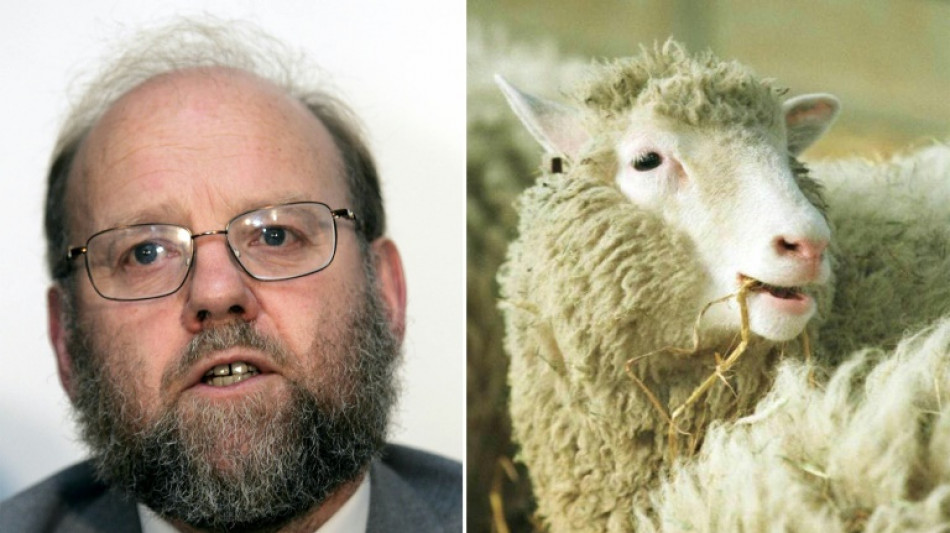
Scientist who led team that created Dolly the cloned sheep dies at 79 / Photo: © AFP/File
 Brussels Education Unions Schedule Major November Protest Over Funding and Reforms

 Making Your Home Safer for Aging Parents: Accessibility Renovations That Add Value

 iPS Cell Research Accelerates Drug Discovery for ALS and Spinal Cord Injury

 Rene Eyre Revisits Autobiographical Performance 'Say A Little Prayer' in London

 UAE's HCT Holds Record Graduation and Announces Major Training Expansion

 NASA Awards $10B Lunar Contract Framework to SpaceX, Blue Origin

 Katy Perry Tells Fans Ex-Husband Russell Brand 'Should Be in Jail' During UK Concert

The British scientist who led the team that created Dolly the sheep, a breakthrough in cloning, has died at the age of 79, his former university said on Monday.
Ian Wilmut, who revealed in 2018 he had been diagnosed with Parkinson's disease, helmed the team at the Roslin Institute at the University of Edinburgh in Scotland, which cloned Dolly in 1996.
Dolly was the first mammal to be cloned from an adult cell, and the breakthrough garnered global headlines and led to new advances in animal and medical research.
Peter Mathieson, the vice-chancellor of Edinburgh University, hailed Wilmut as "a titan of the scientific world" whose work cloning Dolly "transformed scientific thinking at the time".
"This breakthrough continues to fuel many of the advances that have been made in the field of regenerative medicine that we see today," he said in a statement.
Bruce Whitelaw, the current head of the Roslin Institute, said it was "sad news".
"Science has lost a household name," he added.
Wilmut retired from Edinburgh University of 2012.
But in 2018, he announced support for new research into Parkinson's, revealing he had diagnosed with the uncurable, progressive brain disorder, which can cause uncontrollable movements such as shaking.
"There was a sense of clarity, well at least now we know and we can start doing things about it," Wilmut told the BBC at the time.
"As well as obviously the disappointment that it will possibly shorten my life slightly, and more particularly it will alter the quality of life."
Parkinson's is the second most common neurodegenerative disease after Alzheimer's and affects more than 8.5 million people worldwide, according to the World Health Organization (WHO).
P.Martin--AMWN
