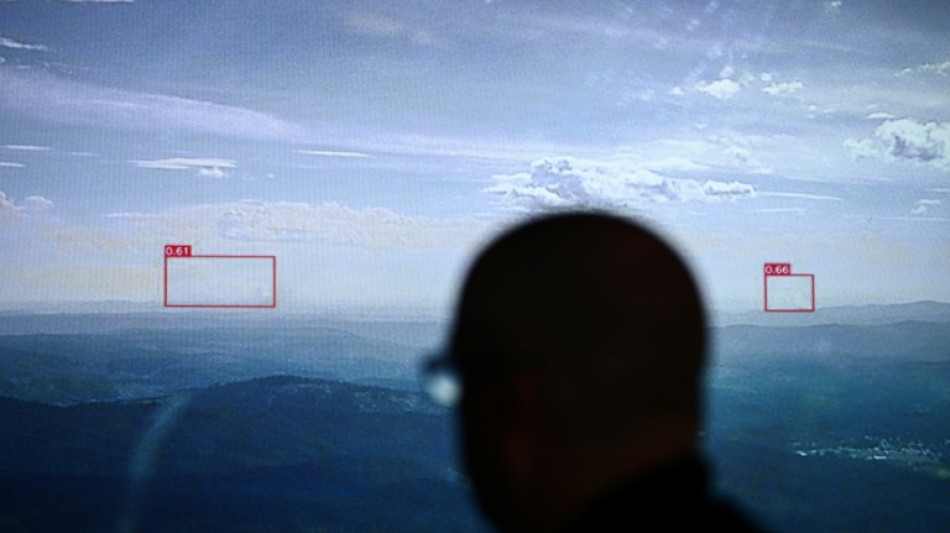
California firefighters use AI to battle wildfires / Photo: Patrick T. Fallon - AFP
 Liverpool sign Barcola from PSG for reported £124 million

 Putin, Xi, Iran's Pezeshkian in Kyrgyzstan for summit
 Fully Permitted Tanzanian Gold Project Clears Path to Construction as Financing, EPCM Fall in Place (LVGLF)

 EdWealth Announces MoneyBench Benchmark Comparing AI Money Answers From Ed, ChatGPT and Gemini

 Root says new balls behind batsmen's struggles in England
 Swollen rivers, washed-out roads hamper Nepal rescue effort

 In France's north, winegrowers bet on a warmer future

 Deadly virus stalks South Africa's sardines
 South Korea women's football body probes 'period' insult
 Transitional Fashion Essentials for Autumn: Key Pieces from M&S and Joe Browns

 China's Xi and Iran's Pezeshkian in Kyrgyzstan, Putin expected

 Rescuers hunt for missing after deadly N.Cyprus ferry accident
 Ethiopia's Abiy could consolidate power as 'executive president'
 Crude prices rise on US-Iran strikes, equities mixed after Warsh remarks
 South Korea court gives Unification Church leader 2 years prison
 US hosts G20 finance talks with growth, Iran pressure on agenda
 African players in Europe: Wissa flick seals Newcastle victory

 Venice film preview: Clooney, Oasis and Musk

 Poorly Djokovic crashes out of US Open first round
 Djokovic falls in US Open first round, earliest Grand Slam exit in 20 years

 Chinese guitar capital's stairway to export heaven

 Stocks drop as Warsh fans US rate hike bets, crude up on US-Iran strikes
 Injuries cloud tennis as US Open gets under way

 Iran retaliates after first US strikes in a month

 Itauma says 'I'll be back' after bruising heavyweight title loss
When a wildfire erupted in the middle of a recent California night, it could have been a disaster.
But thanks to a new monitoring system that uses artificial intelligence to scan for danger, firefighters were able to quell the blaze long before it got out of hand.
"It was less than a quarter acre," Captain Kris Yeary of Cal Fire told AFP.
"Had the AI not alerted us to it, it could have gotten much bigger."
Yeary, who is responsible for organizing firefighting over an area that includes Mount Laguna, around 40 miles (65 kilometers) east of San Diego, sprang into action around 3am on August 5 after a call from colleagues at a command center.
Computers watching live feeds from the Cleveland National Forest spotted what their algorithm had been taught to understand was a column of smoke.
Human operators were able to verify the machines were correct and alerted Yeary, whose firefighters quickly extinguished the flames.
"It could have been a devastating fire," he said.
- Artificial intelligence -
Artificial intelligence is a rapidly developing field of computing that seeks to mimic human abilities to "think."
Unlike a traditional computer, which can only produce answers based on the concrete information it has, AI can infer answers, using experience it has gained from similar problems it has seen before -- similar to a human being.
Over the last few years, its application has spread to include areas as diverse as weather forecasting, stock-picking, art and journalism.
That has brought with it worries from people who fear it will do them out of their jobs -- the writers' and actors' strike currently paralyzing Hollywood is in part about the use of AI in films and television.
But firefighters battling California's wildfires say they will take all the help they can get.
"AI is just another tool for us," said Yeary. "It's never going to replace firefighters."
- Promising results -
California experiences thousands of fires every year, which torch hundreds of thousands -- sometimes millions -- of acres (hectares).
Over the last decade, blazes have claimed more than 200 lives, and destroyed thousands of homes and businesses, wreaking billions of dollars of damage.
For several years firefighters have used a network of more than 1,000 cameras to monitor possible fire hotspots.
Since the end of June, the ALERTCalifornia system has had AI computers "watching" these feeds, and flagging to human operators when they see wisps of smoke that could be a fire -- with promising results.
"Our success metric is the fires you never hear about," says Neal Driscoll, who heads the project for the University of California San Diego.
"We beat 911 calls about 40 percent of the time. And it's going to get better."
The addition of AI has meant each firefighter watching the dozens of feeds they are responsible for now has a helping hand.
When the software believes it detects smoke, it displays a small red rectangle on the screen, and offers a percentage indicating its degree of certainty.
It is then up to the operator to confirm the seriousness of the alert -- and weed out any confusion.
Currently, the system can erroneously flag dust raised by tractors, insects in front of the camera or even a bit of fog.
"When a cloud will go over... it can cast a shadow on the ground and sometimes (the computer) can actually think that that's possibly smoke," says Suzann Leininger, an intelligence specialist at Cal Fire.
The feedback that experts like Leininger give -- no, that's just a bit of weather -- is helping the AI to get better at what it does.
But even in its current state, it's a boon.
"It's getting us time to react in a faster manner," says Leininger.
And when you're talking about fire, time can be everything.
- Climate change -
As California grapples with the effects of human-caused climate change, fires are becoming bigger and more destructive.
The state has experienced 18 of its 20 largest wildfires on record in the last two decades.
With terrifying blazes ripping through Europe, Canada and Hawaii this year, the devastating impact of the changing climate is becoming ever-more apparent worldwide.
"I think that as we see these devastations in other areas, like in Greece, and Maui, that systems like this that provide early confirmation will be a step in the right direction," says Driscoll of UC San Diego.
Faced with the scale of the threat, the scientist has chosen to grant public access to the data on his platform, so that other companies or academics can work on it.
"We need to leverage all of our assets and work together, because extreme climate is bigger than any one of us."
F.Pedersen--AMWN