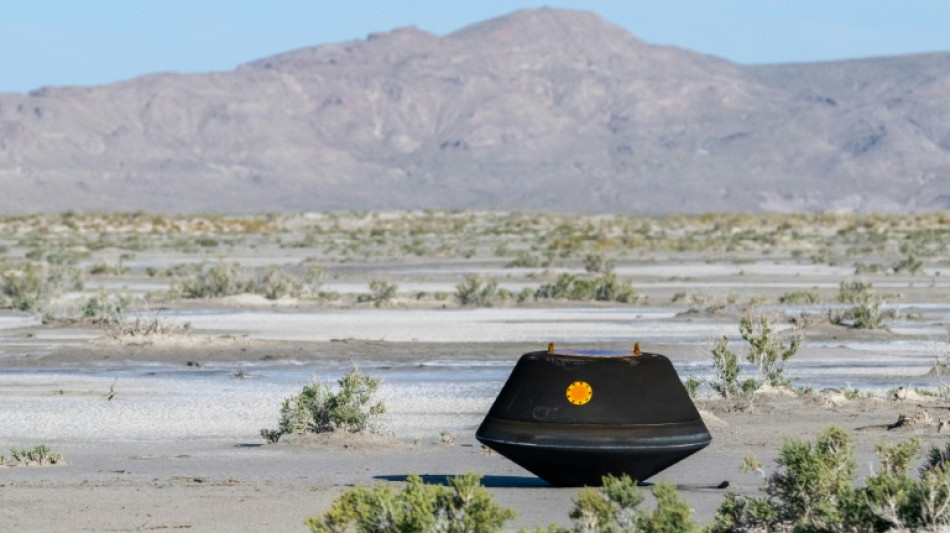
Likely asteroid debris found upon opening of returned NASA probe / Photo: Keegan BARBER - NASA/AFP
 India's top court drops criminal cases against protesters

 Philippine couple married in hip-deep floodwaters

 Villa sign Senegal winger Mbaye from PSG

 Former Peru minister last-minute contender for UN labour agency helm

 Messi legacy will 'live forever', says Beckham

 'Literally tasting the smoke': Malaysians suffer as haze worsens

 Kyiv's defences, 'hybrid' threat from Moscow headline EU talks

 Oil extends gains, stocks mostly down as Trump issues fresh Iran warning
 ThinkMarkets Expands Weekend Trading Offering, Launches Weekend League Competition

 Tibet activists accuse China of downplaying floods

 Afghanistan war victims left 'without justice', UN says

 Iran president offers US olive branch before Putin meeting

 China-Nepal flood toll tops 1,000 as tunnel rescue offers last hope

 Japan to relax overtime regulation under workaholic PM
 Thwarted Niger mutiny exposes junta's Russia dependence
 Illegal mining ravages S.Africa's economic hub

 Nepal's wall of missing offers last hope after Himalayan flood

 US to press G20 on light-touch AI regulation

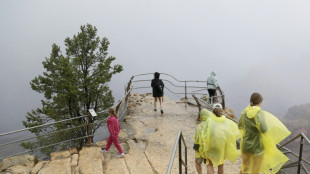 2 die in Grand Canyon flash flood, only 1 person unaccounted for

 US Army Secretary Driscoll submits resignation: White House
 Oil extends gains, stocks drop as Trump issues fresh Iran warning

 Tsitsipas says Kyrgios's positive cocaine test 'kind of expected'

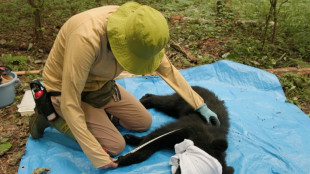 In Japan's mountains, a different way to manage bears

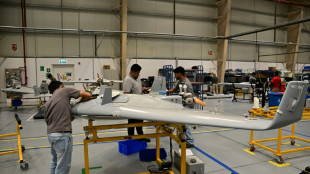 Middle East war a boon for UAE defence giant with global ambitions
 Former gang member found guilty of murdering Tupac Shakur

After a seven-year wait, NASA scientists on Tuesday finally pried open a space probe carrying the largest asteroid samples ever brought back to Earth, finding black debris.
Researchers "found black dust and debris on the avionics deck of the Osiris-Rex science canister when the initial lid was removed today," the US space agency said, though without specifying whether they definitely belonged to the asteroid.
Scientists are eagerly awaiting researching the bulk of the sample, which will require "intricate disassembly" of the probe.
Osiris-Rex launched in 2016, landing on the asteroid Bennu and collected roughly nine ounces (250 grams) of dust from its rocky surface.
Even that small amount, NASA has said, should "help us better understand the types of asteroids that could threaten Earth."
It ended its 3.86-billion-mile (6.21-billion-kilometer) journey after touching down in the desert in the western state of Utah on Sunday, following a high-stakes, fiery descent through Earth's atmosphere.
The residue on the avionics deck found Tuesday was likely a result of issues during the collection, which NASA said were eventually solved, allowing the secure transfer of the sample.
The lid was opened in an airtight chamber at the Johnson Space Center in Houston, Texas.
A news conference is scheduled October 11 in which the bulk of the sample will be revealed to the public.
The analysis of the asteroid, scientists believe, will help researchers better understand the formation of the solar system and how Earth became habitable.
Most of the sample will be conserved for study by future generations. Roughly one-fourth will be immediately used in experiments, and a small amount will be sent to mission partners Japan and Canada.
G.Stevens--AMWN