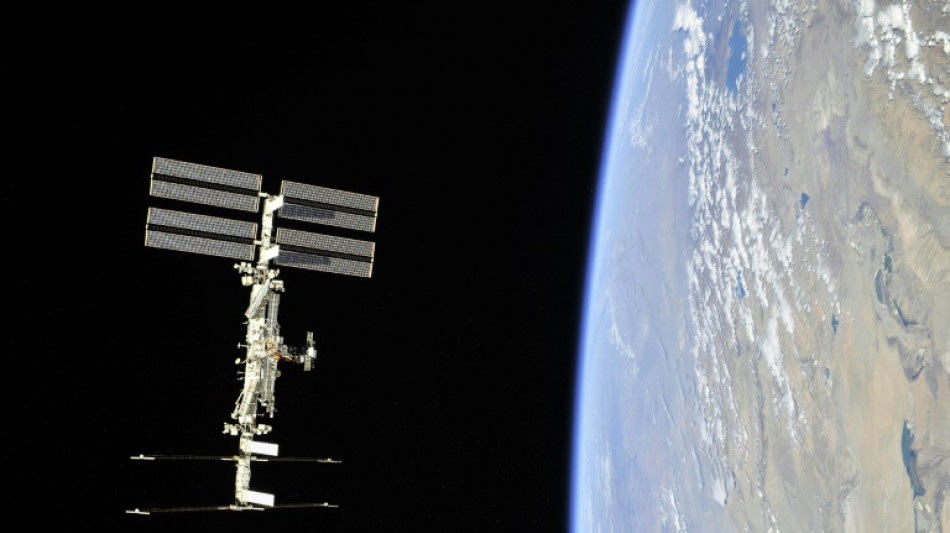
Russian ISS segment springs third leak in under a year / Photo: HO - NASA/AFP/File
 Brussels Education Unions Schedule Major November Protest Over Funding and Reforms

 Making Your Home Safer for Aging Parents: Accessibility Renovations That Add Value

 iPS Cell Research Accelerates Drug Discovery for ALS and Spinal Cord Injury

 Rene Eyre Revisits Autobiographical Performance 'Say A Little Prayer' in London

 UAE's HCT Holds Record Graduation and Announces Major Training Expansion

 NASA Awards $10B Lunar Contract Framework to SpaceX, Blue Origin

 Katy Perry Tells Fans Ex-Husband Russell Brand 'Should Be in Jail' During UK Concert

The Russian segment of the International Space Station (ISS) sprung its third coolant leak in under a year Monday, raising new questions about the reliability of the country's space program even as officials said crew members weren't in danger.
Flakes of frozen coolant spraying into space were seen in an official live feed of the orbital lab provided by NASA around 1:30 pm Eastern Time (1730 GMT), and confirmed in radio chatter between US mission control and astronauts.
"The Nauka module of the Russian segment of the ISS has suffered a coolant leak from the external (backup) radiator circuit, which was delivered to the station in 2012," Russian space agency Roscosmos said on Telegram, adding temperatures remained normal in the affected unit.
"Nothing is threatening the crew and the station," added the statement.
Nauka, which means "science" in Russian and is also known as the Multipurpose Laboratory Module-Upgrade (MLM), launched in 2021.
US mission control in Houston could be heard asking astronauts on the American side to investigate.
"Hi, we're seeing flakes outside, we need a crew to go to the cupola, we think windows five or six, and confirm any visual flakes," an official said to the astronauts.
"There's a leak coming from the radiator on MLM," Jasmin Moghbeli replied a little later.
NASA has yet to release an official statement.
- 'Something systematic' -
This is the third coolant leak to hit the Russian side of the ISS in less than a year. On December 15, 2022, dramatic NASA TV images showed white particles resembling snowflakes streaming out of the rear of a docked Soyuz MS-22 spacecraft for several hours.
Speculation about the cause centered on an unlucky strike by a tiny space rock, or micro meteorite.
That spaceship returned to Earth uncrewed, and then another uncrewed Soyuz was sent to replace it a few months later. Two Russians and an American crew member had to stay for a year-long mission as a result, returning home only last month.
A similar leak in mid-February also affected the Russian Progress MS-21 cargo ship, which had been docked to the ISS since October 2022.
The succession of leaks lowers the probability they were caused by meteorites.
Space analyst Jonathan McDowell told AFP: "You've got three coolant systems leaking -- there's a common thread there. One is whatever, two is a coincidence, three is something systematic," he said, speculating that a subcontractor company may be at fault.
"It really just emphasizes the degrading reliability of Russian space systems. When you add it to the context of their failed Moon probe in August, they're not looking great."
The Russian space sector, which has historically been the pride of the country, has been facing difficulties for years, between lack of funding, failures and corruption scandals.
The ISS constitutes one of the few areas of cooperation still ongoing between Moscow and Washington since the start of the Russian offensive in Ukraine and the international sanctions that followed.
Ch.Kahalev--AMWN
