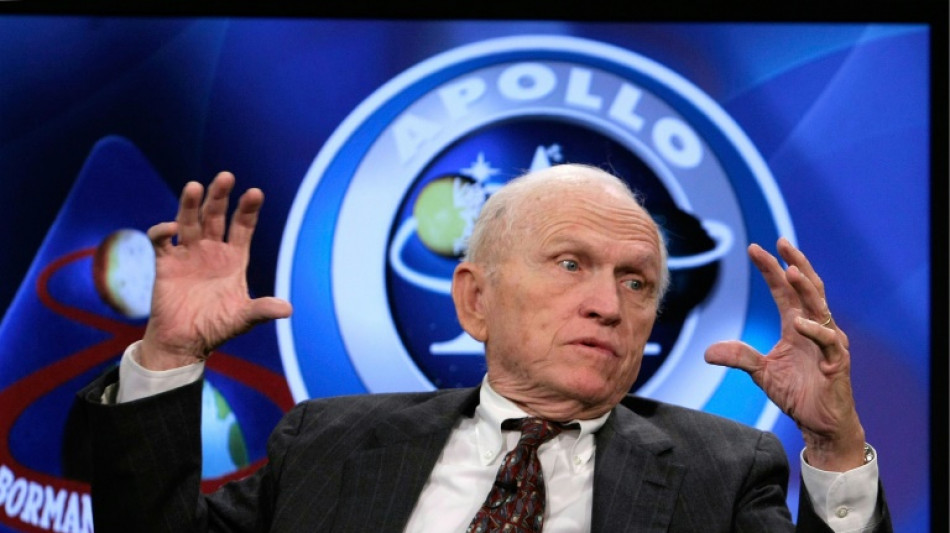
Astronaut who led humanity's first mission around the Moon dead at 95 / Photo: ALEX WONG - GETTY IMAGES NORTH AMERICA/AFP/File
 Brussels Education Unions Schedule Major November Protest Over Funding and Reforms

 Making Your Home Safer for Aging Parents: Accessibility Renovations That Add Value

 iPS Cell Research Accelerates Drug Discovery for ALS and Spinal Cord Injury

 Rene Eyre Revisits Autobiographical Performance 'Say A Little Prayer' in London

 UAE's HCT Holds Record Graduation and Announces Major Training Expansion

 NASA Awards $10B Lunar Contract Framework to SpaceX, Blue Origin

 Katy Perry Tells Fans Ex-Husband Russell Brand 'Should Be in Jail' During UK Concert

Frank Borman, the NASA astronaut who led the 1968 Apollo 8 mission, the first human spaceflight to reach the Moon, has died at the age of 95, the US space agency said Thursday.
He passed away on November 7 in Billings, Montana.
"Today we remember one of NASA's best," said the agency's administrator Bill Nelson, in a statement.
"His lifelong love for aviation and exploration was only surpassed by his love for his wife Susan."
Born on March 14, 1928 in Gary, Indiana, he began his career in the US Air Force where he flew as a fighter pilot, test pilot, and became an assistant professor of thermodynamics at West Point.
But he will be remembered as a pioneer of space exploration.
He set a then-record of 14 days in space during the 1965 Gemini 7 mission alongside Jim Lovell. The voyage featured the first space rendezvous with the Gemini 6 spacecraft.
Borman went on to command Apollo 8, where he became one of the first three humans, alongside crewmates Lovell and William Anders, to see and photograph the far side of the Moon.
Apollo 8 was also famous for producing "Earthrise" -- an iconic image of the Earth and part of the lunar surface, taken by Anders on December 4, 1968.
Following his career at NASA, he became the CEO of Eastern Airlines.
"Frank knew the power exploration held in uniting humanity when he said, 'Exploration is really the essence of the human spirit,'" said Nelson. "His service to NASA and our nation will undoubtedly fuel the Artemis Generation to reach new cosmic shores."
L.Harper--AMWN
