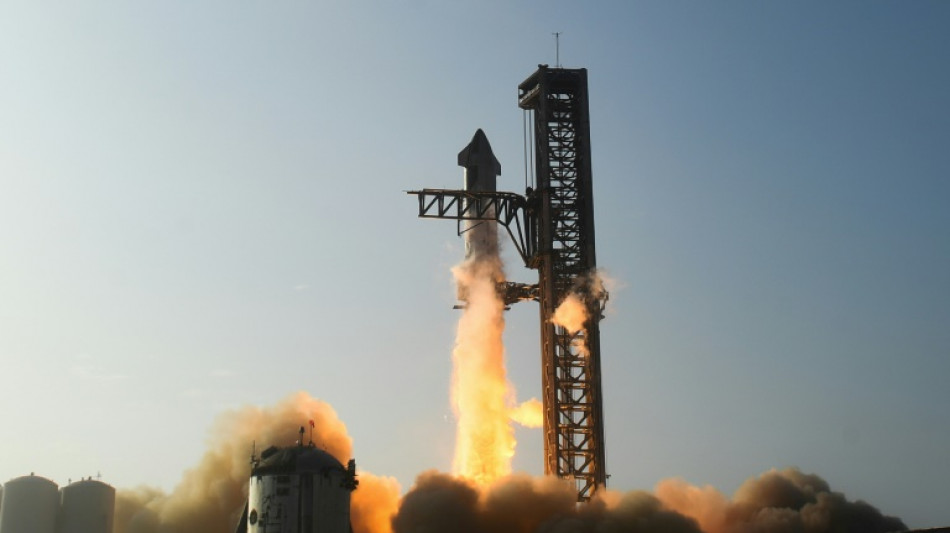
SpaceX hopes for second Starship flight test next week / Photo: Patrick T. Fallon - AFP/File
 Brussels Education Unions Schedule Major November Protest Over Funding and Reforms

 Making Your Home Safer for Aging Parents: Accessibility Renovations That Add Value

 iPS Cell Research Accelerates Drug Discovery for ALS and Spinal Cord Injury

 Rene Eyre Revisits Autobiographical Performance 'Say A Little Prayer' in London

 UAE's HCT Holds Record Graduation and Announces Major Training Expansion

 NASA Awards $10B Lunar Contract Framework to SpaceX, Blue Origin

 Katy Perry Tells Fans Ex-Husband Russell Brand 'Should Be in Jail' During UK Concert

SpaceX is hoping to re-launch Starship, the most powerful rocket ever built, next week, the company said, after an attempt in April ended in a spectacular explosion.
"Starship preparing to launch as early as November 17, pending final regulatory approval," SpaceX said on X Friday evening.
SpaceX foresees Starship as a next-generation, fully reusable spaceship that will eventually carry both crew and cargo to Mars.
The project is being followed closely by NASA, which has contracted a version of Starship to function as a lunar lander for its Artemis program to return astronauts to the Moon by the middle of this decade.
On April 20, SpaceX blew up the uncrewed rocket four minutes after it blasted off from the company's Starbase in Boca Chica, Texas. Starship experienced multiple engine failures, and its first-stage booster did not separate from the spacecraft above it.
The rocket disintegrated into a ball of fire and crashed into the Gulf of Mexico, sending a dust cloud over a town several miles (kilometers) away.
The Federal Aviation Administration needs to issue a launch license for a second test to be attempted. The regulator completed its safety review of Starship in October, but the project still needs a sign-off from the US Fish and Wildlife Service for the license to be given.
A new Starship currently stands ready at the launchpad, according to publicity material posted by SpaceX.
Starship, which stands 394 feet (120 meters) tall, produces 16.7 million pounds (74.3 Meganewtons) of thrust, more than double that of the Saturn V rockets used to send Apollo astronauts to the Moon.
Starship is designed to be fully reusable, with both stages meant to return to Earth, thus greatly reducing costs.
Since the first test from Boca Chica, Starship's separation system has been overhauled, Elon Musk said during a conference in early October, adding that testing this new system would be the "riskiest part of the flight."
"I do want to set expectations not too high," the SpaceX CEO said.
The flight plan will be similar to the one in April. After separation, Starship is to continue to an altitude "a scooch below orbit," according to Musk, completing a near-circle of the Earth before splashing down in the Pacific Ocean near Hawaii.
D.Sawyer--AMWN
