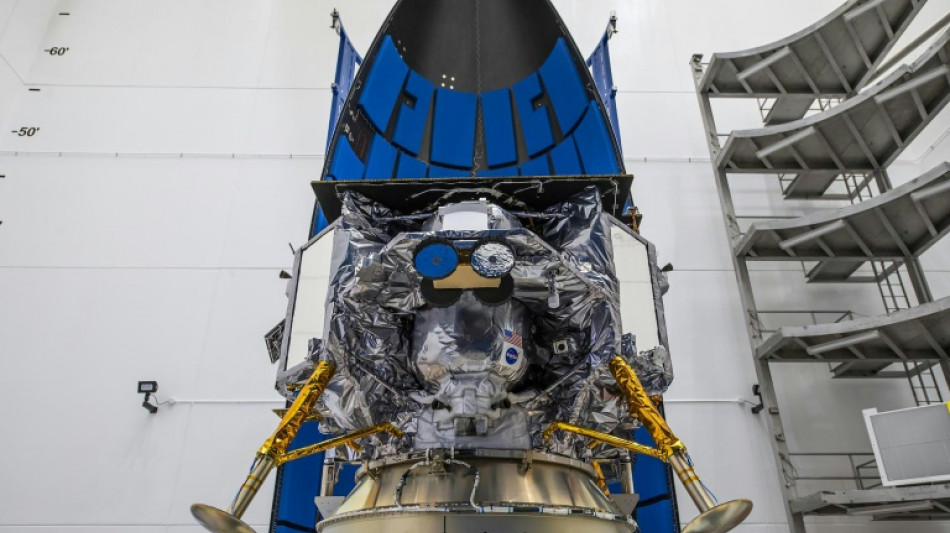
New US lunar lander runs into technical problem: company / Photo: - - NASA/AFP/File
 Brussels Education Unions Schedule Major November Protest Over Funding and Reforms

 iPS Cell Research Accelerates Drug Discovery for ALS and Spinal Cord Injury

 Rene Eyre Revisits Autobiographical Performance 'Say A Little Prayer' in London

 UAE's HCT Holds Record Graduation and Announces Major Training Expansion

 NASA Awards $10B Lunar Contract Framework to SpaceX, Blue Origin

 Katy Perry Tells Fans Ex-Husband Russell Brand 'Should Be in Jail' During UK Concert

The first US lunar lander launched in more than five decades has experienced an anomaly preventing it from pointing its solar panels towards the Sun, the company that built the robot said Monday.
Astrobotic's Peregrine lunar lander separated successfully from United Launch Alliance's new Vulcan rocket overnight from the Cape Canaveral Space Force Base, and quickly established communications with NASA's Deep Space Network of ground-based radio antennas.
All its systems powered on as expected, and it "entered a fully operational state," Astrobotic said in a tweet.
But "unfortunately, an anomaly occurred which prevented Astrobotic from achieving a stable sun-pointing orientation.
"The team is responding in real time as the situation unfolds and will be providing updates as data is obtained and analyzed."
The lander's documentation, available online, says that while in orbit, Peregrine's top mounted solar panel stays pointed at the Sun to enable maximum power generation.
"The solar panel is utilized to provide battery charge and maintain lander and payload operations. After descent to the lunar surface the power system continues to provide reliable power services to payloads through the end of mission," it says.
Peregrine is on its way to the Moon and is supposed to hold its orbit before finally landing on a mid-latitude region called Sinus Viscositatis, or Bay of Stickiness, on February 23.
Until now, a soft landing on Earth's nearest celestial neighbor has only been accomplished by a handful of nations. But the United States and others are increasingly turning to the commercial sector to carry out routine missions and ship hardware at a fraction of the cost.
Y.Nakamura--AMWN

