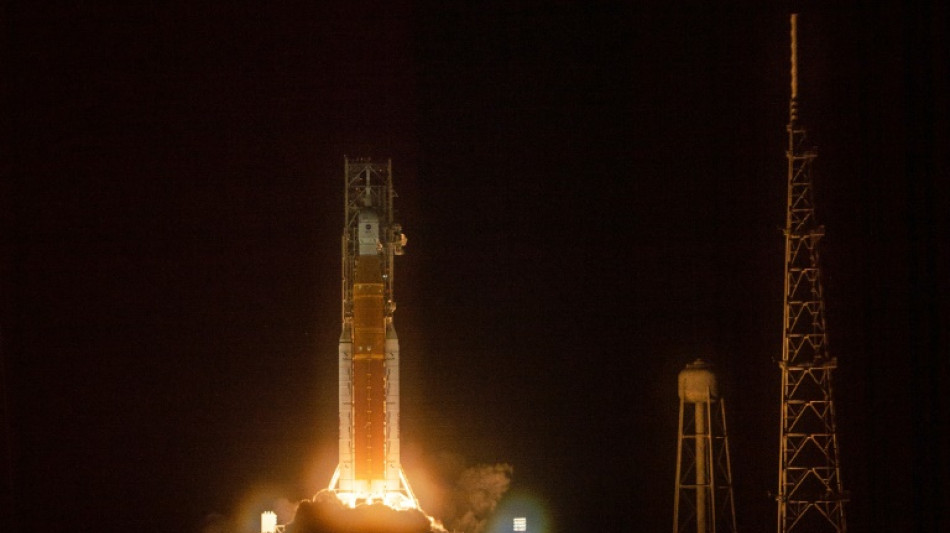
US delays planned return of astronauts to Moon until 2026 / Photo: Jim WATSON - AFP/File
 Brussels Education Unions Schedule Major November Protest Over Funding and Reforms

 iPS Cell Research Accelerates Drug Discovery for ALS and Spinal Cord Injury

 Rene Eyre Revisits Autobiographical Performance 'Say A Little Prayer' in London

 UAE's HCT Holds Record Graduation and Announces Major Training Expansion

 NASA Awards $10B Lunar Contract Framework to SpaceX, Blue Origin

 Katy Perry Tells Fans Ex-Husband Russell Brand 'Should Be in Jail' During UK Concert

The United States is pushing back its planned return of astronauts to the surface of the Moon from 2025 to 2026, NASA Administrator Bill Nelson said Tuesday amid technical challenges and delays.
Artemis, named after the sister of Apollo in Greek mythology, was officially announced in 2017 as part of the US space agency's plans to establish a sustained presence on Earth's nearest space neighbor, and apply lessons learned there for a future mission to Mars.
Its first mission, an uncrewed test flight to the Moon and back called Artemis 1, took place in 2022, after several postponements.
Artemis 2, involving a crew that doesn't land on the surface, has been postponed from later this year to September 2025, Nelson told reporters.
Artemis 3, in which the first woman and first person of color are to set foot on lunar soil at the Moon's south pole, should now take place in September 2026.
"Safety is our top priority, and to give Artemis teams more time to work through the challenges," said Nelson.
NASA is also looking to build a lunar space station called Gateway where spacecraft will dock during later missions.
Elon Musk's SpaceX has won the contract for a landing system for Artemis 3 based on a version of its prototype Starship rocket, which remains far from ready. Both of its orbital tests have ended in explosions.
Delays to Starship have knock-on effects because the spacesuit contractor needs to know how the suits will interface with the spacecraft, and simulators need to be built for astronauts to learn its systems.
And the Artemis 1 mission itself revealed technical issues, such as the heat shield on the Orion crew capsule eroded in an unexpected way, and the ground structure used to launch the giant SLS rocket sustained more damage than expected.
As of March 2023, NASA has agreed to pay approximately $40 billion to hundreds of contractors in support of Artemis, the same watchdog found.
A key difference between the 20th-century Apollo missions and the Artemis era is the increasing role of commercial partnerships, part of a broader strategy to involve the private companies in space exploration to reduce costs and to make space more accessible.
C.Garcia--AMWN

