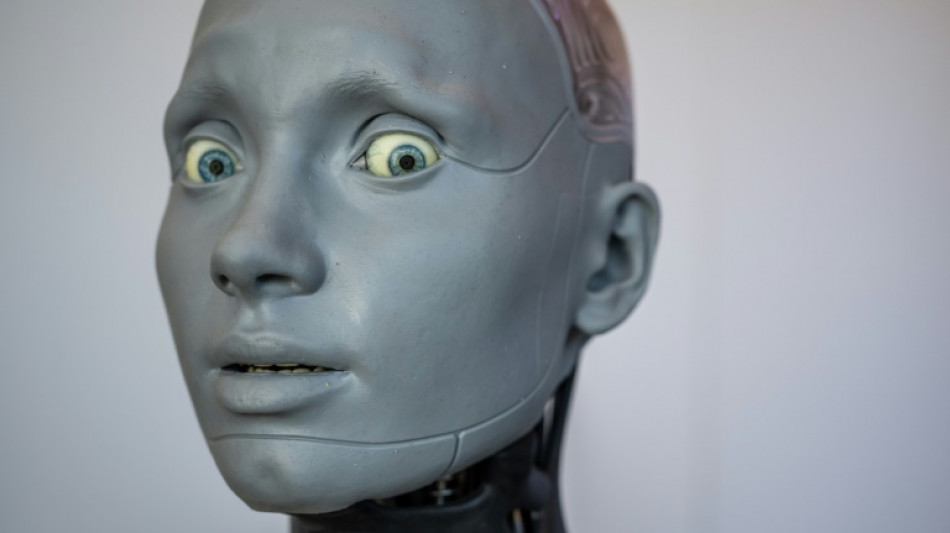
Adecco chief says AI will create new jobs / Photo: Fabrice COFFRINI - AFP
 Brussels Education Unions Schedule Major November Protest Over Funding and Reforms

 iPS Cell Research Accelerates Drug Discovery for ALS and Spinal Cord Injury

 Rene Eyre Revisits Autobiographical Performance 'Say A Little Prayer' in London

 UAE's HCT Holds Record Graduation and Announces Major Training Expansion

 NASA Awards $10B Lunar Contract Framework to SpaceX, Blue Origin

 Katy Perry Tells Fans Ex-Husband Russell Brand 'Should Be in Jail' During UK Concert

Artificial intelligence raises serious concerns for jobs but it will also create new positions, the head of Adecco, the world's biggest temporary staffing agency, told AFP.
From meteorologists to lawyers and screenwriters, generative AI capable of creating content -- such as the chatbot ChatGPT -- could change the contours of many professions.
But it will also create new positions, according to Denis Machuel, the chief executive of Zurich-based Adecco.
- How will AI disrupt the world of work? -
Machuel: "It's probably the largest disruption and revolution that we've seen in decades. It's going to be massive. And let's be clear, no one really knows or can really anticipate with a precise view what's going to happen in the next five years.
"All this productivity enhancement helps people do more but also destroys some of the jobs people are doing. There is definitely an element of jobs being created and jobs that are being destroyed. We've seen that with the internet, with digitalisation.
"What we've seen in the past tells us that there is more or less a balance between the two.
"Technology brings a lot of better understanding of interaction between people and markets but it also brings complexity. And that complexity requires more people to deal with it.
"GenAI will bring productivity on one side but it will also bring more proof-points, more data, more ways of looking at relationships, products and services. And for all these, we need people."
- Are some jobs more at risk than others? -
Machuel: "It's probably a bit too early to precisely describe jobs that are fundamentally at risk. Because we have to look at the tasks behind them.
"If you only compute information, gather information and synthesise it, then your job is at risk, be it a job in finance, in legal, in business, because... it is what GenAI does.
"Probably white-collar workers will be more impacted than blue-collar workers -- at least in the short term.
"Within the white collar space, the things that are linked to massive information management will be more disrupted than the skills that are linked to relationship building, to strategic thinking or problem-solving.
"However, we know that there are limits.
"Take the example of a lawyer or of a paralegal: computing an immense number of legal decisions can be done by GenAI.
"However, the deep and subtle understanding of a complex legal situation and problem-solving skills that are needed to put things together is still very human-related.
"Usually, the sort of mundane tasks that can be automated are not the most exciting for people to do. So if you can automate that, it gives you more time to concentrate on the nicer things."
- How is AI used at Adecco? -
"We've signed a partnership with Microsoft to create a career platform that will advise companies and workers on their path, supporting their reflection on the type of skills and jobs they could go for.
"Opening horizons on things people didn't necessarily imagine but could be achievable for them.
"There are quite a few workers whose skills are transferable.
"The good news about GenAI is that there is a positive explosion of possibilities of upskilling and re-skilling through these tools.
"We've created a curriculum vitae maker with an AI-powered tool that helps people generate their own CV.
"On the daily tasks of our recruiters, I was mentioning this chatbot that interacts with thousands of candidates very quickly.
"It gives the possibility for our recruiters to spend more time in the human relationship, and not in a database search.
"That means a recruiter can spend more time with people than doing the mundane tasks."
X.Karnes--AMWN

