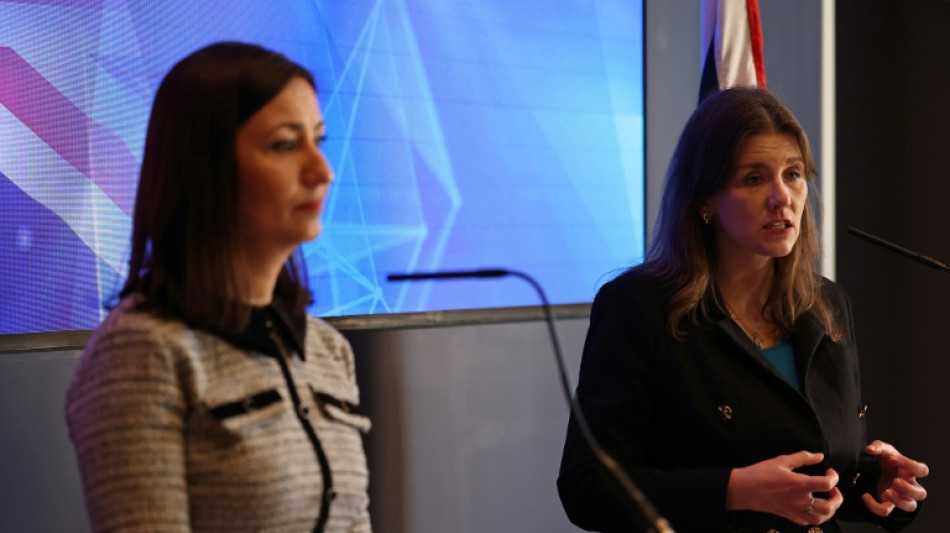
EU, UK urge scientists to join research programme after Brexit concerns / Photo: Daniel LEAL - AFP
 Brussels Education Unions Schedule Major November Protest Over Funding and Reforms

 iPS Cell Research Accelerates Drug Discovery for ALS and Spinal Cord Injury

 Rene Eyre Revisits Autobiographical Performance 'Say A Little Prayer' in London

 UAE's HCT Holds Record Graduation and Announces Major Training Expansion

 NASA Awards $10B Lunar Contract Framework to SpaceX, Blue Origin

 Katy Perry Tells Fans Ex-Husband Russell Brand 'Should Be in Jail' During UK Concert

EU and UK science chiefs on Monday launched a push to attract scientists to Europe's £80 billion Horizon research programme after warnings of high costs and red tape in Britain.
The UK quit the Horizon Europe programme when it left the EU in 2020.
Following years of uncertainty, in which British researchers were prevented from fully taking part in the scheme due to political disputes, the UK rejoined the scheme in January.
At a meeting in London on Monday, UK science, business and research leaders were urged to "seize the opportunity" of Horizon Europe funding, despite the concerns over costs and visas for European scientists wanting to work in the UK.
"There were some concerns that were raised by researchers, and also related to the cost of fees, healthcare surcharges, salaries," the European Commissioner for Research and Innovation, Illiana Ivanova said at a press conference after the meeting.
"I wouldn't want to focus on what might be a potential division," she added.
Britain was last year expected to rejoin Horizon, which focuses on issues like climate change and medical research, after reaching an agreement with the EU on the flow of goods between the UK and Northern Ireland.
Prime Minister Rishi Sunak, however, delayed joining the scheme so he could extract a better deal on budget contributions.
Horizon Europe has a budget of 95.5 billion euros (£81 billion, $103 billion) with the UK expected to contribute on average around 2.43 billion euros per year in order to participate.
Earlier on Monday, Ivanova said that Britain should ease visa procedures or risk missing out on the full benefits of Horizon.
"We are having some difficulties with European researchers going to the UK due to some visa issues and also higher costs that I'm going to raise with the British side," she told the Financial Times.
But British science minister Michelle Donelan denied that the UK was facing challenges in recruiting participants.
She said "the key message" from scientists, innovators and businesses was that "association" with the project would support their interests and further Britain's economic growth and development.
"You will hear first hand from individuals who have actively chosen to locate here because of all those positives we have," she said at the press conference.
She said the UK would consider collaborating on other projects with the EU on "a case by case basis".
"The British public voted to leave the EU to have more control and say over their decision-making," she said.
"Of course that means that on each and every one of these different aspects, the merits and topics would need to be reviewed and examined."
When it came to Horizon, however, rejoining was "somewhat of a no-brainer", she added, saying that Britain took its time to rejoin the project so that it could get value for the taxpayers.
"That is why we continued to negotiate and get a deal that worked," she said.
F.Dubois--AMWN

