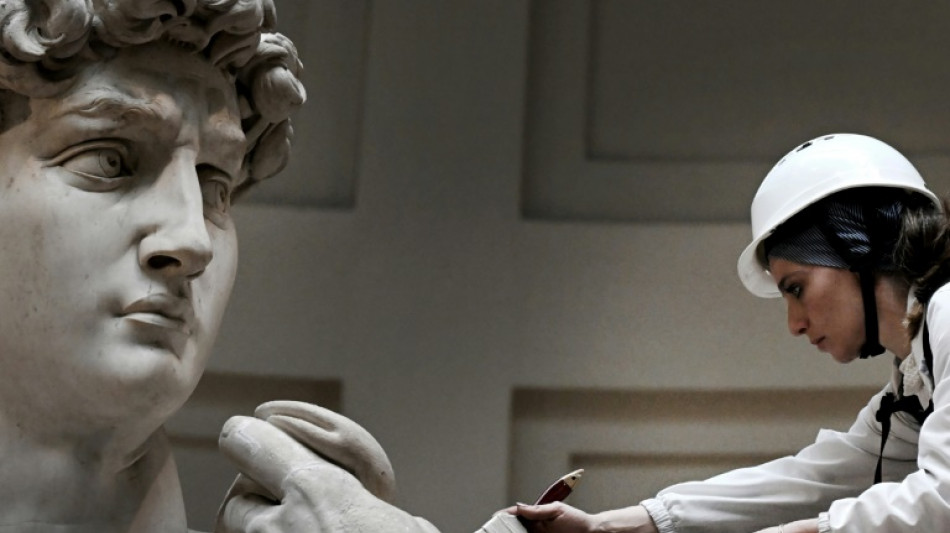
Michelangelo's David gets spa treatment in Florence / Photo: Tiziana FABI - AFP
 Brussels Education Unions Schedule Major November Protest Over Funding and Reforms

 iPS Cell Research Accelerates Drug Discovery for ALS and Spinal Cord Injury

 Rene Eyre Revisits Autobiographical Performance 'Say A Little Prayer' in London

 UAE's HCT Holds Record Graduation and Announces Major Training Expansion

 NASA Awards $10B Lunar Contract Framework to SpaceX, Blue Origin

 Katy Perry Tells Fans Ex-Husband Russell Brand 'Should Be in Jail' During UK Concert

Even the David gets dusty.
Every two months, Michelangelo's masterpiece completed in 1504 undergoes a careful cleaning at its home in Florence's Accademia Gallery, where it has resided for over 150 years.
Considered by many awestruck viewers to represent the perfect man, the 17-foot-high (5.1 metre) sculpture carved from a single block of marble stands alone under the skylight of the domed gallery on Mondays, when the museum is closed.
His personal restorer, Eleonora Pucci, climbs on a scaffolding for an up-close view -- part of a monitoring and cleaning ritual necessary for the preservation of the Renaissance icon visited by over two million visitors last year.
Despite David's good looks and Biblical heritage, the slayer of Goliath needs upkeep.
"A statue that doesn't get dusted regularly, if you get close and look at it from bottom to top, you'll see a form of lint," the museum's director, Cecilie Hollberg, told a group of journalists Monday.
"It's not pretty and it's not worthy of the work of art that we preserve in this museum," Hollberg said.
David's bi-monthly cleaning, then, is "a form of respect, a form of dignity that we want to give to every work."
- 'Delicate work' -
With a furrow in his brow, a vein bulging on his neck, his weight squarely on his right foot and his sling held in his left hand, David remains focused on Goliath, oblivious to the primping going on around him.
Pucci, a petite woman wearing a white laboratory coat, white hard hat, jeans and sneakers, scrambles to the top of the scaffolding where she begins taking photos to monitor David's "state of health", Hollberg said.
After strapping a portable vacuum onto her back, the dusting begins.
With careful sweeping motions, Pucci glides a soft synthetic brush across the David's bent left arm, steering the particles from his forearm into the nozzle of the vacuum, which never touches the statue.
Next is his left thigh, where her delicate brush traces the muscles carved by Michelangelo into the Carrara marble, before the scaffolding is shifted and Pucci is once again at work on David's back.
As the scaffold wiggles despite being locked, Pucci strokes David's shoulders with her brush while leaning in to examine his curly locks -- where spiders sometimes leave tiny webs.
"It’s very delicate work, requiring a lot of concentration, and it needs monitoring centimetre by centimetre in order to control the state of preservation of the work -- which is in great condition," Hollberg said.
Dust deposits left behind are capable of compromising the marble's lustre, rendering it greyer and duller.
Smooth parts are easier to clean than the rougher areas, which are more apt to grab dust.
The filters in the museum's state-of-the-art air conditioning system have cut back considerably on air particles, however, while sensors help control temperature and humidity levels, Hollberg said.
The cleaning takes at least half a day due to the scaffolding involved and other statues and paintings in the museum get similar treatment, she said.
The first colossus since ancient times and the symbol of Florence, Michelangelo's David was unveiled at the dawn of the 16th century to a rapt public in the Renaissance city's main square, the Piazza della Signoria.
Michelangelo was only 29 when he finished his masterpiece.
It stayed in the piazza until 1873 when it was moved to its current location, with the museum literally built around it.
A copy now stands in the Piazza della Signoria.
Other masterpieces of the museum, Michelangelo's Slaves -- which were designed for the tomb of Pope Julius II but never completed -- arrived later in 1939.
S.Gregor--AMWN

