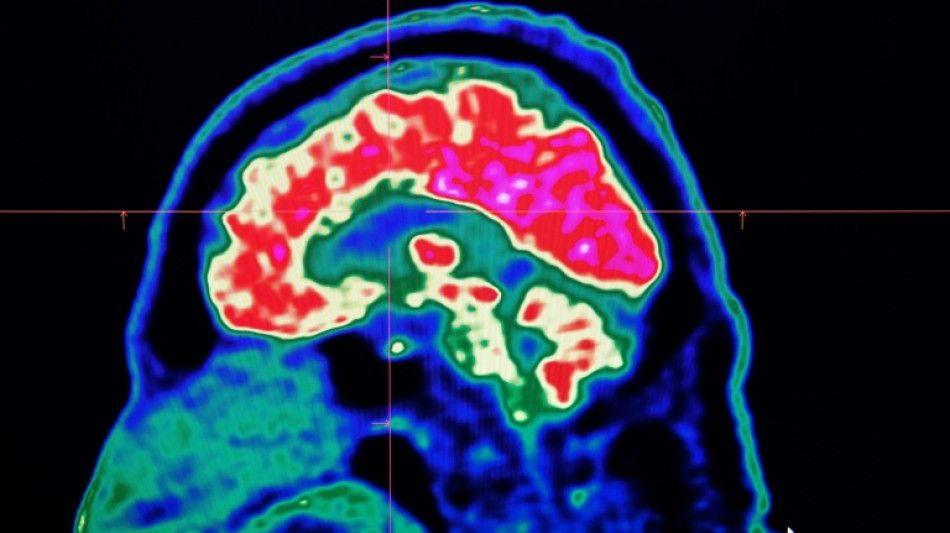
Surging nervous system disorders now top cause of illness: study / Photo: Fred TANNEAU - AFP/File
 Fast-fashion giant Shein plunges 10% on Hong Kong debut

 South Korea hire former Spain boss Moreno as interim coach

 China-Taiwan friction clouds Pacific summit

 Two dead after stabbing in New York's Times Square

 Anthropic signs $35B computing deal with startup backed by Nvidia

 Drones in Ithaca: Azov's Odyssey turns Ukraine war into modern myth

 Boat builders keep Pakistan's fishing heritage afloat

 Australia axe Labuschagne for Zimbabwe, South Africa ODI series

 Heavy rain at Grand Canyon after flood kills 2, dozen missing

 Kushner blames soccer power struggle for World Cup plan collapse

 Buoyant Alcaraz shakes off nerves to advance at US Open

 US draws European pushback with Russia G20 finance invite

 Jury begins deliberations in Tupac Shakur murder trial

 US Supreme Court allows Trump ballroom project to proceed

 Trump says US reviewing position on Falkland Islands

 Saka strikes as flawless Arsenal punish troubled Villa

 Oil prices surge on renewed fighting in US-Iran war

 Cycling superstar Pogacar has surgery after Vuelta crash

 Man City agree deal for Everton's Ndiaye

 Apple CEO Tim Cook gives nod to founder Steve Jobs in final memo

 Russian finance minister makes unexpected appearance at G20

 Happy to be back in NY, Sabalenka advances

 Naomi Watts to receive lifetime award at top Spain film fest

 Jury hears closing arguments in Tupac Shakur murder trial

 Pakistan sack coach, send seven players home after England defeats

Conditions affecting the nervous system -- such as strokes, migraines and dementia -- have surged past heart disease to become the leading cause of ill health worldwide, a major new analysis said on Friday.
More than 3.4 billion people -- 43 percent of the global population -- experienced a neurological condition in 2021, far more than had previously been thought, the analysis found.
The study was carried out by hundreds of researchers led by the US-based Institute for Health Metrics and Evaluation (IHME), which has become a global reference for health statistics.
Lead study author Jaimie Steinmetz of the IHME said the results showed that nervous system conditions are now "the world's leading cause of overall disease burden".
Cases of these conditions have soared by 59 percent in the last three decades, she said, with the increase mainly driven by the fact that the world's population was ageing and growing fast.
The researchers looked at how 37 different neurological conditions affected ill health, disability and premature death across 204 countries and territories from 1990 to 2021.
This data was used to estimate how many years of healthy life were lost to each condition, called disability-adjusted life years (DALYs).
More than 443 million years of healthy life were lost to nervous system disorders globally in 2021, an 18-percent increase from 1990, the study found.
However, if the population's age and growing size was adjusted for, DALYs and deaths from these conditions actually fell by around a third, the researchers said.
Stroke, which was previously counted as a heart disease, was by far the worst neurological condition analysed, accounting for 160 million years of healthy life lost.
It was followed by a form of brain damage called neonatal encephalopathy, migraine, dementia including Alzheimer's disease, nerve damage from diabetes, meningitis and epilepsy.
Cognitive impairment from Covid-19 ranked 20th.
The main reason that nervous system conditions surpassed cardiovascular disease in the latest analysis was a recent World Health Organization classification change that moved stroke into the neurological category, Steinmetz told AFP.
The massive number of healthy years lost from these conditions was partly because several can kill children under five, such trauma during birth leading to neonatal encephalopathy, asphyxia or meningitis, she said.
"Because deaths occur at a young age, this creates a large contribution to years of life lost," she added.
Children accounted for nearly a fifth of all healthy years lost, the study found.
- 'Growing very fast' -
More than 11 million people died from the 37 neurological conditions in 2021, according to the study in The Lancet Neurology journal.
However cardiovascular disease remained the leading cause of death, killing 19.8 million people worldwide in 2022, the IHME said last year.
The most common neurological disorders were tension headaches and migraines.
The quickest-growing condition was nerve damage called diabetic neuropathy from soaring cases of diabetes.
Most of these conditions have no cure.
But there are ways to lessen the risk, including reducing rates of high blood pressure, diabetes and alcohol consumption, the researchers said.
They called for much more to be done to prevent, treat and rehabilitate the disorders, which disproportionately affect poorer countries.
"The worldwide neurological burden is growing very fast and will put even more pressure on health systems in the coming decades," warned study co-author Valery Feigin.
Ch.Havering--AMWN